
It is, or was, perhaps one of the best-known expressions in Latin, surviving in Suetonius’ biography of Julius Caesar: iacta alea est, the “die is cast,” even though it is the product of a lazy copyist. What Suetonius actually wrote, as Robert Kaster has shown, was iacta alea esto “the die will be cast.” Suetonius and the various Greek authors who quote this phrase place it in Caesar’s mouth as he is ordering his army to cross the Rubicon River in northern Italy, thereby beginning the civil wars that would effectively end the Roman Republican system of government.
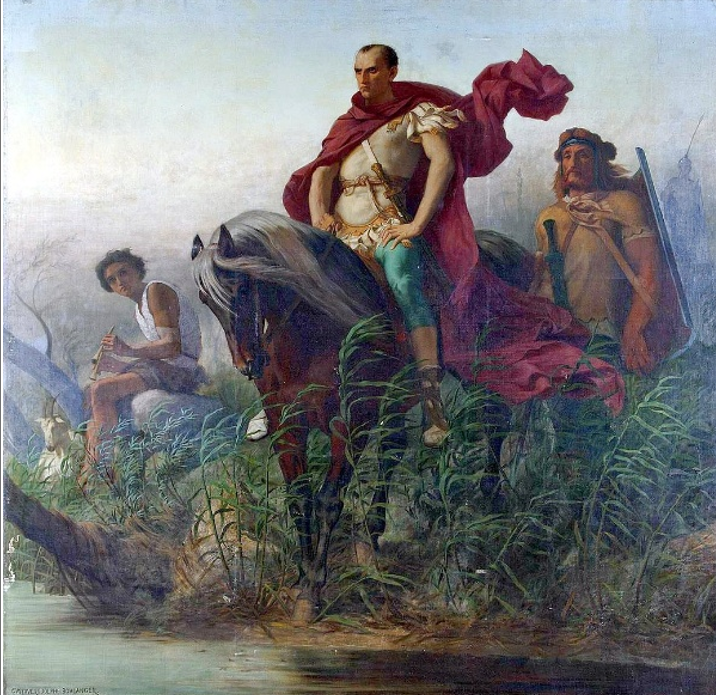
Gustave Boulanger, Jules-César arrivé au Rubicon.

The fact that Caesar’s statement about casting the die is the one consistent point in the various accounts that have come down to us of his crossing of the Rubicon, makes it likely that he did actually say this. At the same time, the fact of different stories about how he came to be standing on the river bank reveals a great deal about the messaging coming out of Caesar’s camp in the wake of the invasion. Caesar needed to be absolutely clear that, when he led his men across the river, he did so under duress. In Suetonius’ version of the story, for instance, before Caesar declared that the die must be cast he and his men have just seen a divine portent, summoning them to action, leading him to say “we will go where the signs of the gods and the injustices of our enemies call us.” Caesar had arrived at the bank of the river in this story after wandering through the night with a few staff members, getting lost until they found themselves on the bank of the river where Caesar said they could still draw back, but once they crossed the little bridge before them, they would have to fight it out—it was then that the divine apparition settled the issue. According to another version, Caesar sat by the bank of the river, his resolution wavered as he discussed the perils to come and the human costs to the war before he steeled himself and determined that the die be cast.
Caesar’s generation had vivid memories of the horrors accompanying Sulla’s invasion of Italy when they were young, and Caesar needed to be clear that he was no Sulla—he was not there to exact revenge, but rather to protect the Roman people from the corruption of his political rivals, corruption which had undermined the Roman system of government. The crossing of the Rubicon was not something that had been plotted in advance but rather was a necessary response to the unreasonable conduct of Caesar’s political rivals at Rome a few days previously.
Caesar’s stress on the war’s unintentional outbreak, at least as far as he was concerned, informs the extensive narrative at the beginning of his Civil Wars. Here it is abundantly clear that the war is the fault of his former friend, Gnaeus Pompey. Caesar had sent a letter to the senate which seems to have set out his desire to be allowed to stand for the consulship later in the year while offering to give up his army so long as Pompey would do the same. This was a major step given that the senate, and Pompey, had agreed that Caesar could run for office while retaining his army just a couple of years earlier. Now the senate rejected Caesar’s deal—the more aggressive a speaker’s attitude, the more it seemed he was speaking for Pompey. Those who tried to argue that Caesar had a point were silenced; and the consuls forced through a motion to the effect that Caesar would have to dismiss his army by a certain date or be declared an enemy of the people. Anyone who spoke in favor of negotiation was silenced and the tribunes who had tried to stand up for Caesar had to flee for their lives. The city streets were full of Pompey’s former soldiers, and there was an army in Spain which Pompey had been building up to needless size and cost for years. And, what was worse, there were two legions that should have been sent to fight Parthia, stolen by Pompey from Caesar, just outside the city walls. What these few days in January had seen was essentially a coup d’état by Pompey’s supporters. What choice did Caesar have? He would defend the constitution with the few troops at his disposal. To protect the tribunes, he occupied what is now Rimini, crossing the Rubicon with but a single legion, while all the rest of his men were north of the Alps. It was a terrible risk. Or was it?
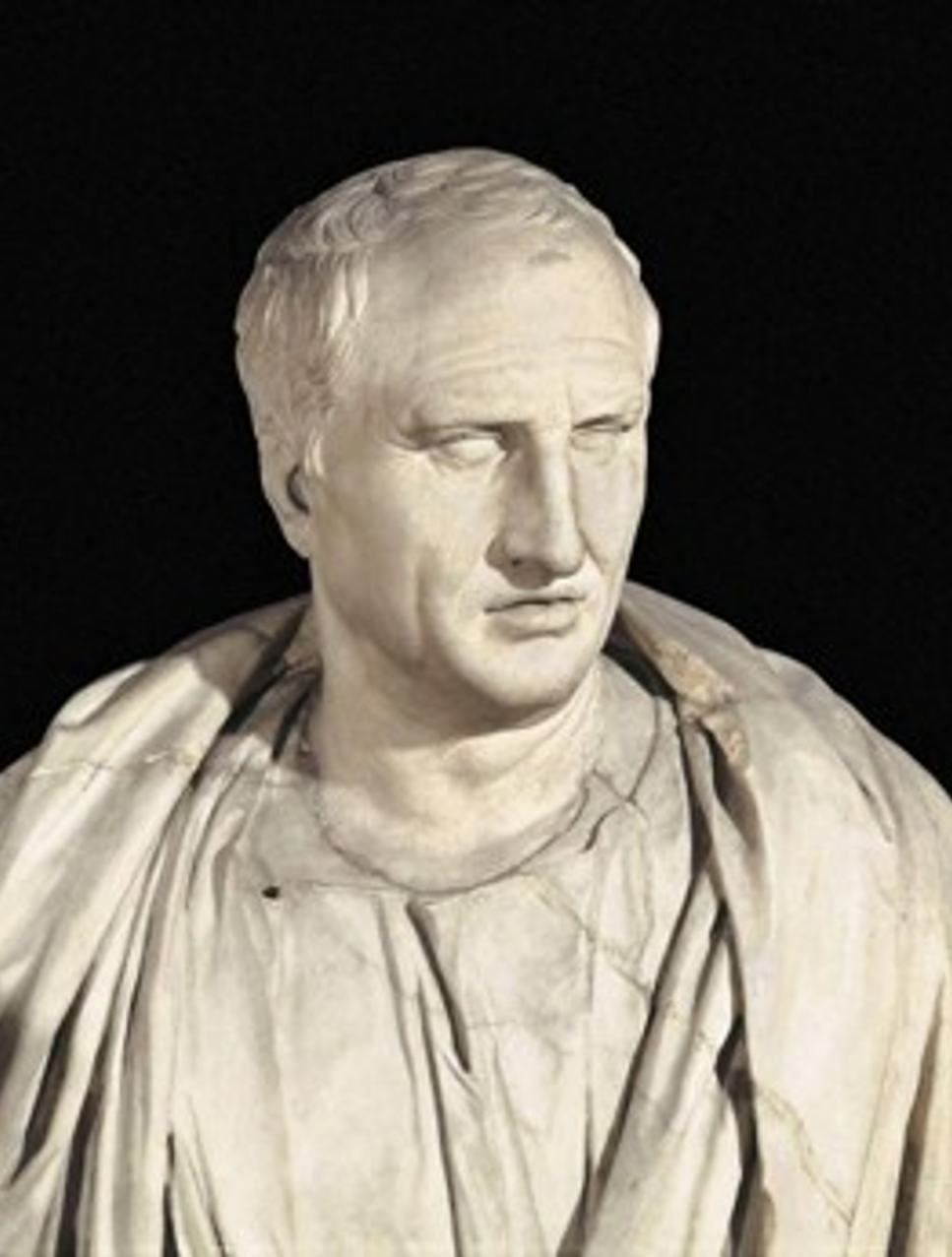
Marcus Tullius Cicero
Our other contemporary source for the outbreak of the civil war is Marcus Cicero. In his voluminous correspondence he allows us to observe the breakdown of the relationship between Caesar and Pompey and have some impression of the way people were talking. For Cicero this issue is never one of principle, but rather one of personal relationships. It is notable, for instance, that in December of 50 Pompey told him that when one of Caesar’s trusted agents left Rome, where he had been drumming up support for his boss, without meeting him, that war was coming. This is in contrast to Caesar’s presentation, where the breakdown of the personal relationship between himself and Pompey is the result of the intervention of a faction which is undermining the government is striking.
Also notable is Cicero’s lack of interest in the military situation, which he seems not to see as potentially decisive. So he ignores the point which a friend had made in September pointing out that the armies were not comparable. Elsewhere he appears to think that Caesar had ten legions, which, as we’ll see, was a significant understatement. He also believed peace was possible even after the invasion had begun. As is so often the case with Cicero, the quantity of verbiage and accuracy of perception are not one and the same.
Unlike Cicero, Pompey had very real intelligence about the size and condition of Caesar’s army, especially when Caesar’s chief lieutenant, Titus Labienus, deserted him in the days after the crossing of the Rubicon. Pompey lied to his supporters about his intentions. His plan was never to defend Italy against Caesar’s superior forces, but rather to leave for the east with as many recruits as possible. His ability to anticipate Caesar’s actions is brilliantly illustrated by some letters he sent a disobedient ally, Domitius Ahenobarbus, spelling out the way Caesar would cut him off at Corfinio and pointing out how Caesar would proceed. In one he wrote “What I expected and foretold has happened: he currently refuses to meet you in the field, and he is pressuring you with all his forces concentrated, so that the road may not be clear for you to join me and unite your loyal contingent with my legions whose allegiance is questionable.” And further he noted that his freshly raised troops who “do not even know each other by sight” were no match for Caesar’s veterans. He was right in both cases. The consequence of Domitius’ stupidity was that Caesar would acquire two more legions from Domitius when Domitius surrendered.
Numbers are the key to understanding what was happening in January of 49, and here we are indebted to the work of the German scholar Hans-Martin Ottmer. Ottmer pointed out that while Caesar may have crossed the Rubicon with a single legion, there were two more veteran legions marching rapidly after him, and two and a half legions of new recruits, giving him a substantial advantage even before he started picking off units originally raised to serve with Pompey. In addition, he had eight legions in Gaul, six of them veterans of the major campaigns in the previous summers. Shortly after Caesar crossed the Rubicon, six of these legions would move into northern Spain where they confronted five legions in the service of Pompey’s lieutenants. This military establishment was fully funded by the annual tribute of forty million sesterces Caesar had set for Gaul in the summer of 50.
Despite his elaborate claims to the contrary, Caesar was more than ready to invade Italy and secure his political future. He had previously advertised his alliance with Pompey—stating clearly in the sixth and seventh books of his account of the Gallic wars that his alliance with Pompey worked well to protect the interests of the Roman people. These books had been doing the rounds of the reading public—hence the importance for Caesar in making the case that it was jealous rivals who had detached Pompey from their friendship. The truth of the matter was a bit trickier—as the poet Lucan would later write, the real problem was that Caesar could not endure a superior or Pompey an equal. By the summer of 50 it was clear to Pompey that this is what he would have to do if he was not to reassert his supremacy on the battlefield. So what of the numbers? Pompey had a plan for that, which was summed up succinctly to Cicero’s horror in February of 49. “Sulla did it, why can’t I?” Pompey was responsible for the organization of the eastern provinces and hoped he could raise and train an army that could take Caesar on. In the end it looks as if, although Pompey made up the difference in numbers, he could not make up the difference in the quality of troops. That proved decisive on the day of Pharsalus. Just because a plan proved to be bad doesn’t mean it wasn’t a plan.
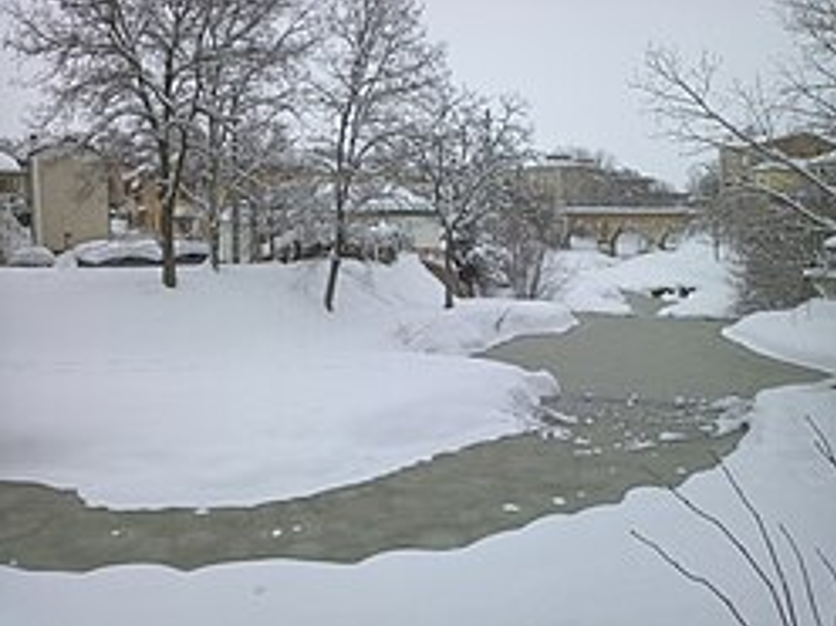
The Rubicon in Winter (Wikipedia)
The tale of the Rubicon defines the very real differences between the two sides. Pompey’s people were defending the status quo. For Caesar’s people the status quo was hopelessly corrupt. Their elaborate rewriting of the story of the Rubicon, making up for his decision not to mention the crossing in his Civil War, underscores Caesar’s stress on the point he was not a later day Sulla—he was defending the constitution that he would now make work better for the average person whose interests was trampled by Pompey’s supporters. That Caesar was not the aggressor was the point his friends were making when they recalled the very private moments on the bank of the river before he decided that the “die will be cast.”
All who had watched Caesar during his years in Gaul were aware of his obsession with efficiency, accountability and detail. Gaul was not conquered through massacres of the population, but rather through the construction of alliances with local leadership. These alliances allowed Caesar to build an army for the defense of Roman values against the “barbarians” who Pompey is shown to be relying on throughout Caesar’s narrative. The irony it is that the army Caesar led to the “defense” of the Roman republic was largely Celtic. In effect he oversaw what was the second Gallic capture of Rome. That was also something best left out of the story on Caesar’s side.
David Potter is Francis W. Kelsey Collegiate Professor of Greek and Roman History,
and Arthur F. Thurnau Professor of Greek and Latin in the Department of Classical Studies at the University of Michigan. His most recent books are: Master of Rome: A Life of Julius Caesar (Oxford, 2025), Atlas of the Roman Empire: Battles, Conquests, Legions and Rulers (Basic Books 2026) and Disruption: Why Things Change (Oxford 2021), explores the way radical change results from the collapse of the political centre: He has also published The Origin of Empire: Rome from the Republic to Hadrian (Harvard 2019).