Classical Civilisation and Ancient History qualifications
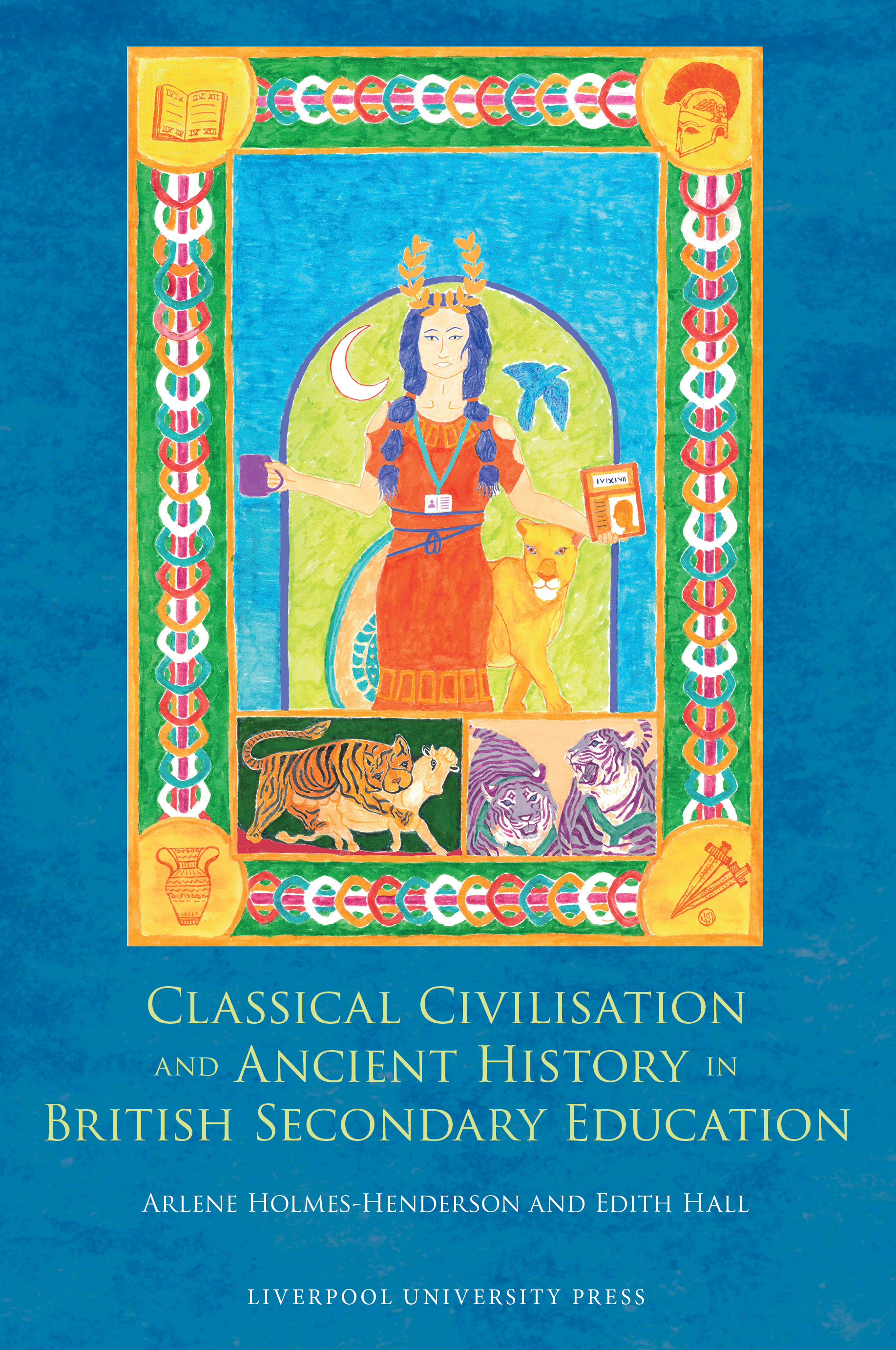
For more than half a century, Classical Civilisation and Ancient History have enabled young people in British secondary schools to encounter the ancient Greek and Roman worlds in ways that are intellectually demanding, culturally enriching, and socially transformative. The book co-authored by Edith Hall and myself (Classical Civilisation and Ancient History in British Secondary Education, Liverpool University Press, 2025, open access) records how these subjects came into being, why they have mattered deeply to generations of students, and why their future demands active promotion.
Classics in Britain has never been confined to those who could read Greek and Latin. Edith’s book with Henry Stead (A People’s History of Classics, Routledge, 2020, open access) showed how the ancient world has been encountered through translation, performance, art, political thought, and popular culture across the British Isles. Classical Civilisation, in particular, belongs to this long tradition of engaging seriously with antiquity without linguistic gatekeeping. Its emergence in secondary education in the mid-twentieth century was not a compromise, but a conscious and principled response to a changing educational landscape—one that sought to widen access to the ancient world rather than ringfence it.
As secondary education expanded after the Second World War, teachers, examiners, and policymakers recognised that Classical Civilisation and Ancient History offered rigorous, interdisciplinary subjects grounded in literature, history, archaeology, philosophy, and art. They enabled students to study poetry, tragedy, democracy, imperialism, religion, warfare, gender, and slavery—topics that speak powerfully to modern concerns—while developing analytical and interpretative skills of lasting value.
Responding to the Charge of “Classics Lite”
No account of Classical Civilisation and Ancient History in British schools would be complete without addressing a criticism that has dogged these subjects in recent years: the claim that they represent a diluted or inferior form of Classics—sometimes dismissively labelled “Classics Lite”, “the Diet Coke of Classics” or even “intellectual baby food.” Such characterisations (by classicists!), often repeated without serious engagement with classroom practice or curriculum content, reveal more about biased assumptions than about the subjects themselves.
At the heart of this criticism lies a narrow definition of what constitutes intellectual rigour. Too often, rigour is equated solely with linguistic difficulty, as though the mastery of Greek and Latin grammar were the only valid measure of scholarly seriousness. While the intellectual demands of language learning are undeniable and should be valued, it is entirely erroneous to assume that disciplines grounded in translation, interpretation, and material culture are therefore intellectually inferior. Classical Civilisation and Ancient History ask different questions and require different, but no less demanding, skills.
Students of Classical Civilisation are required to engage critically with complex literary texts in translation, to analyse historical and archaeological evidence, and to construct arguments about societies that are distant in time and in values. They must grapple with ambiguity, conflicting sources, and scholarly debate. Students are asked to interpret, evaluate, debate and explain. This is not intellectual simplification.
Moreover, Classical Civilisation and Ancient History foreground precisely those aspects of antiquity that have proven most enduring and influential: ideas about politics, ethics, art, gender, religion, and power. These subjects demand that students synthesise evidence across genres and disciplines, often at an early stage in their education. For many pupils, this represents their first encounter with genuinely interdisciplinary thinking.
It is also worth observing that Classical Civilisation has often served as a gateway rather than a substitute. Many students encounter the ancient world through Classical Civilisation and go on to study Latin, Greek, Ancient History, or Classics at university. Far from undermining traditional Classics, the subject has helped sustain interest in antiquity at a time when language teaching has declined for structural reasons beyond the classroom. To disparage this role is to misunderstand the ecology of Classics education as a whole.
Crucially, dismissive attitudes towards Classical Civilisation have social consequences. When these subjects are portrayed as second-rate, it is often the students in state schools—those without access to extensive language provision—who are implicitly devalued. Such rhetoric risks reinforcing the very elitism that critics of Classics so often condemn. A subject that has enabled thousands of students to think seriously about the ancient world should not be disparaged because it refuses to erect unnecessary barriers to entry.
Rather than asking whether Classical Civilisation is “less than” traditional Classics, we would do better to ask what it has made possible. The answer, we suggest, is clear: broader access, richer perspectives, and a more inclusive engagement with the ancient world—outcomes that should be regarded not as compromises, but as achievements.
Celebrating growth in student numbers
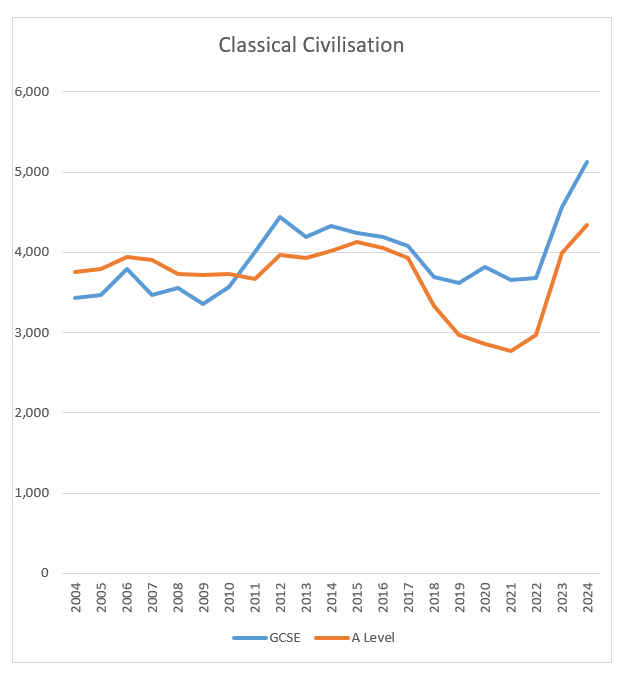
Recent years have seen meaningful changes in participation in Classical Civilisation and Ancient History at both GCSE and A-Level, with growth in many contexts suggesting renewed interest among students. GCSE entries for Classical Civilisation have increased significantly since the introduction of the current qualifications, reflecting greater availability and uptake in secondary schools and colleges.
At A-Level, the data also point to significant increases in student numbers. Between 2022 and 2023, entries for A-Level Classical Civilisation rose by approximately 25% in a single year, making it one of the fastest-growing subjects in that examination cycle.
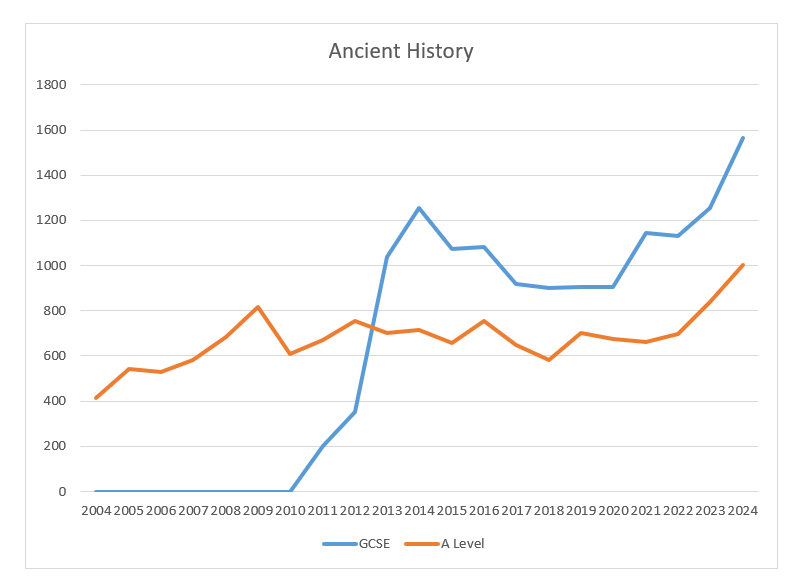
Entries for Ancient History at GCSE have risen by around 74% since the first assessment of the current qualification in 2019, a striking increase over a relatively short period.
At A-Level Ancient History has also seen notable gains, taking entry figures to their highest levels in the last twenty years.
The book details the role of the AHRC-funded Advocating Classics Education project in driving up uptake and supporting expansion across the state-maintained sector.
While absolute participation remains modest compared with major subjects such as History or STEM subjects, the upward momentum in entries suggests a strengthening presence for Classical Civilisation and Ancient History in the broader secondary-education landscape. In contrast, Latin and Ancient Greek have seen very little growth at either level.
One of the strongest messages to emerge from our research is the profound impact these subjects have had on students’ lives. Learners describe Classical Civilisation and Ancient History as subjects that made them think differently—not only about the past, but about the present. The distance of antiquity allows for a kind of intellectual freedom: students can debate democracy, empire, justice, and power without immediately reproducing contemporary political positions. This space for reflection is increasingly rare within crowded curricula and high-stakes assessment systems.
Celebrating Classics teachers
Teachers, too, speak eloquently about the distinctive character of these subjects. Many emphasise the joy of teaching material that invites discussion rather than memorisation (although memorisation is not entirely absent!), and that allows connections to be drawn across literature, history, and visual culture. Classical Civilisation and Ancient History often attract students who might otherwise feel alienated from traditional academic subjects, precisely because they reward curiosity, interpretation, and debate. In this sense, they play an important role in broadening participation in the humanities.
At the heart of the book is a commitment to recognising and celebrating the work of teachers. The survival and success of Classical Civilisation and Ancient History have depended, above all, on their ingenuity, determination, and belief in the value of what they teach. Often working without departmental colleagues or institutional memory, teachers have built courses from scratch, trained themselves in unfamiliar areas, and made the case for Classics to senior leaders, parents, and pupils alike. Their efforts have been sustained by professional networks, subject associations, universities, and charitable organisations that have provided resources, training, and advocacy.
We are acutely aware that this story has unfolded against a backdrop of ongoing challenges. Reforms to curricula and examinations, shifts in accountability measures, and the narrowing of educational priorities have placed increasing pressure on humanities subjects. Classical Civilisation and Ancient History have frequently been required to justify themselves in terms of economic utility or “transferable skills” (which they definitely cultivate, as we show in the book).
The history we recount is a story of resilience, adaptation, and innovation. Classical Civilisation and Ancient History have evolved in response to changing contexts, incorporating new scholarship, new pedagogical approaches, and new ways of engaging with the ancient world. Far from being static or conservative, these subjects have proved relevant and interesting for young people in the 21st century.
This is particularly evident in relation to questions of diversity, inclusion, and social justice. The ancient world was complex and interconnected; shaped by migration, empire, exploitation, and cultural exchange. Teaching Classical Civilisation and Ancient History allows students to confront these realities directly. Discussions of slavery, imperialism, gender, ethnicity, and power are not add-ons to the curriculum; they are central to understanding antiquity on its own terms. When taught critically, these subjects encourage students to interrogate how the past has been used and misused, and to reflect on shifting cultural contexts.
Celebrating collaboration
The book is also deliberately practical. Alongside historical analysis and reflection, we offer guidance for schools and teachers seeking to introduce or sustain these subjects. This includes advice on curriculum design, resourcing, assessment, and building institutional support. We emphasise the importance of collaboration—between schools, universities, charities, assessment bodies, museums, and subject organisations—and of sharing expertise across traditional boundaries. Classics has survived not through institutional inertia, but through collective effort and conviction.
Looking ahead, we argue that the future of Classical Civilisation and Ancient History depends on a broader rethinking of educational ‘value’. In an era increasingly dominated by short-term economic metrics, it is vital to articulate why the study of the ancient world matters. These subjects do not merely transmit knowledge about Greece and Rome; they cultivate habits of mind that benefit participation in democratic societies: critical inquiry, empathy, historical awareness, and the ability to live with complexity and uncertainty.
This book is therefore both retrospective and forward-looking. It documents a remarkable educational achievement—the creation of intellectually serious, inclusive Classics subjects in secondary schools—and calls for renewed commitment to their future. We showcase the work of teachers and advocates who have kept Classics alive in classrooms across the country, often against considerable odds.
Classics in state school classrooms
One of the central aims of this book has been to document the remarkable achievement of these subjects in state schools. Too often, public discussion of Classics remains shaped by assumptions of elitism. Yet Classical Civilisation and Ancient History have thrived precisely because they have allowed students from diverse backgrounds to participate fully in the study, analysis and critique of the ancient world. Students encounter cultures that are recognisably human yet profoundly different from our own, prompting reflection on politics, power, justice, and identity. For many, this is their first sustained experience of asking historical and ethical questions for which there are no simple answers.
Listening to teachers and students has been at the heart of our work. Their input to the book reveals classrooms alive with debate, curiosity, and discovery. Again and again, students describe these subjects as spaces where they learn to argue, to weigh evidence, and to see the present through the lens of the past. Teachers speak of the freedom Classical Civilisation and Ancient History give them to teach across disciplinary boundaries and to respond creatively to student interests.
We are also keenly aware that the ancient world itself is not politically neutral. Classical Civilisation and Ancient History provide powerful frameworks for examining empire, inequality, cultural interaction, and historical violence. When taught critically and inclusively, they allow students to engage thoughtfully with the legacies of antiquity. Far from being outdated, these subjects are uniquely well placed to contribute to contemporary conversations about identity, power, and the uses of the past.
Looking forward
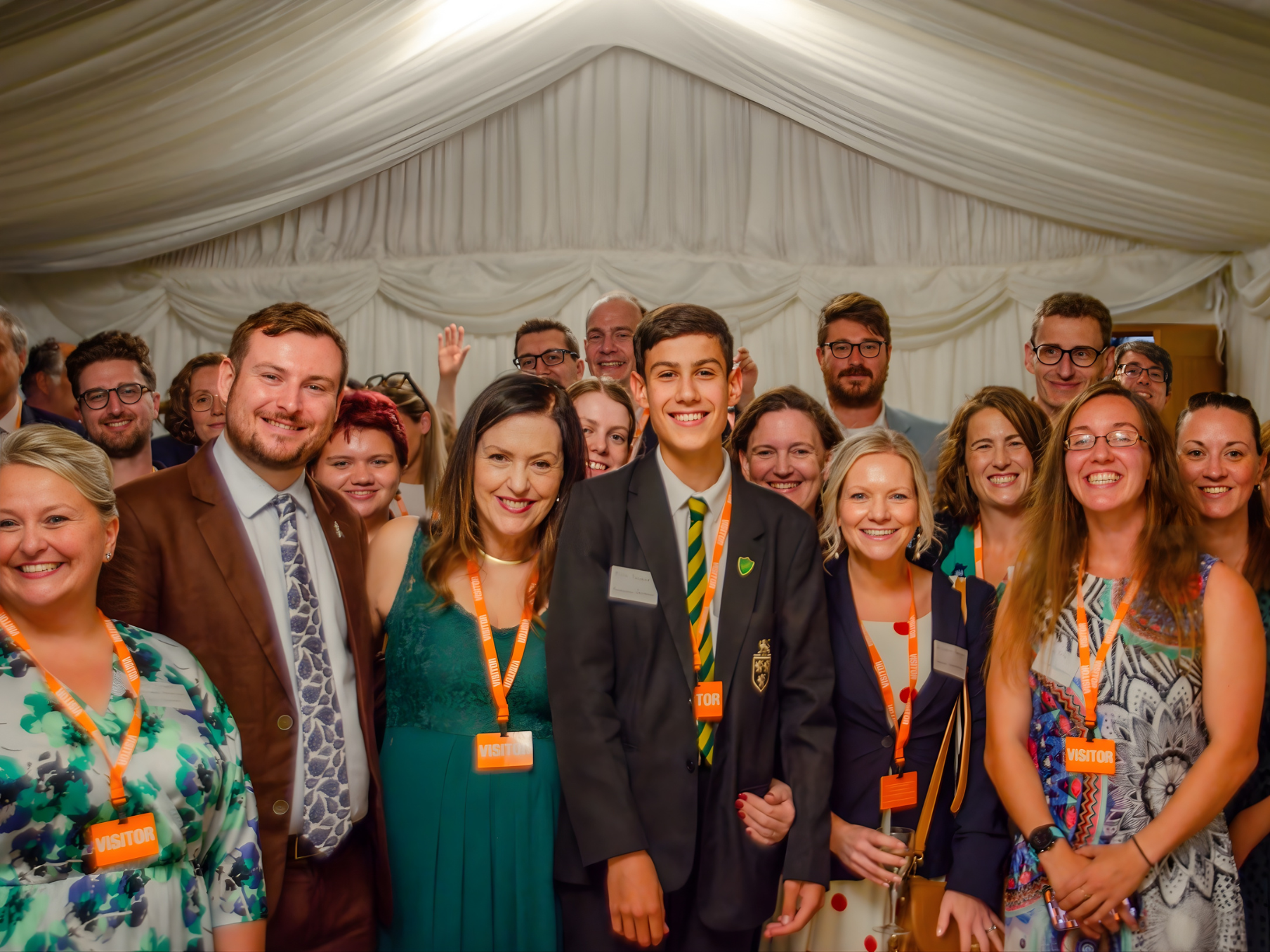
With three of the UK’s home nations currently undertaking a curricular review process, now is an important time to celebrate how far we’ve come. In 2025, we celebrated the book’s launch at a parliamentary reception held in the Palace of Westminster, hosted by Dr Peter Swallow MP, marking the 60th birthday of Classical Civilisation as an examined subject in English schools.
In 2026, we will celebrate Ancient History’s 75th birthday. Alongside the re-establishment of the Classics All-Party Parliamentary Group after a hiatus of 17 years, we have made significant progress on the national stage.
This book is therefore both a history and a call to action. It invites educators, policymakers, and classicists to recognise what has already been achieved and to build on it. Introducing or sustaining Classical Civilisation and Ancient History in schools is not an act of nostalgia, but an investment in young people’s intellectual and personal development. We hope this book showcases the inspiring and innovative work of those who have kept Classics alive in classrooms across the country and encourages new generations of teachers and students to champion these subjects. The future of Classical Civilisation and Ancient History depends, as it always has, on the belief that these subjects matter—and on the collective will of the Classics community (broadly defined) to ensure that they remain part of a genuinely comprehensive and balanced education.
Arlene Holmes-Henderson is Professor of Classics Education and Public Policy at Durham University. Her book co-authored with Edith Hall Classical Civilisation and Ancient History in British Secondary Education, (Liverpool University Press, 2025) can be read online at: Classical Civilisation and Ancient History in British Secondary Education.