
Claire Bubb looks at one aspect of dissection in the ancient world
So pervasive was the pull of rhetorical performance in the Roman empire of the second century CE that the period and the activity have been treated as almost synonymous. When we think of second century culture, the “Second Sophistic” looms large (the moniker can be embraced or rejected as a term, but it stands for the flourishing of performative rhetoric that dominated the entertainment and, to a degree, the politics of the period). Certainly, the super-stars of the second century were the sophists, and rhetorical performance was king. In this intellectual climate, it is surely no coincidence that one of the most popular scientific performances was a suite of vivisections demonstrating how the voice is produced. Tucked away in the writings of the physician Galen, these performances have not been central to modern discussions of the period, but they highlight the inherent entanglement of science and culture in antiquity.
The performances begin, fittingly, with their own bit of speechmaking. The dissector opens with an oration in which he sets out what he is going to show his audience and what it reveals about the anatomy and physiology of the body. In this case, he explains that the brain is the control center of the body’s movements, both voluntary and involuntary, and that the spinal cord, with its branching nerves, conveys the brain’s bidding to the muscles of the body. A complex team of muscles and nerves work together to coordinate the expansion and contraction of the thorax and the concomitant production of the voice. Disruption to these muscles and nerves should therefore impede, or even completely silence, vocalization, thereby proving their central role. Having captured his audience’s attention with this tale of the invisible power of microscopic objects, he goes in—metaphorically and, I’m afraid, quite literally—for the kill.
In the least complex version, the dissector might simply make a transverse cut to the spinal cord of an animal. Depending on where the cut is made, he explains, the animal loses mobility in its thoracic muscles, its diaphragm, or both (not to mention all the other muscles innervated by the spine below that point). Each progressive incision along the spinal column diminishes, and finally silences, the animal’s cries. More dramatically, the dissector might take a different animal and make a well-placed incision into the muscles between two of the ribs and the pleural membrane that lines them; when such an incision is made on one side only, the voice’s volume is diminished by half, but when mirroring incisions are made, the creature falls silent. Even more dramatically, this version of events offers the dissector the opportunity to doubly prove his point. If he uses his hands to pinch together and block up the incisions, temporarily undoing the damage he inflicted, the animal immediately draws in a breath and utters a cry. Alternatively—and requiring still more skill—the laryngeal nerves, which run alongside the carotid arteries in the throat, can be isolated and either severed or compressed. Though the loss of voice in this instance is not complete (a hoarse sound like snoring will continue), the change in volume will still be impressive compared to the disproportionately small incisions required to produce it.
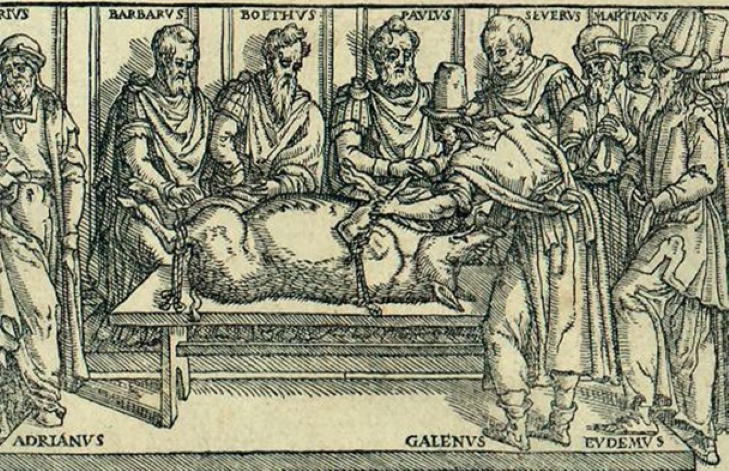
Vivisections along these lines were performed across the Roman empire in the early second century CE. A doctor named Pelops certainly performed them in Smyrna, and his colleague Satyrus likely gave them a whirl in Pergamon around the same time. Both men learned them from their teachers, Numisianus in Alexandria and Quintus in Rome. Such was their effectiveness and appeal that the students attached to all of these men would have taken the repertoire home with them as they returned from their studies to set up practice. Certainly, some of Pelops’ students did. Galen of Pergamon—the renowned second-century doctor who was student to both Pelops and Satyrus—took meticulous notes when Pelops demonstrated to him how the various movements of the thorax come about. And he wrote these notes up into a treatise for one of his classmates, who was not a gifted orator (though, one hopes, a competent doctor for his time) and requested this crib sheet from his friend Galen in order to help him in composing the “display speeches” he needed to precede the vivisections by which he proposed to make his professional reputation.
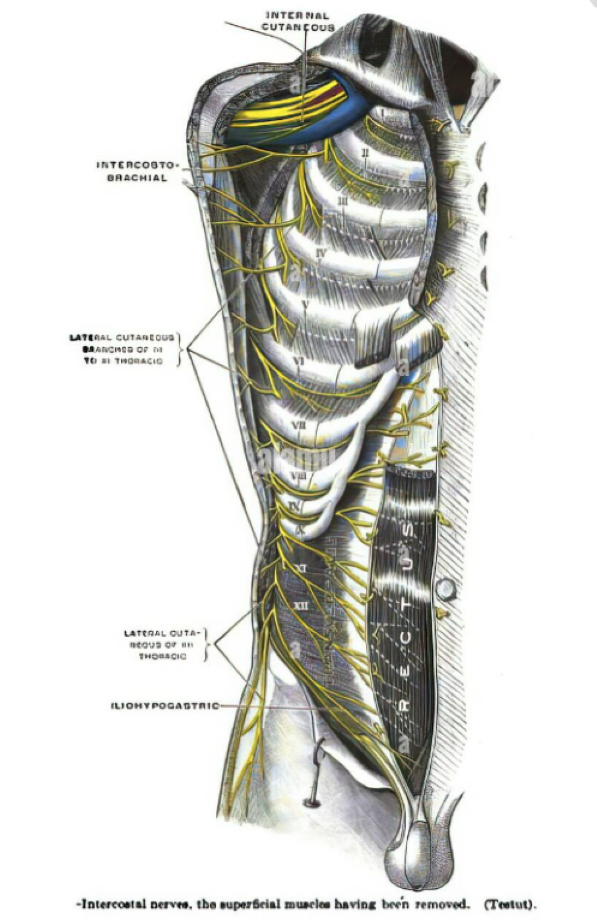
Indeed, we know everything that I have so far related because Galen takes the time to describe the knowledge and demonstrations of his teachers. However, he does this in the context of going into considerably greater detail about his own perfected version of the event, having improved on both the science and the showmanship. Galen had discovered the essential role that the intercostal muscles play in the voluntary movement of the breath and, therefore, in vocalization. On the strength of his discovery, he was able to adapt his own iteration of the demonstration on the voice to make it still more unforgettable. While he himself gave the display speech, his team of highly trained assistants got to work in the background. Having already selected a large and vociferously squealy pig, they lashed it into place, and prepared it for “surgery.” Having exposed each of the intercostal nerves (the nerves that innervate the muscles between the ribs, thereby controlling the expansion and contraction of the ribcage), they delicately fished them out with hooks and threaded a piece of string under each one, which they fashioned into a slipknot. At the psychological moment, Galen and his assistants tightened these knots, with the result that the pig—hitherto squealing madly—fell instantly silent, though still in possession of all other movement. Galen describes this outcome as “astonishing” to his spectators. Forgoing the bloody and debilitating mess attendant on previous versions, Galen has isolated and then pressed a series of minute mute switches along the pig’s side. Still more spectacularly, the mute switches are two-way. Because he has merely constricted the nerves, rather than severing them, as soon as Galen loosens the slipknots, the pig instantly begins to squeal again, providing a still more astonishing encore to the performance.
Galen presented these vivisections on numerous occasions, sometimes singlehanded, sometimes with his support staff, but the occasion he is proudest of was a multi-day event that took place at the behest of the former consul Boethus, who invited Galen to show him and his friends “how breath and speech are produced.” Boethus’ friends had no idle interest in speech: this audience was the crème-de-la-crème of the rhetorical world. Galen mentions that prominent among them were Adrian of Tyre, soon to become one of the most celebrated performers of the Second Sophistic, and Demetrius of Alexandria, a student of the famous Favorinus, who performed spontaneous orations daily in Rome in the manner of his teacher. It is hard not to wonder what was in the minds of these rising and respected orators as they saw the voice of the pig so magically stopped and started. How did the knowledge of the source of their own voices—their most potent possessions—affect them, practically and psychologically?
Certainly, some of the rhetoricians of the day were deeply interested in the science that underlay their discipline. The only text on physiognomy that survives in any form from this period is attributed to none other than Polemon, one of the most famous sophists of them all. Though physiognomy is today classed as a pseudo-science, it was considered in antiquity to have a legitimate theoretical foundation. Admittedly, little could be done about the color or shape of one’s eyes, but the data physiognomy provided on how demeanor, posture, and gait can reveal aspects of the soul would have had obvious relevance for an orator seeking to embody different characters. Similarly motivated curiosity about speech—what makes a powerful voice? how can it be modulated and controlled?—must have fueled some of the broad interest in the biomedical work of Galen and his peers. Surely this was one of Boethus’ motivations in requesting that Galen write him an entire treatise On the Voice (now all but lost). Indeed, the anatomy of the tongue was an equally popular subject. Galen notes that it was a topic of much debate and that “there is no agreement among anatomists about the number of muscles that move the tongue—that is how far we are from certain knowledge about which muscle superintends each of the movements of this part” (Foet.Form. 6 (IV.690K)); he marvels how it can be that we are able to deftly manipulate this complex organ to produce a subtly differentiated array of speech when its anatomy is too complex for even the most advanced men of science to perfectly grasp.
In the end, for any orators who were drawn to anatomical performances by their professionally driven curiosity, the most striking element of the whole experience may have been the unsettling familiarity of the scenery. Galen mentions performing in one of the “large auditoria” in Rome—a stage often home to the mellifluous voice of a rhetor, now filled with the carefully curated screams of one of Galen’s living puppets. One wonders who had performed there the day before, and what he would have made of it all.
Claire Bubb is Assistant Professor of Classical Literature and Science at New York University. Her book, Dissection in Classical Antiquity: A Social and Medical History (Cambridge, 2022) traces the practice of dissection from early Greece through Late Antiquity and offers a parallel study of anatomical literature across the same span. She also co-edited, with Michael Peachin, the volume Medicine and the Law under the Roman Empire (Oxford, 2023), which argues for unique parallels between the two fields and juxtaposes them within their broader social contexts.
DISCLAIMER: the views expressed in these articles are solely those of the author(s) and do not necessarily reflect the views of Classics for All.