
2025 marks a remarkable - and perhaps unexpected - birthday in one small but beloved corner of the world of Classics. In September, the Godolphin and Latymer Ancient World Breakfast Club celebrated its 20th birthday. When the idea was first mooted in 2005, one colleague commented that the venture was ‘unlikely to last more than three weeks’! The occasion was marked with a dinner at the school, together with a display of photographs and other memorabilia, while speeches were given by Professor Costas Panayotakis, a regular and popular speaker; Margaret Borton, one of the founder members; and myself, the AWBC coordinator (i.e. organiser).
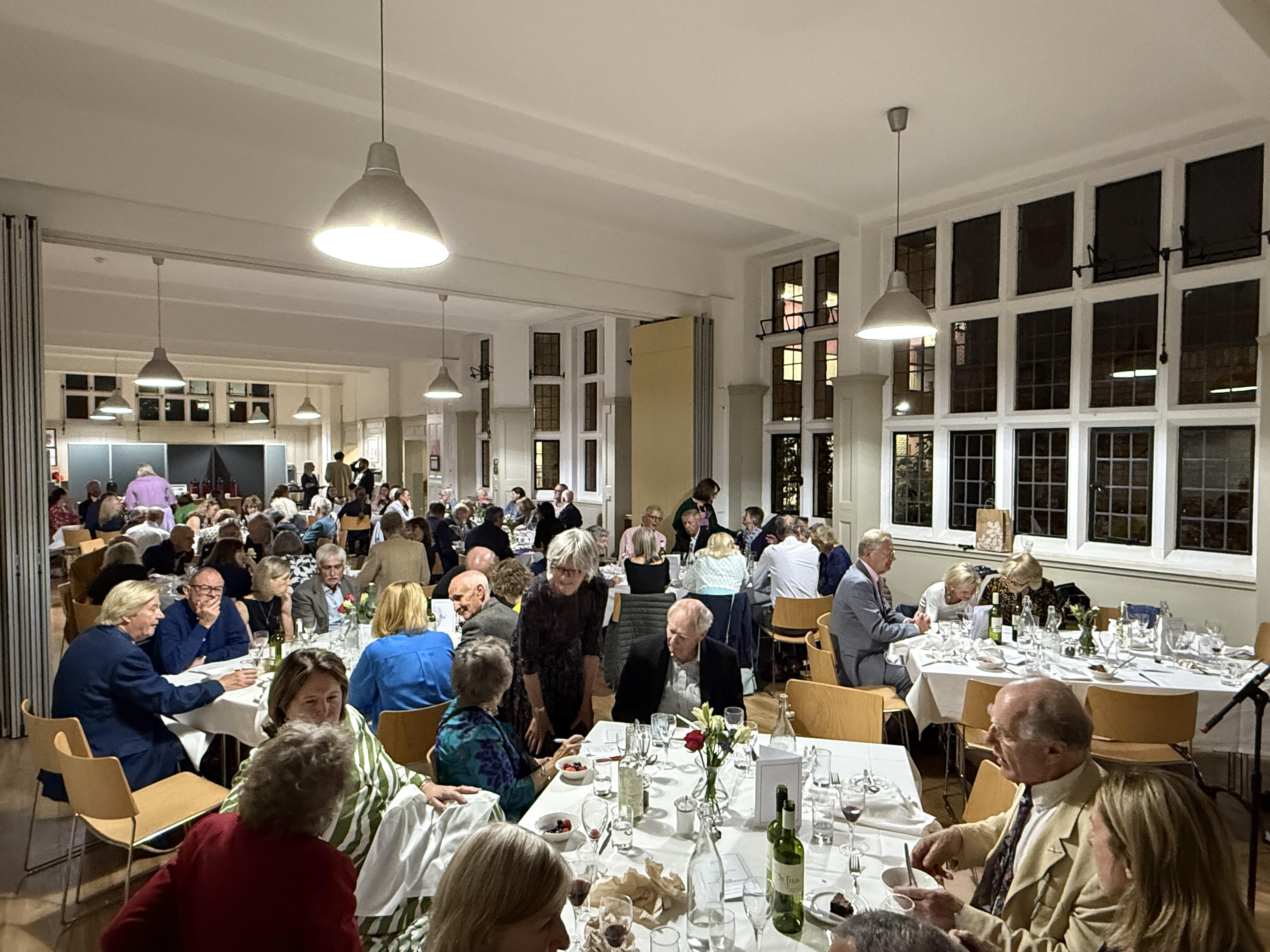
20th Anniversary Dinner
The club is a tribute to the passion and vision of former Godolphin and Latymer Head of Classics, Jenny Gibbon. In 2005 Jenny launched the Ancient Greek Breakfast Club as a way to engage with parents and other interested members of the local community in west London. Originally, this was focused on reviving Latin for those who may have studied it at school, but talks on the cultural history of the ancient Greek world soon became the popular focus. Jenny herself gave the early talks, and then started to invite guest speakers. The first guest speaker was Classics for All’s own Peter Jones, who spoke on Homer. Soon afterwards, Tom Holland came to speak on Xerxes’ invasion. As topics spread beyond Greece, the Club was renamed the Ancient World Breakfast Club, and has heard talks on Romans, Egyptians, Carthaginians, Babylonians, Persians, Phoenicians, Etruscans, early Britons and more.
The AWBC runs almost every Friday morning during term time at Godolphin and Latymer, in Hammersmith. The doors open for breakfast at 7:30am, and the talk starts at 8am. Speakers usually speak for about 45 minutes, leaving about 15 minutes for questions afterwards, so that it is all done by 9am. Membership is open to any member of the public, and on a typical week we have about 70 adults present, as well as about 15-20 G&L pupils. Some members attend religiously every week, some just drop in on an occasional basis when they can, while there are plenty between those two ends of the spectrum. No knowledge of the ancient world is required (or examined!), and the club draws a wide range of people: eminent retired classics teachers, those whose careers have never encompassed the ancient world, former parents and students of the school, and those who have come across it quite by accident and found they enjoyed it. There is no ‘typical’ AWBC member, and this is one of the club’s strengths.
The social aspect is also important. As one member put it: “We wouldn’t come just for the breakfast, and we wouldn’t come just for the talk!” The breakfast includes coffee, tea, orange juice, fruit salad, muesli, yogurt, pain au chocolat, and croissants. The cost of membership is subsidised by the school, which simply aims to cover its costs for running each event. You are unlikely to get a cheaper breakfast of that quality anywhere in London. The social aspect of the club has always reached beyond the school. There are winter and summer social events, held at the house of a member, while for the more academically adventurous members there are separate Greek and Latin reading groups, where members read, translate and discuss classical texts in the original language. Many members have also become regular attenders at other classical events organised in London, not least the various opportunities which Classics for All offers. Indeed, when Classics for All wishes to publicise an event, asking for the AWBC email list - numbering well over 200 people - to be informed has become an important strand. Some members have taken Classics degrees as adults – Birkbeck, University of London is a popular choice.
As the coordinator of the club, I have the pleasure and responsibility of attracting a wide range of speakers from across the country. We are rarely turned down, and then usually for very understandable reasons. Many speakers return, and comment on the warmth of the welcome, as well as the incisiveness of the questions. They have included academics, museum curators, and people you’ve seen on TV or whose books you’ve read, together with independent scholars and club members themselves (I have also learnt to have an emergency talk ready to go in case of an unexpected withdrawal!). A particular pleasure for me was to run an AWBC podcast service for four terms during the covid pandemic: this kept the AWBC alive for members during those challenging times, and enabled me to interview people from overseas too. Not to be put off by the mere challenge of a global pandemic, the Latin and Greek reading classes moved online as well.
Some examples of speakers, chosen at random from our archive, are John Taylor, well known for his Ancient Greek and Latin textbooks; Lucy Hughes-Hallett on Alcibiades, Cleopatra, Cato and Achilles (not all at once); Mary Beard on the Parthenon and Pompeii; Bettany Hughes on Helen of Troy; Roland Mayer on Rome; Paul Arnold on pimps in Greek and Roman comedy (parts 1 and 2); Llewelyn Morgan on what takes a classicist to Afghanistan, and on the British search for Alexander in North-West India; Andrew George on Be My Baby in Babylonia: an ancient poem of adolescent longing; Victoria Moul on translating Horace in the English Civil War; Charlotte Higgins on Roman Britain from a camper van; Philomen Probert with an introduction to ancient Hittite; Henry Stead, author of A People’s History of Classics, on Classics and class; Simon May on the influence of the classics on P. G. Wodehouse, and club member Vice-Admiral Sir Jeremy Blackham on Nicias and the doomed Syracusan expedition of the Athenian Navy.
Another long-standing member of the Club is Michael Wright, former Curator of Mechanical Engineering at the Science Museum. Several talks – given as work has progressed – on his own research into the Antikythera Mechanism, and on his reconstruction of an astronomical instrument by Archimedes described by Cicero, have been illustrated by his own working reconstructions. Other talks, on ancient boats and ships, sundials, water-clocks, and aspects of Greek mathematics, have also been illustrated by home-made demonstration apparatus. Michael produced a display of these at our 20th anniversary dinner.
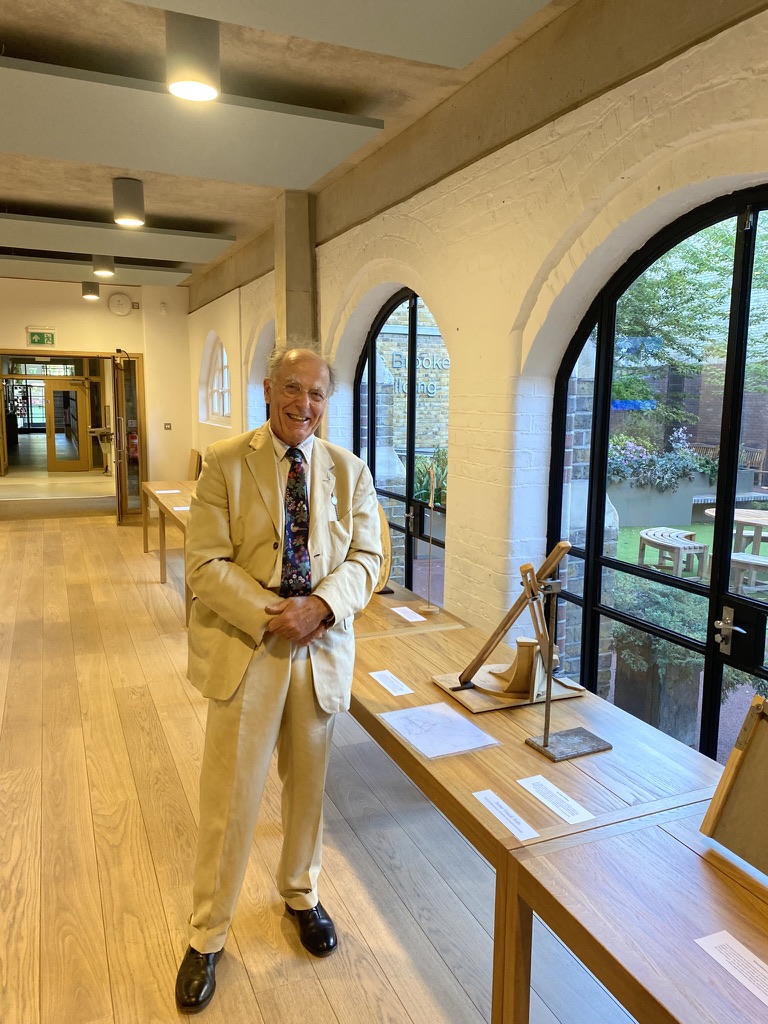
Michael Wright and his astronomical instrument
Professor Armand D’Angour of Jesus College, Oxford, reflects on his seven talks for the AWBC as follows: ‘My typical experience is for a personal connection to be rediscovered, partly because I grew up in West London – an audience member will come up and ask me if I remembered that sixty years ago his mother taught me the piano (of course I did), or someone will point out that we shared a tutor at Oxford in the '70s despite ourselves never having met at the time. Sometimes the audience will include parents with candidates keen to apply to study at Oxford, but that's no reason to think they aren't all genuinely interested in what I have to say about the sounds of ancient Greek music! Or about what novelty meant to ancient Greeks, and most recently why Aspasia of Miletus should be considered the founder of Western philosophy. I have come to expect sharp and productive questions, which will often feed into my thinking and research on a topic – an unexpected boon that shows that anyone prepared to come and listen to a serious talk first thing in the morning has their brain switched on and really wants to think about what is on offer.’
The 20th anniversary is in fact a bitter/sweet one for me, as this will be my last term running the AWBC: after 25 wonderful terms running the AWBC and teaching at Godolphin and Latymer, I will be leaving in December to write a book on the history of the marathon race, and pursue other projects alongside. It has been a remarkable privilege to hold this role, and I pass it on to the very capable hands of my successor, Nicola Grace. She will be the sixth AWBC coordinator - it’s a bit like a new Dr Who arriving! The club will no doubt continue to flourish - and here’s to another twenty years of classical and culinary stimulation.
James Renshaw teaches Classics at Godolphin and Latymer School in Hammersmith, West London, which offers all four classical A Levels in the 6th form - Ancient History, Classical Civilisation, Greek, and Latin - as well as IB Latin and Greek. In addition to teaching, James has written a number of educational textbooks, and is the general editor for the OCR/Bloomsbury suite of endorsed textbooks for the Ancient History and Classical Civilisation qualifications at GCSE and A Level. His latest book for Bloomsbury - The Marathon: an Epic History - is due out in spring 2027.