
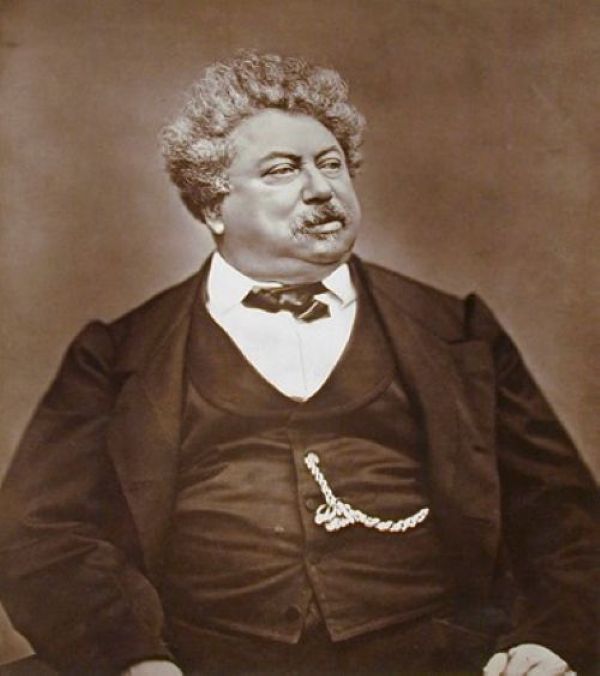
Alexandre Dumas
One might think that Alexandre Dumas requires no introduction. Not a year goes by without another rendition of one of his works. After new versions of The Count of Monte Cristo last year, this year will see the novel on stage, as well as the release of The Countess of Monte Cristo on television, and a musical called The Legend of Monte Cristo. For fans of Dumas, his penchant for classical allusion is notable. However, the extent of his reception of classical literature has been largely overlooked. This is the point of the project I am engaged in, the Classical Dumas Series, critical translations into English of works set in the ancient world. The first edition is Isaac Laquedem: A Tale of the Wandering Jew; the second is Acte: A Tale of Greece and Rome; and the third, The Memoirs of Horace: A Tale of Rome. This article makes use of all three.
For a general sense of Dumas’s relationship with antiquity, I direct you to my earlier article https://classicsforall.org.uk/reading-room/ad-familiares/alexandre-dumas-and-classics. We, however, will move swiftly on to those three works.
Acte is a work of historical fiction, but even so, it is evident that Dumas grounded it in research, making extensive use of Cassius Dio and Polybius in particular. There are numerous occasions when we see the influence of the former coming through: Nero’s confession to Acte in Chapter VIII about his family history, how his uncle Caligula “smothered his guardian with a pillow,” comes straight from Dio; when Nero plots to have his mother poisoned in Chapter IX, the response of Locusta, that “there are some, like Mithridates, on whom poison has no effect, because they have little by little trained their stomachs to bear the most poisonous potions and the most lethal powders”, also comes from him; in Chapter XVIII, when Dumas describes the meeting between Vindex and Verginius as Nero’s reign draws to an end, he writes, “according to historians”, where he is clearly referring to Dio as well as Suetonius, for these are the ones who record this, and the account of the Battle of Vesontio comes from Dio specifically; and finally, when Nero sings in the theatre before fleeing Rome and delivers the line, “My wife, my mother, and my father wish me dead!”, this again comes from Dio.
But Dumas also draws upon Polybius. Back to the first chapter, when Nero arrives at Corinth to take part in the games, Dumas writes that “Corinth had seen its citizens put to the sword, its women and children sold as slaves, its houses burned down, its walls toppled, its statues sent to Rome, and its paintings—one of which Attalus had offered a million sesterces for—used as mats by those Roman soldiers whom Polybius found playing dice on Aristeides’ masterpiece!”, which comes from Polybius’ Histories.
Dumas also makes us of the Greek geographer Strabo to help him paint a picture of his scenes. In the sixth chapter, when Nero is taking Acte back to Rome, Dumas describes the journey and includes a curious anecdote: “on the right, Rhegium, from whom Dionysius the Tyrant had demanded a consort, and been offered instead the hangman’s daughter!” This comes straight out of the Geographica, in which Strabo also refers to the Strait of Messina as the Strait of Sicily, like Dumas, when it is clear that Nero and Acte are sailing between the northeastern tip of Sicily and the toe of Italy, with Messina on their left and Reggio di Calabria on their right, through what is now called the Strait of Messina, whereas the Strait of Sicily is the broader channel between the west coast of Sicily and Tunisia, indicating that Dumas is relying on research over experience.
And of course, Dumas cannot avoid Homer. Back to the first chapter, when Acte is showing Nero the bas-reliefs of the fountain of Pirene, the Emperor recognises the scene illustrated, “‘It is Ulysses’ clash with his wife Penelope’s suitors, is it not?’”, an episode recounted in the Odyssey. And then, in the penultimate chapter, Dumas has Nero spluttering out a line of the Iliad: “It is the sound of swift-footed horses that strikes upon mine ears.”
Moving on to Isaac Laquedem, Dumas again draws upon Greek historians to lay the foundations. Dumas himself, in the first volume, names Herodotus as one such source when he writes, “Herodotus tells us—from the ancient Ethiopians—that there are a great number of buried treasures, and that there are griffins who guard this gold. He also talks of the sap of a plant that can be rubbed on one’s eyes in order to render these griffins visible.” This seems to be an invention on Dumas’s part, as this does not appear in Herodotus. In his Histories, he does mention griffins as guardians of gold, but he is talking about the north, and elsewhere, he does mention the abundant gold of the Ethiopians, but there is nothing about the sap of a plant being rubbed on one’s eyes as being related to this, so it seems that Dumas is combining source material and then embellishing it.
As with Acte, Dumas again uses ancient sources to help him with the geography of the world he is describing. For instance, in the fourth volume, Dumas cites Pausanias when describing Mount Helicon: “And it was upon Helicon, finally, that those fruits of exquisite sweetness which Pausanias speaks of grew.” Further, the use of “Tyropoeon Valley” in the third volume indicates Dumas’s use of Josephus, for he it was who coined this term in his Wars.
All this aside, however, there are three significant Greek influences on Isaac Laquedem. My translation of the fourth volume, Apollonius of Tyana, is heavily based on Philostratus’ Life of Apollonius of Tyana. One particular example can be found in The Wedding of Clinias chapter, where Dumas tells of the wedding of one of Apollonius’ disciples and a beautiful Phoenician woman. The whole chapter draws heavily on Philostratus, in which one of Apollonius’ followers is to marry a beautiful Phoenician woman too, only for Apollonius to reveal that the woman is actually a phasma or empousa, a phantom or vampire. Similarly, in Isaac Laquedem, Apollonius comes to reveal that the beautiful Phoenician is not what she seems to be either, but the witch Canidia.
The second significant influence is Aeschylus, and Dumas even directs the reader in a footnote of Volume IV to Aeschylus’ Prometheus Bound: “See this prophecy in Aeschylus, which can be found there word for word.”
And the third significant source is Hesiod, about whom Dumas writes in the fourth volume, “It was upon Helicon that Hesiod, Homer’s rival, was born, and where a copy of his works was exhibited, written entirely in the hand of the author of the Theogony and the Works and Days”. Dumas makes extensive use of the Theogony, as when he describes the three Fates whom Isaac goes to visit, and in doing so, also refers to Homer and Plato: “These three women, who preceded the creation of the first man, these three sisters, who had seen forty centuries pass by without aging even one day—whom Homer had made the daughters of Zeus and Themis; whom Orpheus had made the daughters of Night; whom Hesiod had made the daughters of Erebus; and whom Plato had made the daughters of Necessity—are the Moirai of the Greeks, or the Fates of the Latins.” Indeed, Dumas again directs the reader to Hesiod in a footnote elsewhere in the fourth volume: “For Hesiod’s Theogony, which Prometheus here gives a glimpse of, see the beautiful work of M. Guigniaut.”
And finally, The Memoirs of Horace. As a fictional historical autobiography, this relies mostly on history too, which comes principally from Plutarch, but also from Dionysius of Halicarnassus. Plutarch’s Parallel Lives is exploited the most, with Dumas moving effortlessly between The Life of Julius Caesar, The Life of Pompey, and The Life of Cicero. When civil war erupts between Caesar and Pompey, Dumas bounces between their two lives. Considering whether omens are favourable or not, he picks out examples from Julius Caesar, such as one “at Tralles, a town in Lydia near the Meander, where, in a temple of Victory, Caesar had a statue, the cobblestones of the temple suddenly rose up and a palm tree was seen emerging from the ground, the amiable top of which gave shade to the forehead of Caesar’s statue”; then, when battle breaks out, Dumas turns to Pompey, which also allows him back to Homer, for Plutarch here quotes from the Iliad: “Jupiter, the father of the gods, sat on his throne on high, put fear into Ajax, and he halted, stricken with confusion”. Dumas turns to Plutarch’s Cicero when, for example, describing Cicero’s death: “That would have been better than dying at the hands of the centurion Herennius on the road from Gaeta; that would have been better than having his tongue pierced by Fulvia’s golden hairpins and his hands nailed to the Rostra by Antony.” Elsewhere, Dumas also uses Plutarch’s Moralia, for in his description of Rome, his mention of the Fons Muscosus must come from this, as the ‘Mossy Spring’ is only cited here. And as for Dionysius of Halicarnassus, Dumas’s story about Horatius Cocles is drawn from the fifth book of his Roman Antiquities: “It was on this bridge, and on the side that touches the right bank of the river, that the valiant Horatius Cocles alone thwarted the tyrant Porsena, while his companions demolished the bridge behind him; with the bridge destroyed, the heroic Horatius Cocles leapt fully armed into the river and got to the far bank safe and sound amidst the arrows of his enemies.”
As we can see with the last two references, in moving through the Roman Empire, Dumas again needs to describe the world around his characters, and elsewhere he also calls upon Strabo once more: “Those two hillocks, Saturnia and Palatinus, barely a hundred feet in height—the former, a thatched village built by Evander, the latter, an extinct volcano—separated by a valley, which is the Forum”. It is Strabo who says, in his Geographica, that Rome was an Arcadian colony founded by Evander.
It is important to note that, despite being such an avid fan of antiquity, Dumas himself readily admits in his own memoirsthat “he never had a word of Greek.” So, he must have relied upon translations, as well as other work, such as Joseph-Daniel Guigniaut’s thesis on the Theogony, as mentioned above. Further, in an article on The Memoirs of Horace, Marco Fucecchi shows that Charles Walckenaer’s History of the Life and Poetry of Horace, Charles Dezobry’s Rome in the Age of Augustus, and Jules Michelet’s Roman History were all utilised too.
Like any writer of historical fiction, grounding his fiction in history serves to substantiate his storytelling. But Dumas, perhaps due to his racial heritage, also found himself dismissed by academia and wanted to prove himself. It seems that, in turning to historical fiction, and with the sheer amount and variety of material he made use of, he was almost trying to play academics at their own game.
But Dumas was not a historian, and his works should not be read as histories. For example, in the Memoirs of Horace, we find Caesar crying out, “strike to the face!”, which comes from Chapter V of Dumas’s own The Three Musketeers, where D’Artagnan is prepared to strike Aramis “to the face, as Caesar had recommended doing to Pompey’s soldiers”! This is an invention of Dumas’s. His source material is, then, equally a source of inspiration, a springboard for his creativity to leap from, and as such, not only does Dumas’s use of Greek literature reveal his passion for antiquity, it also points towards a more practical use, using the old to create something new.
Dr Paul T. M. Jackson is a translator, writer, and poet living in Provence. A graduate with master’s degrees in classics and teaching and learning, he holds a PhD in ancient philosophy. Further information about Paul’s work can be found on his website: paultmjackson.com