
The process of fulling is the cleaning and maintaining of textiles and was a vital part of Roman daily life. The study of it can tell us about numerous facets of life in the ancient world, including the Roman economy, industry, business, the social status of fullers, and even sanitation. However, the most commonly known aspect of Roman fulling was that it was a very malodorous business – that is to say, rather smelly!
Fulling was carried out in workshops called fullonicae, which have been discovered across the Roman world but most prominently in Pompeii. Given the scale and quality of the remains at Pompeii, the site is a natural starting point for studying an industry such as this, and has led to a number of different studies on fulling. Most recently, there has been a rise in the study of fullonicae as sensory environments and what they would have been like to experience.
Part of the fulling process involved cleaning textiles with stale urine, trampling the urine into the cloth in a process like that of making grapes into wine. The ammonia of the urine would break down any grease and stains in the textiles, but this ammonia is also the source of the odour, created through a process called enzyme urease.
The aim of my MA dissertation was to develop a deeper understanding of just how strong the odour of this stale urine was, and whether the Pompeians experienced this odour as unpleasant. Additionally, I aimed to assess whether the architecture of the fullonicae was utilised in way that would allow the odour to disperse.
The speed at which enzyme urease made ammonia is affected by 3 key factors: diet, temperature, and the amount of time it is left to go stale. I started my analysis by looking at these factors to see the extent to which they were present at Pompeii.
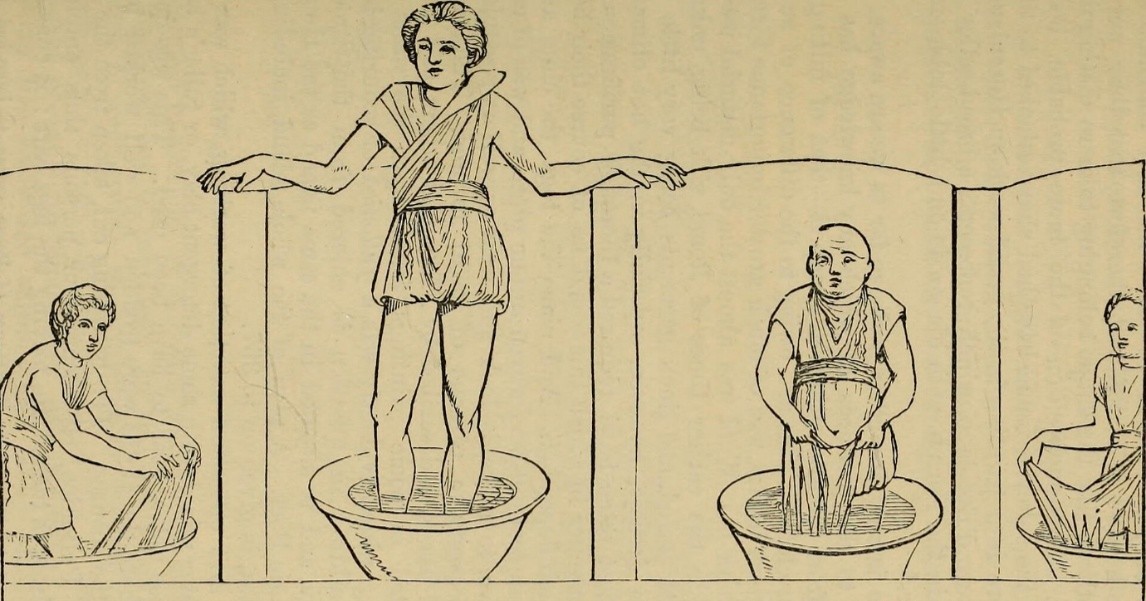
A drawing based on a painting found in a fullonica at Pompeii, depicting fullers washing clothes in stale urine. Wikimedia
The first is diet. It is well known that certain food and drinks can produce a stronger odour from urine, so I needed to look at the diet of the people the urine was sourced from. It is commonly believed that the urine was collected from pots left in the street into which passersby would urinate. There have been questions about this theory recently, but it is still the prevailing belief. Therefore, I needed to establish the diet of the average Pompeian to assess the impact this had on the strength of the odour. Luckily, Pompeii and nearby Herculaneum are two of the most fruitful when it comes to evidence of diet. We know that the Pompeians ate a number of foods that would have increased the strength of the odour of their urine, including seafood, dried fruits, cabbage, asparagus, garlic and honey. Alcohol would have also been consumed with each meal, although often watered down, which would have also increased the strength of the odour.
Next is temperature. The higher the temperature, the quicker the process of enzyme urease. If we again assume that the urine was indeed collected from pots in the street, then it is the climate of Pompeii that needs to be explored to understand how far temperature affected the strength. For this I looked at the hottest month and the coldest: August and February. Pompeii’s climate was likely slightly warmer 2000 years ago than it is today, so February’s average temperature would likely have been slightly warmer than the 7°C it is today. Even so, this temperature is not enough to speed up the process of enzyme urease. However, the summer months are a different story. Today, Pompeii’s average temperature in August is 31°C, which would have significantly increased the speed of enzyme urease, and therefore the strength of the odour. Overall, then, the odour would have been weaker in the cooler months, and stronger in the summer months.
Finally, we have the length of time that the urine is stored for. The longer that the urine is left to age, the longer the process of enzyme urease can occur and therefore increase the odour. Exactly how long the urine was left to age would have varied across fullonicae, due to personal preference and the storage capabilities of the property. Given that a range was possible, I choose to focus on an average of 7 days’ storage time as a balance between the extremes of the particularly small and particularly large fullonicae. In a study of Seoul National University, urine left to age for 7 days at room temperature increased in ammonia content from 65.70% to 75.61%. This is a substantial increase and would have created a noticeable increase in the strength of the odour.
It is also important to note that the urine was used in conjunction with another chemical, known as fuller’s earth, that also helped to break down the grease on textiles. We know very little about fuller’s earth: it’s a type of clay called calcium montmorillonite, but the exact chemical composition varies. We have a few samples from across the ancient world, including two from Pompeii. In these samples, particularly those from Pompeii, the largest components are silica and alumina. Silica can absorb ammonia molecules in the air through a process called chemisorption, but this effect would have been minimal and was not the motivation for using fuller’s earth. Alumina also reacts with ammonia, but not at temperatures less than 1000°C so this can be ruled out. As such, fuller’s earth wouldn’t have affected the strength of the odour much, if at all.
Overall, then, urine creates a natural odour that is made stronger by the conditions present at Pompeii. But that doesn’t necessarily mean that the Pompeians perceived this odour as unpleasant.
Not everyone experiences the same environment in the same way; factors such as age, gender, disabilities—to name just a few—shape an individual’s experience. As an added complication, we cannot simply go to Pompeii and experience the fullonicae for ourselves. Pompeii is now a city of tourists. There is no shortage of life, but the everyday tasks of the ancient world no longer occur, fullonicae no longer operate and the unpleasant smells no longer exist. This is why the combination of scientific and cultural evaluation I have carried out is so important.
Today, we generally understand urine to smell unpleasant, but just because we dislike it doesn’t mean the Romans felt the same. The Romans would have been exposed to it more, so we also need to consider the possibility of them going “nose blind” to it. We have a handful of Roman literary sources on urine, but this is often only a passing mention. Still, when analysed together, a picture begins to emerge.
One of the most well-known stories on ancient urine is Vespasian’s urine tax. In an anecdote recounted by both Suetonius and Dio Cassius, Vespasian asks his son Titus if the odour of the money the tax produced was as offensive as the urine it came from. Whether or not this conversation actually took place, the anecdote would not have made sense without some level of belief that the odour of urine was unpleasant.
In another source, this time from one of Martial’s Epigrams, a woman named Thais is made fun of and her numerous negative qualities listed, including smelling worse than “an old jar of a covetous fuller broken in the street”. While this is clearly meant to be humorous, it again shows that the Romans widely understood urine to be malodorous.
In a political speech against Cicero, recorded by Dio Cassius, Cicero’s father is said to be a fuller and that he “defiled himself with the foulest filth”. This is likely untrue, but the purpose of the speech was to cast doubts on Cicero’s suitability as a senator by using the negative qualities of a particularly unpleasant profession as a political weapon.
It is clear, then, that the odour of stale urine was strong and was experienced by the Romans as being an unpleasant experience, despite being exposed to it more frequently than we are today.
Next, I decided to explore what the real-world impact of this was and whether any steps were taken to help disperse the odour and make the fullonicae less unpleasant spaces to be in. Specifically, were the fulling stalls placed in a way that the available architecture would encourage the odour to disperse outside of the workshop and into the atmosphere?
First, I needed to work out how far the odour would travel. To do this, I created a code, with the help of a chemist and a physicist, that would calculate how far the odour would travel over 6, 8, 10 and 12 hours. The results of this code were then mapped onto a diagram of each fullonica’s layout. These diagrams were based on the data collated by the Pompeii Bibliography and Mapping Project. Unfortunately, I was only able to use 12 of the 19 fullonicae I had identified at Pompeii due to a lack of data on the remaining 7. Nevertheless, the 12 I was able to analyse provide a good range in size and available architecture.
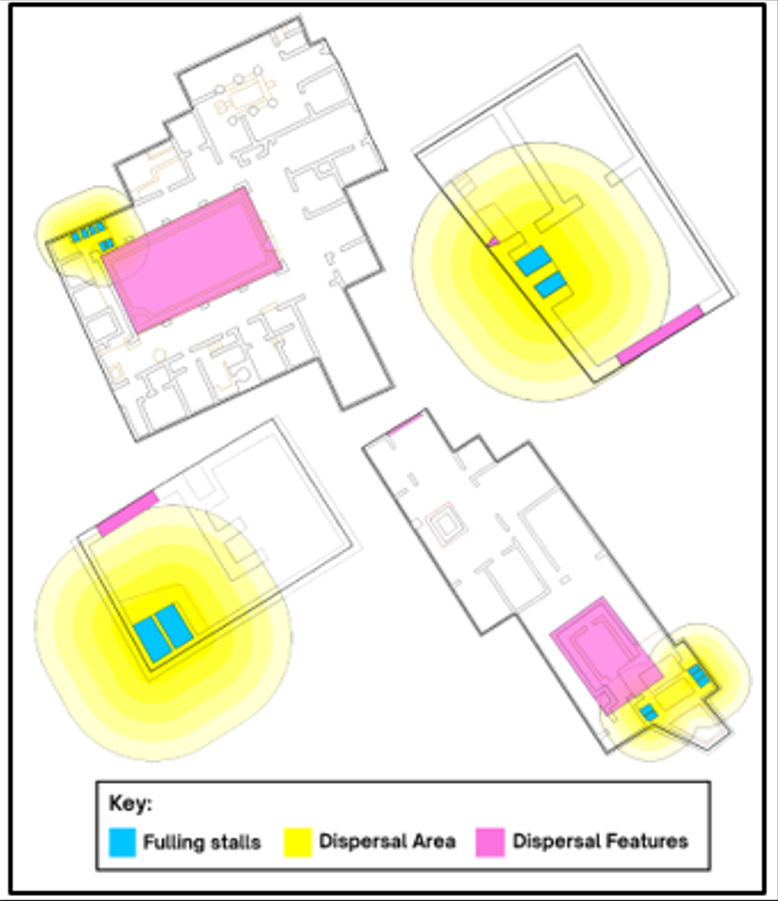
A selection of the maps used during my research.
For the architecture that would help disperse the odour, I decided to focus on windows, wide doorways and open courtyards, all of which would allow the odour to move out of the property and disperse into the atmosphere. I referred to these as “dispersal features”.
Windows were easy to rule out quickly. On the ground floor level, the majority of properties at Pompeii don’t have windows, and where they are they are often very small. Only 1 of the 12 fullonicae in my sample had a window, and it was small enough that it is difficult to spot if you don’t already know where it is. Therefore, it is easy to say that windows played no role in the dispersal of odour in fullonicae.
As for wide doorways, these are more common in the smaller fullonicae or those that are part of a larger property but isolated to one room; this is the case in 9 of the 12 fullonicae in my sample. However, only 4 out of these 9 have the stalls located close enough to the wide doorways to aid dispersal. The stalls are typically placed at the back of the room, meaning the odour has to travel across the whole fullonica to escape. One potential explanation for this is that customers are unlikely to have gone to the back of the workshop themselves. Keeping the stalls at the back of the workshop would reduce the impact of the odour at the front and may have had some aesthetic benefits too.
Courtyards are present in 6 of the 12 fullonicae in my sample and only in the larger properties. 3 of these don’t make use of them for odour dispersal; instead, they have the fullonica isolated in a single room facing the street, like those discussed above. For the 3 that do have the stalls placed close enough to the courtyard that they would aid dispersal, this placement appears to be deliberate and done in a way that would prevent the odour from reaching the rest of the property. This would have a similar effect as the doorways, keeping the unpleasant odour away from any customers. It is also likely that properties of this size were lived in to some extent and this would help keep the odour away from the residents. No one wants to be smelling stale urine while they eat their dinner!
Overall, my research showed that the odour of the stale urine used in the fulling process was strong and unpleasant. There does appear to have been some attempts made to reduce the unpleasant odour of stale urine in Pompeii’s fullonicae, but primarily to make the experience more palatable for customers and residents, rather than the workers.
Molly Mather is a PhD student at Royal Holloway, University of London. Her research focuses on the multisensory environment of Fishbourne Roman Palace, how this changed over time, and how the different senses impacted the layout of the site. Her MA dissertation (of which this article is a short summary) won the Roman Society's MA Dissertation Prize and is currently being prepared for publication