
One day, probably late in 65 CE, the emperor Nero sent for one of his Greek slaves, a man named Sporus. The recently widowed emperor had a strange demand for his subordinate. Nero had Sporus castrated, and thereafter referred to him by the name of his deceased wife, Poppaea Sabina. We might be inclined to accept this story as yet another example of the crazy emperor acting out of his usual madness. You can’t bring back the dead by impersonating them. And yet when Nero’s regime crumbled a few years later, his successors Otho and Vitellius kept Sporus / “Poppaea” at court, and continued to refer to them as if they were the reincarnation of the dead empress. Nero’s successors wanted to keep Poppaea alive somehow. We know of no other Roman woman who was celebrated in this bizarre way.
This story might naturally lead us to be curious: who was Poppaea Sabina? It’s understandable that her husband loved her, even if he kicked her to death in a drunken rage. But how could she mean so much to the Roman people that later emperors would continue the charade that she lived on in Sporus? And we are hardly the only ones to be fascinated by Poppaea’s story. People began dreaming up melodramatic, misogynist fantasies about her from the moment she appeared in the emperor’s court. Her family was scandalous; she had an affair with the emperor while married to Otho, one of his friends; Nero was so in love with her that he divorced and executed his wife Octavia to marry her; she may then have egged him on to murder his mother Agrippina; she was supposedly interested in Judaism; she was married to Nero for three years, but then he kicked her to death while she was pregnant. Then came her posthumous divinization and impersonation by Sporus. All these elements of Poppaea’s story presented an unforgettable narrative template—especially appealing to people who did not have to worry about how much of it was true. So she shows up, again and again, in operas such as Monteverdi’s L’incoronazione di Poppea (1643) and films like Quo Vadis (1951).
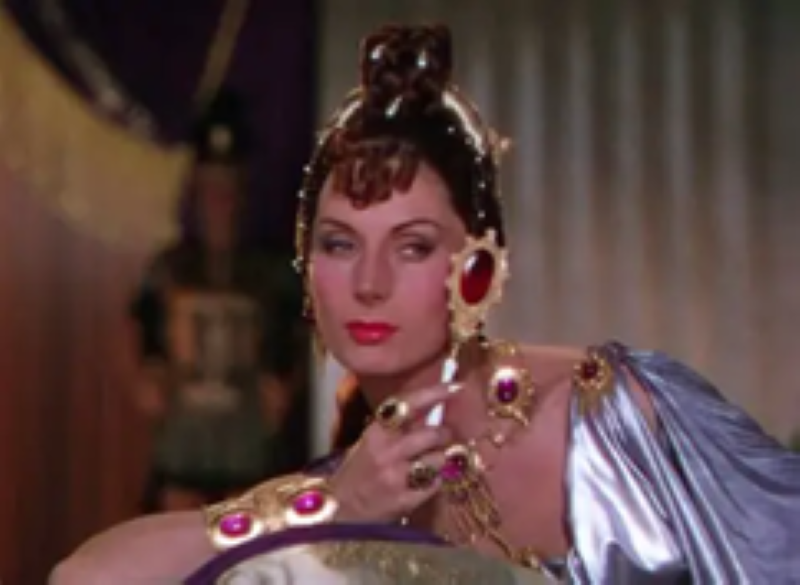
(an image from Quo Vadis showing Patricia Laffan as Poppaea)
The ancient sources have clearly exaggerated and fictionalized Poppaea’s story in an effort to induce moral panic. That makes it hard to recover her genuine motives and actions. My recent book, Poppaea Sabina: The Life and Afterlife of a Roman Empress (Oxford, 2025), tries to strip away layer after layer of misogynist fantasy in order to find out what can be known about the real woman, and to suggest why and how these stories were created about her. A more recent opera than Monteverdi’s, Michael Hersch’s Poppaea (2019), takes a similar approach. Lead soprano Ah Young Hong rightly interprets her character as a victim, with little agency, unable to control how others manipulate her body and interpret her story.
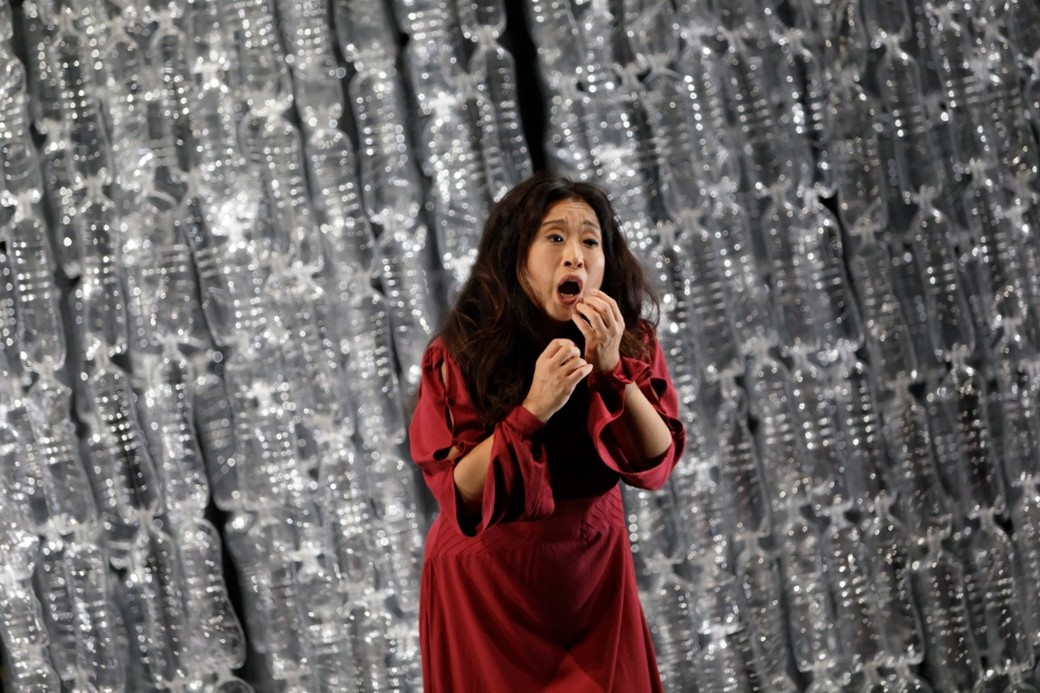
Ah Young Hong sings Poppaea in Michael Hersch’s 2019 opera
Poppaea Sabina was born, probably around 30 CE, into a family that would be marked by scandal. When she was probably no more than two years old, the emperor Tiberius charged her father Titus Ollius with conspiring against him and executed him. When she was in her late teens, the empress Messalina executed her mother, the Elder Poppaea. Poppaea must have appeared at court fully aware of its dangers and also that her scandalous family would be a target of gossip. She married Rufrius Crispinus, the Prefect of the Praetorian Guard, the elite detachment of soldiers charged with protecting the emperor’s life. They had a son, also named Rufrius Crispinus after his father. But soon after they divorced, and she married the aristocrat Marcus Salvius Otho, one of the playboys in Nero’s circle.
At this point the ancient sources diverge in a significant and revealing way. They agree that Otho introduced Poppaea to Nero, and that she began an affair with the emperor. But they disagree on who took the initiative. Did Nero simply take Poppaea from her husband, as had been occasional imperial practice since Augustus? Or did Otho choose to share his wife with the emperor, in order to gain further influence with him? If he did, it was a poor choice; Nero would eventually marry Poppaea and send Otho away to govern the distant province of Lusitania. Either way they tell the story, the ancient sources make Poppaea an object to be traded between men.
There was a further obstacle to Poppaea’s marriage to Nero: he was already married to his stepsister Octavia. The teenage empress provided Nero with his claim to be the legitimate emperor. We must step back to the previous regime to understand the situation. The previous emperor Claudius (reigned 41-54 CE) had had four wives; the last, Agrippina, had brought her son Nero into the marriage. Claudius adopted Nero as his own son and engaged him as a young child to his birth daughter Octavia. So without Octavia, Nero could be dismissed as an interloper.
Nero eventually stopped caring, however, about his links to the preceding emperor. In 59 CE, after he had been on the throne for five years, he executed his mother. Here is where the ancient sources start attributing agency to Poppaea, claiming that she egged Nero on to kill Agrippina because she knew the emperor’s mother hated her and would never permit their marriage. But the fact that Nero remained married to Octavia for three more years shows us that his desire to marry Poppaea cannot have been the reason why he killed his mother.
From the perspective of imperial dynasts, the empress’s most important role was to provide the emperor with a son who could be his legitimate heir. After eight years of marriage, Octavia had not yet given birth. Once more the ancient sources concoct a story of Poppaea manipulating Nero to remove Octavia and marry her. The historian Tacitus imagined her delivering an inflammatory speech to her lover, accusing him of cowardice, and arrogantly questioning whether her beauty and proven fertility were not enough for him. In the summer of 62 CE, Nero implausibly accused Octavia of adultery with an Egyptian flute player and had her executed. Crowds protested in the city of Rome, and Nero called out the Praetorian Guard to restrain them.
Nero’s divorce from Octavia and marriage to Poppaea became the central moment of Poppaea’s reception ever after. In the 70s CE, shortly after Nero’s death, an unknown playwright wrote a tragedy called Octavia, which presents the events of 62 and elicits our sympathy for the wronged empress. If we had more contemporary sources, we might tell the story differently. But as it is, we have very little between the Octavia in the 70s and the major sources, Tacitus and Suetonius, in the early second century. Accordingly, we speculate that the play’s representation of the characters may have influenced the way that the historian and the biographer tell the story. In 1641/2, Monteverdi wrote a famous opera, L’Incoronazione di Poppea (The Coronation of Poppaea). Here Poppaea triumphs thanks to the intervention of the god Amore, and at the end of the opera the goddess Venere (Venus) transforms her into an earthly goddess.
Poppaea would only be Nero’s empress for three years. In that time, she gave birth to a daughter, Claudia Augusta. Ancient Rome, like many premodern societies, had very high rates of infant mortality, and the princess passed away after only a few months. Poppaea’s family was from the area around Pompeii, and she apparently maintained strong ties to the city. Graffiti preserved by the eruption of Vesuvius record the existence of “Neropoppaeans” (Neropoppaenses), a fan club for the imperial couple, who provided assistance to the city after a devastating earthquake in 62.
The Jewish historian Josephus recalls how Poppaea received him as part of an embassy from the Roman province of Judaea, and describes her as “pious” (theosebes). Some scholars would assume from this single word that Poppaea was interested in Judaism, and even claim that she converted to the religion. This claim is baseless. Very few Romans converted to Judaism, and Josephus would have told us if she had. Still, the fantasy of an empress with Jewish sympathies led to other fantasies. Edward Gibbon, in his extraordinarily influential History of the Decline and Fall of the Roman Empire (1776) blames Poppaea for Nero’s persecution of the Christians after the great fire that swept through Rome in the summer of 64. Since he assumed Poppaea was a Jewish sympathizer and good at manipulating her husband … then she must have told Nero to exterminate the Christians in order to let the Jewish community at Rome thrive without competition.
Gibbon’s fantasy was built on a familiar combination of misogyny and anti-Semitism, and it continued throughout the 19th and 20th centuries. Henryk Sienkiewicz’s novel Quo Vadis (1896) picks up Poppaea’s story after she has been married to the emperor for a while. Where Gibbon disposed of Poppaea’s imagined role in the Christian persecution in a few sentences, Sienkiewicz tells the story at length, even imagining Poppaea meeting with two rabbis from Trastevere to concoct the plan. Some of the anti-Semitism is gone in the MGM film version of Quo Vadis (1951), though the misogyny still remains. The Polish novelist Sienkiewicz invented a new erotic rival for Poppaea, the barbarian princess Lygia captured from the forests of northeastern Europe, the imaginary ancestral land of the Polish people. Poppaea worries that her husband will become infatuated with the beautiful teenager, and so devises a plan to destroy her in the arena. The film created the image of Poppaea that endures today, parodied by Mel Brooks (in his film History of the World Part 1), half-remembered in cheap novels set in imperial Rome.
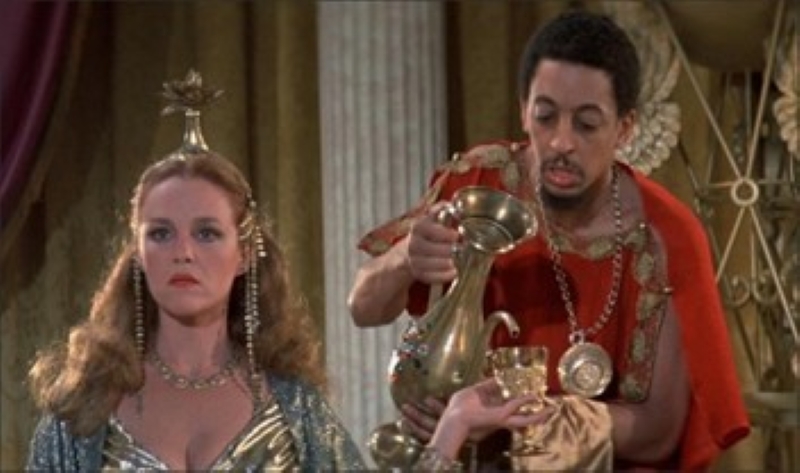
Madeline Kahn plays ‘Empress Nympho’ in Mel Brooks’ film History of the World: Part 1 (1981)
Let us return to the story of Poppaea’s death. After the loss of her daughter Claudia, she became pregnant again. As the sources tell the story, Nero returned late one night from the games, drunk as usual, and kicked his wife’s pregnant belly when she rebuked him, causing a miscarriage that led to her death. He felt immediate remorse and searched for ways to commemorate his dead wife. First he had dancers perform in masks that resembled her; then, as we have already explained, he castrated Sporus and renamed them Poppaea. In the mean time, he had the Senate decree that his wife was now a goddess, and married his third wife, Statilia.
Michael Hersch’s contemporary opera Poppaea (2019) includes these moments, bypassed by the earlier works that I have mentioned. Stephanie Fleischmann’s libretto endeavors to show Poppaea’s vulnerability in a hostile, misogynist world. Her character observes early on that “My beauty is a front I hide behind… a thing divorced from me.” Later scenes show Poppaea’s murder and replacement by Sporus, and the Chorus tersely observes that the emperor “grieves / and then he finds himself a lookalike.” Hersch’s Poppaea reverses the tradition of Poppaea as a manipulator. While still a fantasy, this one makes far better sense after #MeToo.
Neil W Bernstein has taught at Ohio University since 2004. His many books include most recently Poppaea Sabina: The Life and Afterlife of A Roman Empress (Oxford University Press, 2025), an annotated translation of the complete works of Claudian (Routledge, 2022) and scholarly editions of Silius Italicus Punica books 2 (Oxford 2017) and 9 (Oxford 2022).