Stephen Halliwell looks at the shifting fortunes of an ancient concept
When did you last hear something called ‘sublime’, and, if you noticed, what did you make of it? The adjective, like its counterpart in many languages, has become a relatively mundane epithet to express admiration of eye-catching feats in almost any domain; a quick search of the BBC website confirms, for example, that it is a favourite with sports journalists of the more effusive kind. The noun ‘sublimity’, by contrast, and still more its Greek-style equivalent, ‘the sublime’, is still largely reserved for the rarefied air of aesthetic theory and criticism, where it has found a home in numerous schools of thought. What lies behind these seemingly discrete facts is a fascinating but tangled history of both words and ideas which is of particular interest to classicists. It is worth trying to untangle just a few of the historical threads in question.
General uses of ‘sublime’ in our own language distantly inherit a metaphorical extension which originally took place with the Latin adjective sublimis itself. From the primary sense of physical height, the word came to denote, among other things, an ‘elevated’ style or tone of language: Ovid, for instance, applied it to Lucretius, while Quintilian employs it frequently of a special register of rhetorical or poetic speech. But long before this development in Latin, the corresponding word-family in Greek had undergone a kindred semantic evolution. Already in Homer’s Odyssey the suitor Antinous four times calls Telemachus hupsagorês, a ‘lofty speaker’: he does so sarcastically, for sure, but the availability of ‘height’ as a conceptual metaphor for oratorical aspirations is clearly visible. Thereafter, the metaphorical vocabulary of height, hupsos, appears intermittently in Greek (several times in Plato, for example, though never in Aristotle) to describe qualities of language and thought which lay claim to an exceptional level of distinction.
It was only in the later first century BC, however, in Greek as in Latin, that the trope of ‘heightened’ language and thought became an important part of the vocabulary of a number of literary critics. We can observe this in Dionysius of Halicarnassus, the classicizing rhetorician and historian who worked at Rome under Augustus and moved in intellectual circles both Greek and Roman. For Dionysius, hupsos primarily signifies a self-consciously formal style of writing, a style he finds in Thucydides and Isocrates and which he thinks that Plato sometimes carries to a fault. Dionysius had a friend, Caecilius, who wrote a whole work on the subject of hupsos. Although we cannot reconstruct exactly what the concept meant for Caecilius, we know that his views prompted another Greek critic, by reaction, to bring together his own thoughts on the subject for the benefit of one of his Roman students. It is this later critic who has played a bigger role in the history of ideas of ‘sublimity’ than anyone else.
The critic in question was the author of the treatise Peri hupsous or (in its usual English translation) On the sublime. We do not know his name, though the fact that he was later misidentified as the third-century AD neoplatonist Cassius Longinus has led to him being generally called ‘Longinus’ for the sake of convenience. We also do not know his date, though he may have been writing in the early first century AD. Nor can we say much about his Roman student, Postumius Florus Terentianus, except that he evidently had advanced facility in Greek as well as early experience of public speaking (in both respects like, say, the younger Pliny, who started to practice as a forensic orator at the age of only eighteen). What’s more, On the Sublime survives in a single medieval manuscript which has lost two fifths of its folios. Yet despite all this uncertainty, the work is one of the most remarkable documents of literary, rhetorical and aesthetic criticism to have come down from antiquity.
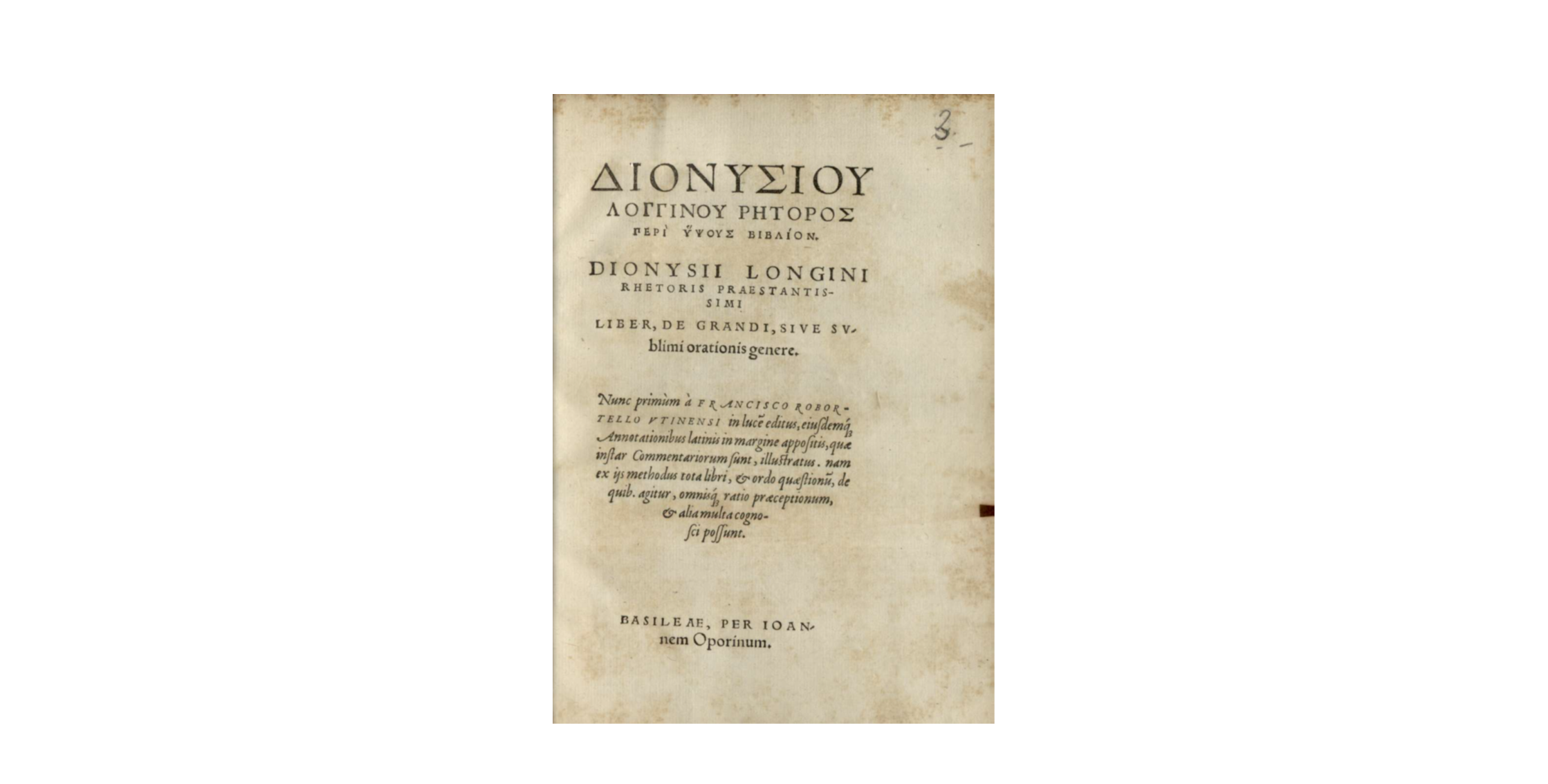
Robortello’s editio princeps of 1554
An essential feature of Longinus’s treatise is that it does not tie sublimity to any particular style, genre or subject-matter. On the contrary, it finds moments of sublime impact, which it associates closely with fierce intensity of thought and emotion, in a wide range of authors and genres (Archilochus as well as Homer, Euripides as well as Aeschylus, Herodotus as well as Thucydides, Xenophon as well as Plato). Nothing demonstrates this more pointedly than the fact that among its most striking exhibits are the creation of the world (in particular, ‘Let there be light …’) in the Hebrew Genesis (quoted in a form which differs from that of the Septuagint) but also one of Sappho’s erotic songs, the famous φαίνεταί μοι lyric, ‘I think that man equal to the gods …’, which Catullus 51 translated into Latin as ‘Ille mi par esse deo videtur …’. Images of awesome divine creativity and of something like an erotic panic attack can, it seems, be equally ‘sublime’.
Quite apart from the unusual, if not actually unique, admiration for a Jewish text on the part of a pagan critic (though some have speculated that the author may himself have been Jewish, as Dionysius’s friend Caecilius certainly was), that pair of examples drives home how Longinus is interested in something very different from a category of style or even a literary-rhetorical register. His notion of the sublime is focused on concentrated passages in which a reader’s or hearer’s consciousness is powerfully enlarged by, but also fused with, the expressive intensity of the text – so much so that he memorably remarks that when exposed to true sublimity ‘the mind is filled with joy and pride as though it had itself created what it has heard’. It is worth adding that there is nothing intrinsically ‘elevating’ or edifying about the work’s central concept. Many examples of hupsos involve elements of destructive violence: it is telling, as well as an ironic play with light and dark, that the extract from Genesis is juxtaposed with Ajax’s anguished cry to Zeus in Iliad 17 from the mist-shrouded battlefield where Patroclus’s corpse is being fought over. Even so, one particularly expansive part of the treatise reflects on the human mind’s capacity to admire the greatness of the cosmos as a whole and even, as it were, to travel in thought beyond the visible boundaries of the world. Such contrasting and disparate elements endowed the work with a potential to influence modern critics in a plurality of ways.
That influence started with the sixteenth-century Italian humanists who produced the first printed editions of On the sublime. For the most part, however, they understood its central concept in terms of a high-flown style for which they were familiar with the Latin vocabulary of sublimitas. It was only gradually, but especially after the publication of a French translation of the treatise in 1674 by the poet and critic Nicolas Boileau, that Longinus became the standard-bearer for what turned into a whole new wave of interest in ‘the sublime’ as a distinctive category of aesthetic experience, now extended from language to such phenomena as stunning landscapes (an extension anticipated at one point in On the sublime itself). Textbook histories of aesthetics highlight the leading roles played in this movement by Edmund Burke (who had certainly read Longinus) in Britain, and Immanuel Kant (who had not) in Germany. Both of them sharply distinguished sublimity from beauty (which Longinus had not done), Burke stressing a connection with imaginative ‘terror’ and Kant dwelling on a sense of forces too vast for the mind to encompass. But what matters more than individual thinkers is that in the course of the 18th century the terminology of sublimity assumed an enhanced position in the lexicon of aesthetics – a position it has never lost, but, equally, one which it has never converted into a stable consensus of understanding.
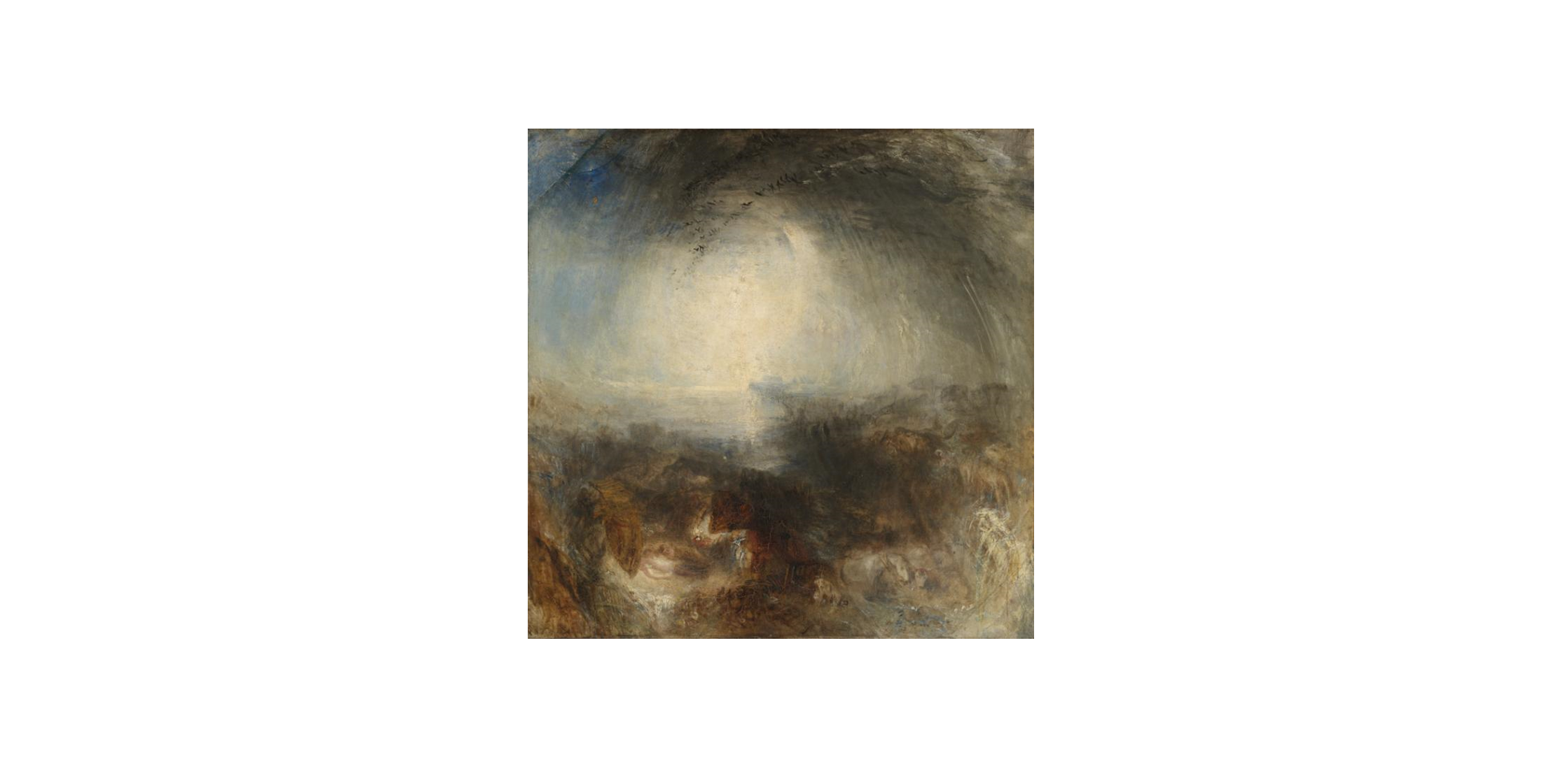
J.M.W. Turner Shade and Darkness (1843)
Here, then, we can discern a subtle thread of connection between the two facts from which I started: the modern usage of ‘sublime’ as a term of effusive but indeterminate approbation, and the persistence of ‘sublimity’ as a key but constantly retheorized term of art in aesthetics for the last three hundred years. Once the criteria of ‘the sublime’ were uncoupled from rhetorical style, for which there were certain rules, and opened up to numerous phenomena only loosely connected by a notion of ineffable power, theories of sublimity proliferated: hence such varieties as the Romantic sublime, the American sublime, the technological sublime, the postmodern sublime ... (what next?). This proliferation in turn allowed the semantics of the adjective to float free in general discourse while retaining just a hint that those who employ it are vaguely aware of its historical cachet.
In the domains both of theory (including much contemporary classical scholarship) and of ordinary usage, what counts as sublime remains an open-ended problem. Is this perhaps an inevitable trajectory for concepts with an extended history of debate and redefinition behind them (think, say, of the diffuse semantics of ‘tragedy’, ‘tragic’, ‘the tragic’) or has sublimity succumbed to a peculiar fate of its own? Longinus himself, after all, already recognizes a version of ‘from the sublime to the ridiculous’: he stresses that literary sublimity treads a thin dividing-line between intensity and bombast, and specifically cites Gorgias for ‘ridiculous’ instances of the latter. Has sublimity itself, as an idea and a vocabulary, become absurdly overstretched and deflated? Or is it still a valuable means of coming to terms with extreme features of both art and nature, features irreducible to strict and stable definition? There are no easy answers – there never are – but reading Longinus’s challenging treatise is still a rewarding way of pondering what is at stake in this area both for Classics and beyond.
Stephen Halliwell is Wardlaw Professor Emeritus of Greek at the University of St Andrews. His edition of pseudo-Longinus, On the Sublime, was published first in Italian in 2021 and by Oxford University Press in 2022.