
Investigation
A few years ago, I visited Athens for the first time, and decided to use this opportunity to answer a question that was frequently discussed amongst my friends in the first two years of our classics degree: can Pausanias’ Hellados Periegesis actually be used as a travel guide? His work is incredibly expansive in scope, containing minute detail not found in any other ancient writer, and he seemingly describes the ancient world in a clear to follow path. I wanted to know whether this path would be possible to follow in the modern world.
I spent a week in Athens, with trips to Olympia and Delphi. Prior to the trip, I read the relevant sections of the Periegesis and found that they would not be entirely practical to follow. Pausanias regularly ‘digresses’ to elaborate on historical context, also mentions elements that I knew would not be extant, such as trees, paintings, and statues. This makes it hard to quickly grasp any navigational instructions. I prepared for my journey by typing up step-by-step instructions based on Pausanias’ description. For ease of use, these instructions assumed that by listing buildings, Pausanias is indicating that they are close to each other, as his use of directional langauge is not always frequent.
My full investigation included Athens (the Kerameikos, the Agora, the Temple of Olympian Zeus, the Akropolis, and Plato’s Academy), Delphi, and Olympia. To keep this article brief, I have only included the Olympia section in full, because I believe that this section highlights the structure and purpose of Pausanias’ work most clearly. However, I have included the maps from the Athenian Akropolis & Agora as well as Delphi, as I feel that they are valuable for understanding Pausanias’ work.
Olympia
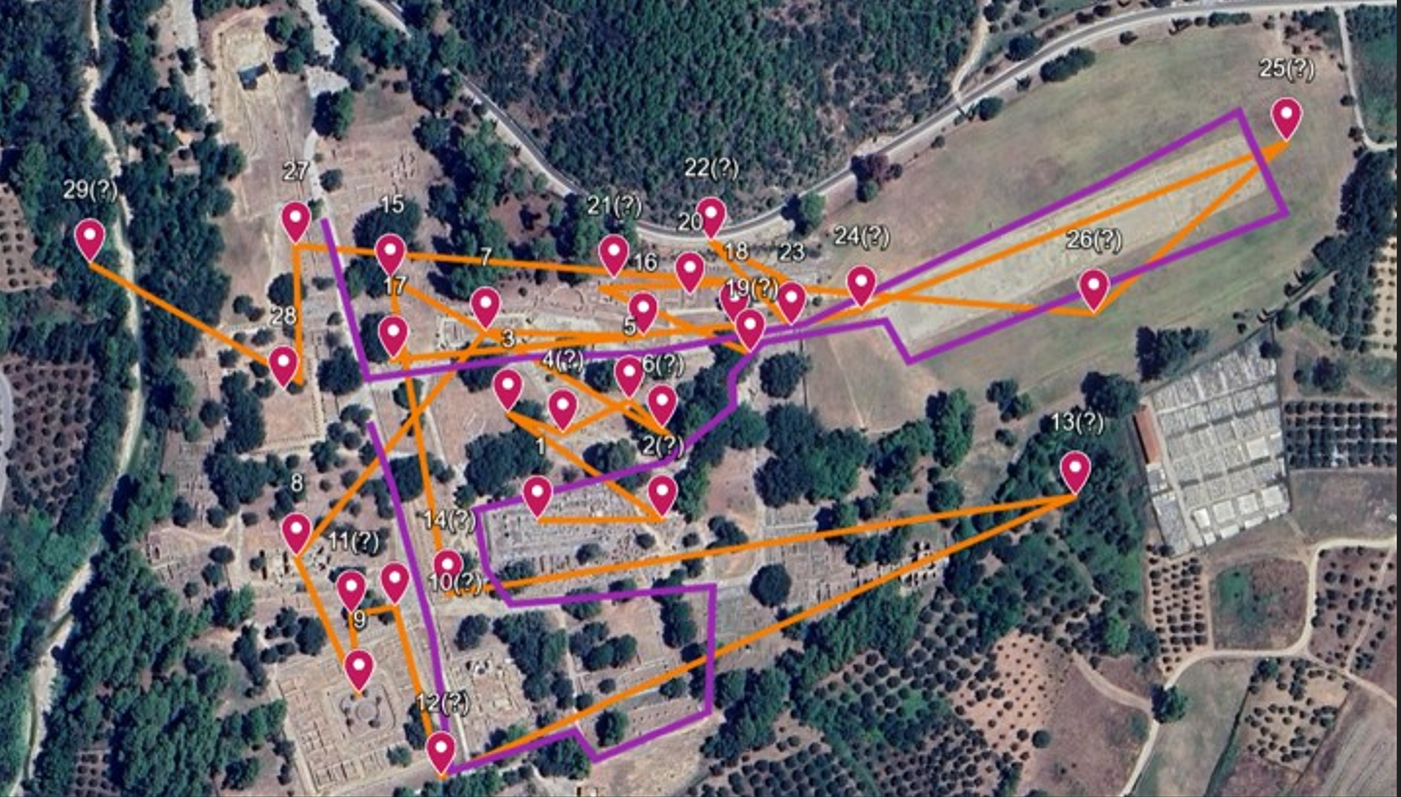
Map of Olympia, with Pausanias’ suggested route in orange and the route I ended up taking in purple. Made with Google Earth.
As is clear from the map, Pausanias’ account of Olympia is very convoluted and illogical. He begins by describing the Temple of Olympian Zeus in the centre of the religious enclosure (the Altis). The temple is somewhat extant, but does not contain the cult statue or any of the offerings that Pausanias saw in his day. Next comes the house of Oenomaus and two altars dedicated to Zeus, none of which survive. To the right of the temple, there is the Pelopion, an enclosure dedicated to Pelops. This is visible in the modern archaeological site, but the altars to Dionysus, the Graces, the Muses, and the Nymphs nearby do not survive. An ash altar to Zeus is positioned near the Pelopion, along with some more altars that are not visible. Next to the altar to Zeus, there is the Temple of Hera. Again, this temple is somewhat extant, but it is further than Pausanias describes.
After highlighting these key sites, Pausanias jumps outside the Altis to mention the workshop of Pheidias, close to the Leonidaeum and the processional entrance. I found that Pheidias’ workshop was actually quite near to the Temple of Olympian Zeus, so this could explain why Pausanias mentioned it here, even if it was outside the enclosure. However, I also observed some Roman buildings in this area, such as a bathhouse. If they were in existence when Pausanias visited Olympia, he did not see them worth mentioning. Many other elements that Pausanias describes in this area, such as some more altars and a sacred olive tree, are not extant.
He then jumps across the enclosure to the chariot race track, where he describes the altars at the starting point. However, he deliberately disregards a house built by Nero right near this area. Returning to the processional entrance, he states that there are many more altars here behind the Temple of Hera. I found a spring altar near the Temple of Hera, but this is not really close to the processional gate, which Pausanias has already established is by the Leonidaeum, and then later says is by the Hippodameium. This is a very confusing direction, but perhaps simply indicates that there are multiple processional entrances.
Having brought up the Temple of Hera again, he decides to describe the contents of the temple here. Many of the statues he mentions are not extant, but amazingly the Praxiteles statue of Hermes and Dionysus he describes has survived in very good condition, and can be seen in the museum. Near this temple, he accurately describes the Metroum to the left of the Temple of Hera and the Philippeum to the right, as well as Mount Cronius on the left of the road by the Metroum. This road is still lined with treasuries for different city-states, as Pausanias describes. In between these treasuries and the Temple of Hera is a theatre built by Herodes Atticus, which Pausanias does not seem to mention. He later says that Herodes Atticus dedicated some statues for the stadium (6.21.2), but does not mention his building here. Near the treasuries, I encountered another recurrent problem. The foot of the mountain was inaccessible to the public when I visited, so I was unable to verify whether the sanctuaries to Eileithyia and Heavenly Aphrodite were behind the treasuries as Pausanias states.
Pausanias then moves on to describing the stadium, with many altars surrounding it that are not extant. Also in this area are some Roman buildings that are not mentioned. Perhaps because he has just described the stadium, Pausanias chooses finally to talk about the Gymnasium next, on the other side of the Altis, which still has visible foundations.
This section is the least usable as a travel guide. Pausanias makes a lot of jumps around the site and returns to different points multiple times. He groups up sites based on purpose and themes more than general location. He also lists the altars in the order in which they are sacrificed at, not the order in which they appear on the site. These factors made it incredibly difficult to use his narrative as a route planner. Some of his directions are very conflicting. When preparing for this section of my research, it felt like I was assembling a puzzle by putting together pieces of information from all over the description to create a cohesive route.
As with other sections, he has neglected to mention a lot of Roman buildings. While it is true that some of these could have been built after his time, a house built by the emperor Nero would have been visible to Pausanias, and yet he chooses not to mention it.
Unfortunately, many of the elements he describes do not survive. Olympia would have been full of votives, small altars, statues, and pilgrims in his day. Although the site is incredible to walk around, Pausanias’ work conjures a vivid world of activity and colour that cannot be experienced by in the modern day.
However, the limited value as a travel guide around Olympia does not take away from the value of Pausanias’ work. His description of Olympia paints a picture of the experience of the enclosure as a pilgrim. It highlights minor altars yet neglects prominent Roman additions, creating the impression of a strongly united, wholly Greek, ancient religious culture.
Athens
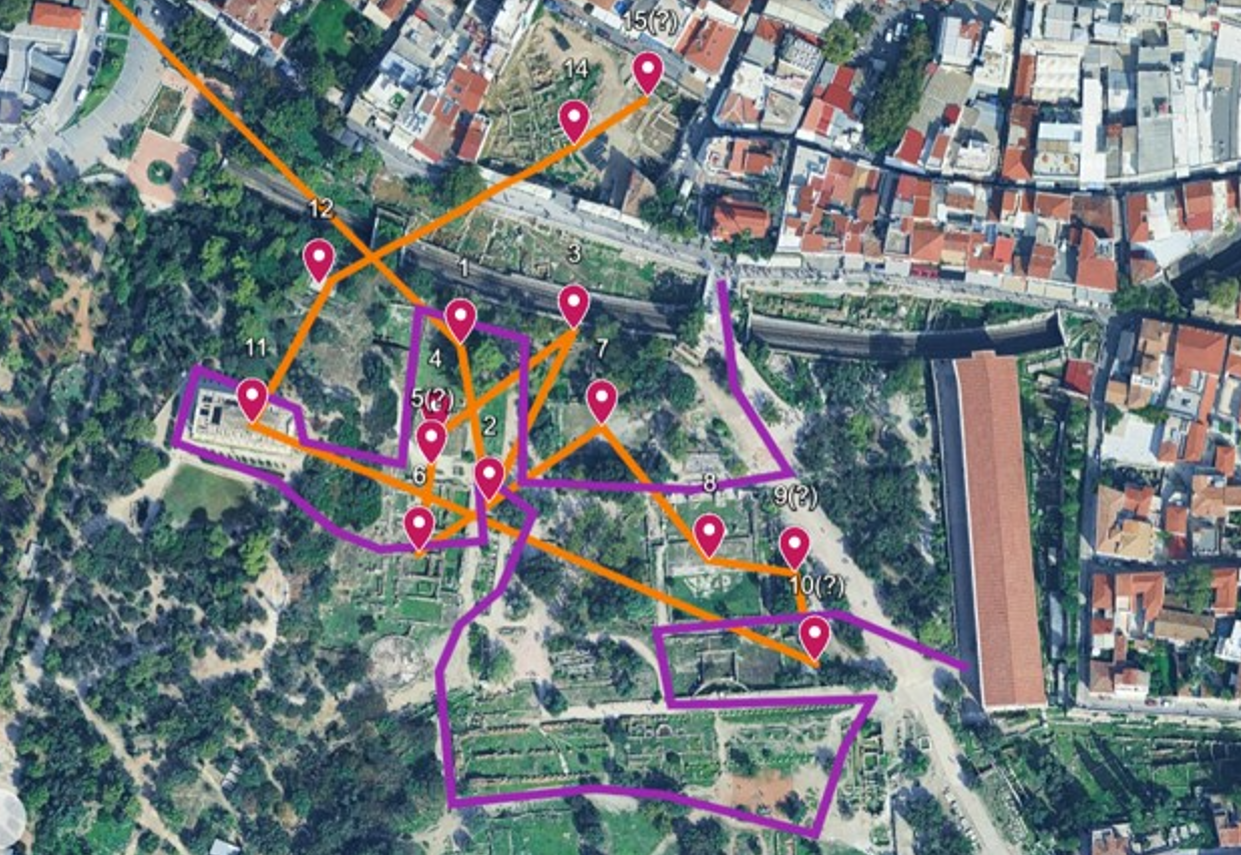
Below is a map (made with Google Earth) of the Athenian Agora, with Pausanias’ suggested route in orange and a more logical route in purple. Like with Olympia, it was somewhat possible for us to follow the route that Pausanias seems to have described, but it was very impractical, so this map displays what I believe to be a more appropriate route.
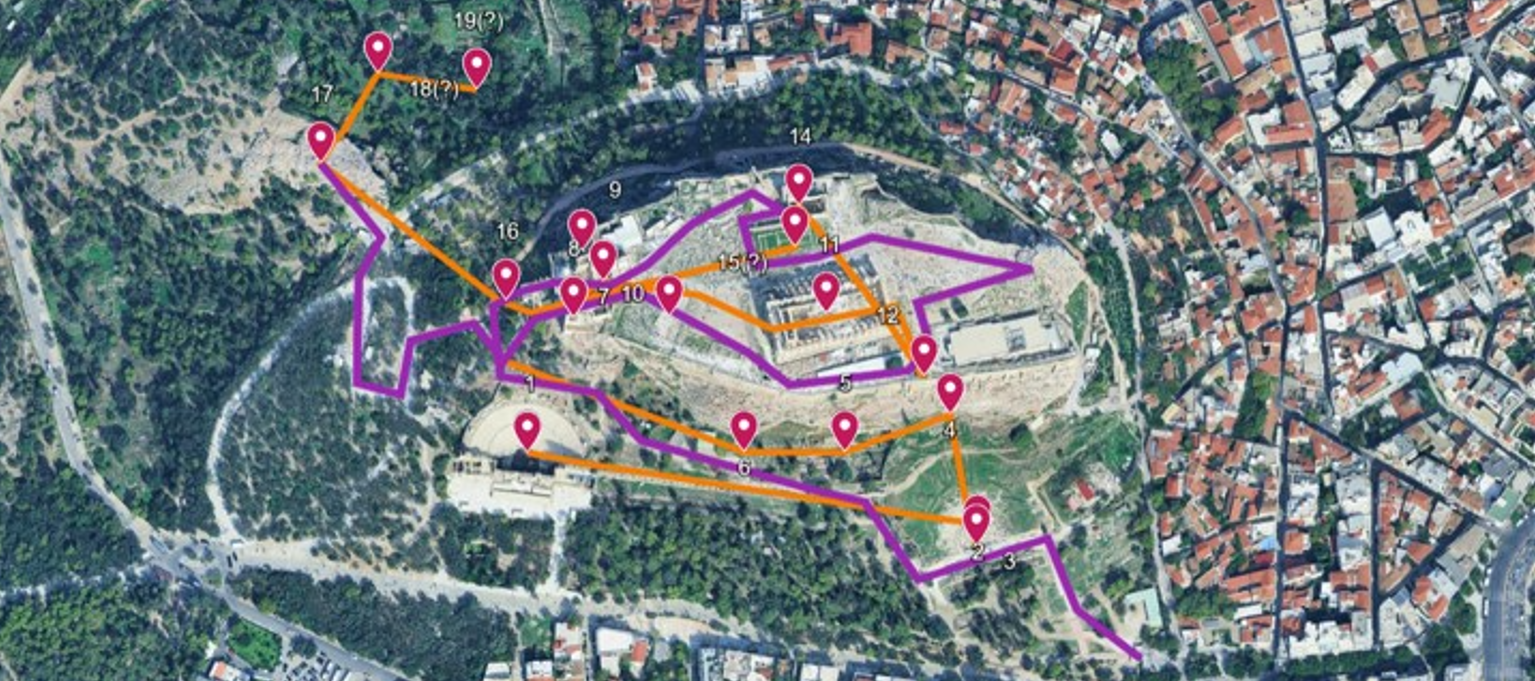
Below is a map of the Akropolis, with Pausanias’ suggested route in orange and the route I ended up taking in purple.
.
Delphi
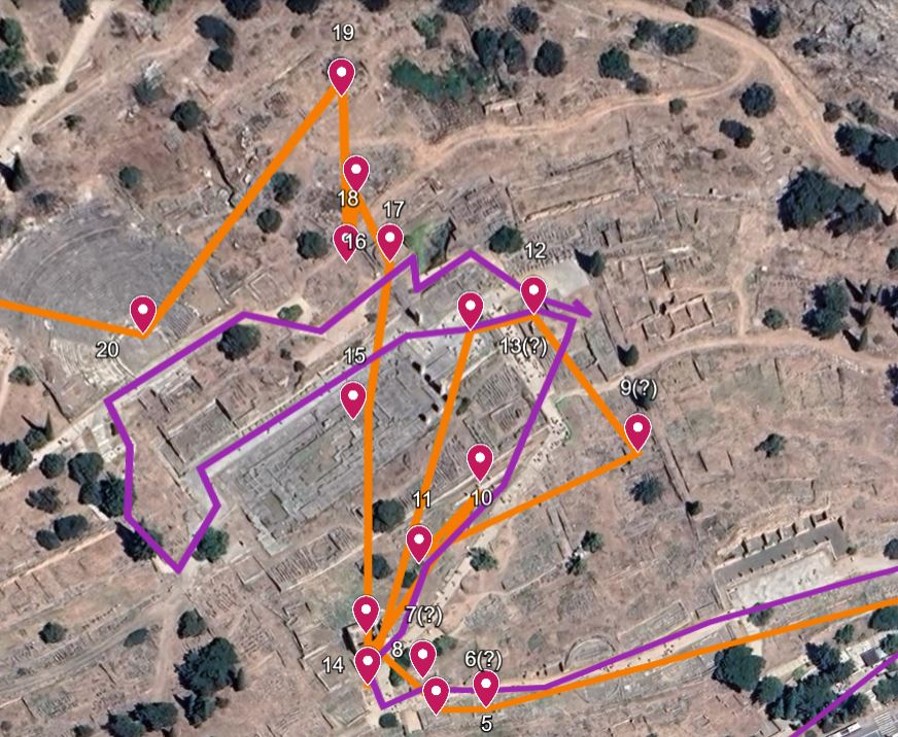
Map of Delphi, with Pausanias’ suggested route in orange and the route I ended up taking in purple. Made with Google Earth.
Historical context: ‘digressions’ or fundamental?
Pausanias’ frequent historical ‘digressions’ could easily be interpreted as him just going off topic, but I do not believe this to be the case. Pausanias clearly felt that they were crucial to his work. The use of regular cross references demonstrates that he planned which information he would deliver in each section. This also suggests that he expected the work to be read in its entirety. He uses various elements of the topography and the architecture as a vehicle to discuss parts of history he finds interesting. This points towards the conclusion that what have historically been called ‘digressions’ are in fact a fundamental element of the work. Both the λόγοι (logoi, words and stories) and θεωρήματα (theoremata, what you can see) were intended to be equally important parts of the work, with the result being both a travel guide and a historical/cultural record.
He was writing with the intention of recording everything about the Greek world, but overlooked secular sites like the prison and houses in the Athenian agora in favour of religious ones. He used these religious landmarks as a way to connect with Greek culture, emphasising that the glory of Greek history was not the distant past, but something alive and thriving in his own time. He also frequently neglects to mention any Roman buildings clearly visible alongside the Greek ones. By focusing on Greece’s rich religious and cultural history, Pausanias was responding to the Roman occupation and the changing fabric of his homeland. The glory of Greece’s past is not just an abstract concept, it is something tangible that can be accessed through interaction with the country’s landscape.
Conclusions
There is definitely value in using Pausanias’ Hellados Periegesis to navigate modern-day Greece. I found that by using it as my travel guide, I was pushed to examine more of the ancient sites around me. I also gained a greater understanding of the context behind a lot of these sites and the way they were connected.
However, I struggled a lot with using this work as a straight-forward ‘travel guide’. The fact that so many of these ancient sites have been preserved and restored allowed me to see many of the landmarks Pausanias mentions, but these sites are all enclosed spaces, meaning there is none of the interconnectivity that Pausanias describes. In addition, it seems clear that Pausanias did not intend for his work to be utilised in this way. He does use directional language, sometimes accurately, but mostly in an incredibly vague manner which is left up to the reader’s interpretation. His historical details complicate this matter further, and a reader can go pages before discerning what building should come next on a route.
In my view, the purpose of Pausanias’ work was to record what he felt was most important to Greek society and culture while under Roman occupation. By completing the journey himself and highlighting the connections between landmarks and the Greek past, Pausanias has created a work that conveys the experience of travelling through Greece as a pilgrim and historian. Through delivering this experience, he was rejecting the Roman occupation and instead presenting an idealised, unified Greek culture that is still accessible in his time. Even with the struggles I faced using his work as a travel guide, I was still able to connect with the history and culture of ancient Greece in a way that I believe Pausanias intended.
Eve Jeffreys is a recent graduate from the University of Edinburgh in Classical Archaeology and Ancient History. They undertook this journey in the summer following their second year as an independent project. Their research interests primarily concern ancient social conventions, such as familial dynamics or constructions of race, and the role of material culture in discerning these conventions. Their undergraduate dissertation, presented at the Classical Association Conference 2026, examined the perception of blackness and black skin in the Roman world.