
A lot of recent scholarship questions – rightly - the tradition of focusing on history’s great men. It’s vital to reflect on the experiences - and the agency - of those whose labour enabled the men of Rome’s elite to focus on politics, war, partying – and literary pursuits. Yet anyone interested in the late republic – in ancient Rome, indeed – struggles to escape Cicero’s clutches. My own book on Cicero, Orator: the life of Cicero and the end of the Roman republic, to be published in 2026 by Hutchinson Heinemann, will explore Cicero’s life in the context of the turbulent times in which he lived but also in the light of recent research on issues such as slavery, gender politics in ancient Rome and the dynamics of Roman imperialism.
Modern biographies of Cicero are many. In recent years, they’ve had to compete with Robert Harris’s compelling, three-volume fictional version of Cicero’s life, as narrated by his slave, later freedman, Tiro. Fiction, indeed, may sometimes be a very fruitful means to get at the experiences of those, such as Tiro, whose own words are now lost. In fact, Tiro actually wrote a biography of Cicero. Sadly, it has not survived – though Plutarch made use of it in writing his own, composed more than a century after Cicero’s death.
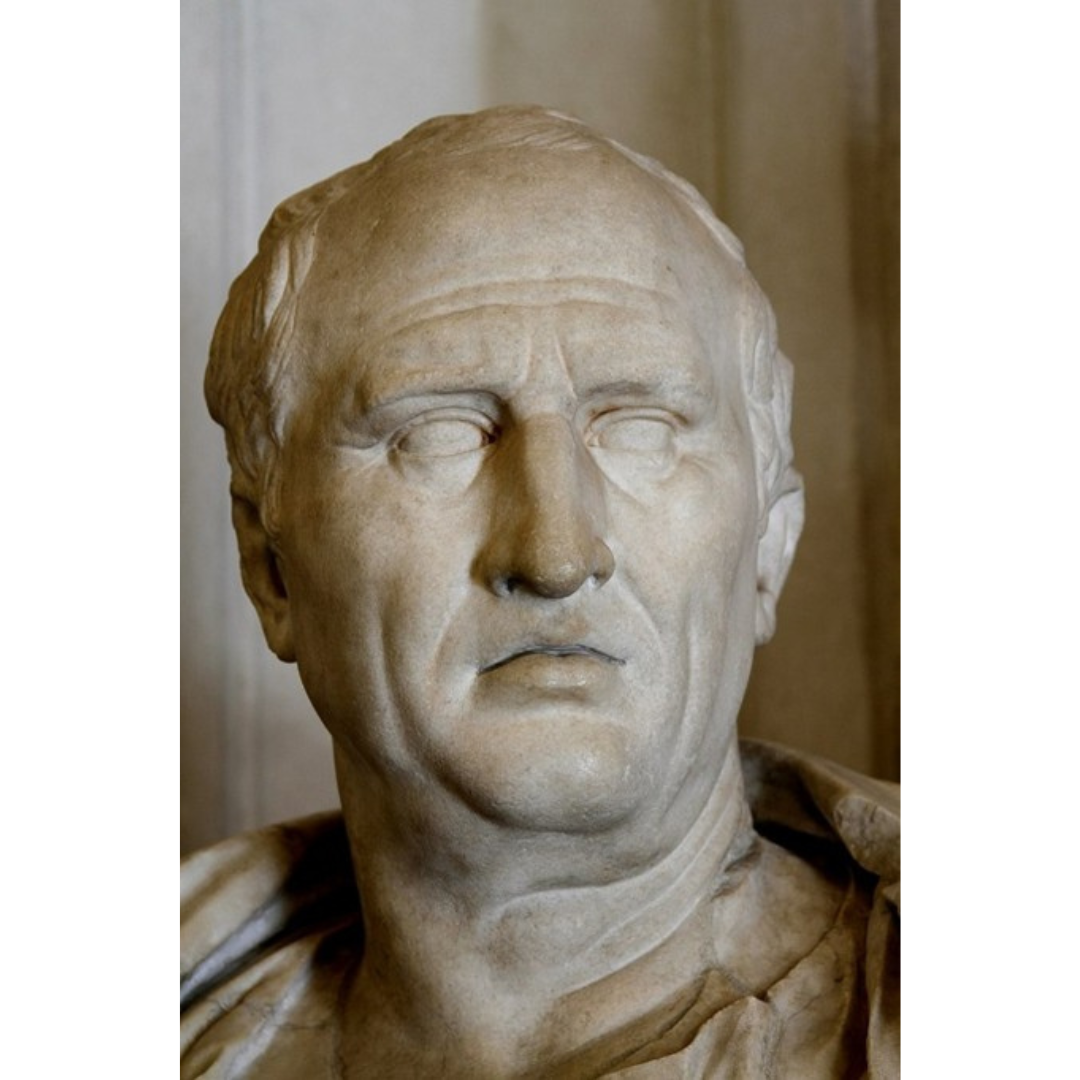
Bust of Cicero (Capitoline Museum: wikipedia)
Cicero himself, of course, supported by a vast army of slaves and freedmen, as well as by his wife Terentia and by his friends, too, wrote prolifically. An astonishing quantity of his writing has survived, including numerous speeches, as well as treatises on philosophy and rhetoric - and letters. As a result, Cicero’s perspective on the world he lived in has had, it’s worth noting, a hugely disproportionate influence on our understanding of Roman society, politics and intellectual life. In fact, I’d suggest, it is to a large extent through Cicero’s works that this particular ancient Mediterranean state has exerted such a profound influence on ways of writing and thinking in later western societies.
But that is all the more reason, I think, why we need to get to grips with Cicero, as a product of his time and as someone who made a huge impact (even if perhaps less huge than he himself represented it) on the period in which he lived. We also need to be aware of just how Cicero’s view of the world has inflected later perspectives on republican Rome. The quantity of Cicero’s writing in which that view of the world is articulated is invaluable - albeit somewhat daunting!
Though he wrote long after Cicero’s time, the Greek biographer Plutarch had access not only to Tiro’s biography but also to a huge range of other materials, now lost. This makes his Life of Cicero an important resource. But in drawing on ancient life-writing, we also need to be cautious. We need to appreciate the profoundly different understanding of human character and development in operation in the ancient biographical tradition. Cornelius Nepos, for instance, in his biography of Cicero’s friend Atticus, declares his intention: ‘as best we can, we will teach readers by the example of deeds that… the character [mores] of each man generally brings about his fortune’ (Atticus 19.1, trs. J.C. Rolfe). How those mores are generated is not an explicit concern in his biographies.
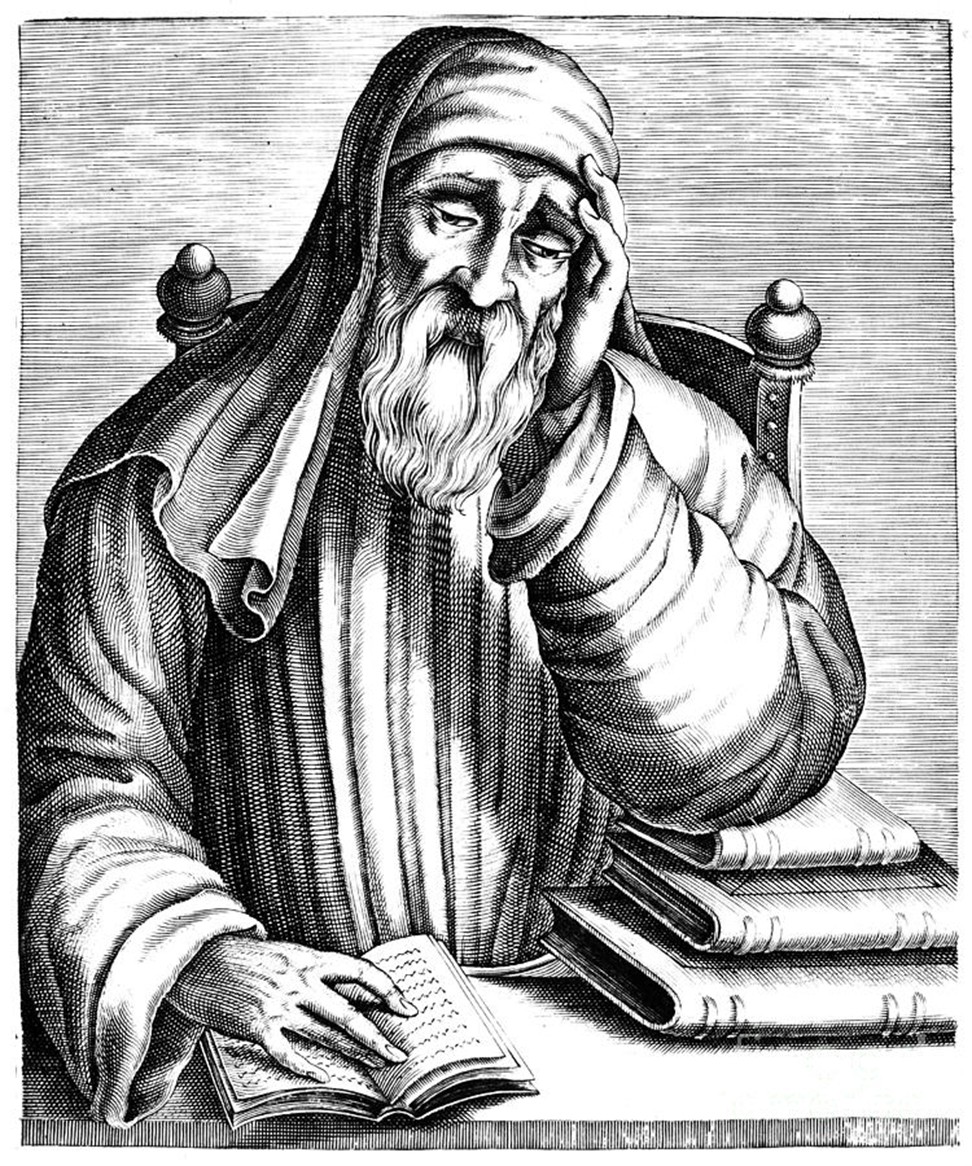
An (unflattering) 18th Century engraving purporting to show Plutarch
Plutarch’s biography of Cicero is significantly informed by his own comparative project - to write parallel lives of Greek and Romans - and by his more general preoccupation with plotting the relationship between Greek philosophical education and his subject’s character. For Plutarch, despite all Cicero’s years of study in Athens and elsewhere, his engagement with Greek philosophy, his paideia, was never profound enough. Cicero, in his experience of exile and at several key points afterwards, failed conspicuously to put into practice the lessons he should have learned from reading all that Plato. Modern readers might hesitate to concur in Plutarch’s judgement. More generally caution is needed, I think, with the ancient biographical traditions around Cicero, coloured as they evidently are by his extraordinary reputation in the early principate. The multiple – and melodramatic - versions of the circumstances of Cicero’s death which circulated in the early first century CE are only the most obvious instance.
Since Lytton Strachey’s Eminent Victorians (1918), modern biographers, concerned with the question of why their subjects turned out the way they did, have tended to focus on childhood traumas or relations with parents as keys to explain character. Such matters are not regarded as significant by ancient biographers. They tend to treat individual character as inborn rather than malleable. Many aspects of what made Cicero who he was must remain beyond our grasp. We know nothing of his relationship with his mother, for instance, or with other care-givers, and can glean only the haziest sense of his formative early years. Our knowledge even of his relations with his wives (Terentia and later Publilia) and children is extremely sketchy. And yet he remains the ancient Roman about whom we know the most. The volume of Cicero’s surviving writings – in particular the huge number of his personal letters – makes him perhaps the only individual from the ancient world before Augustine about whom it is possible to write a biography.
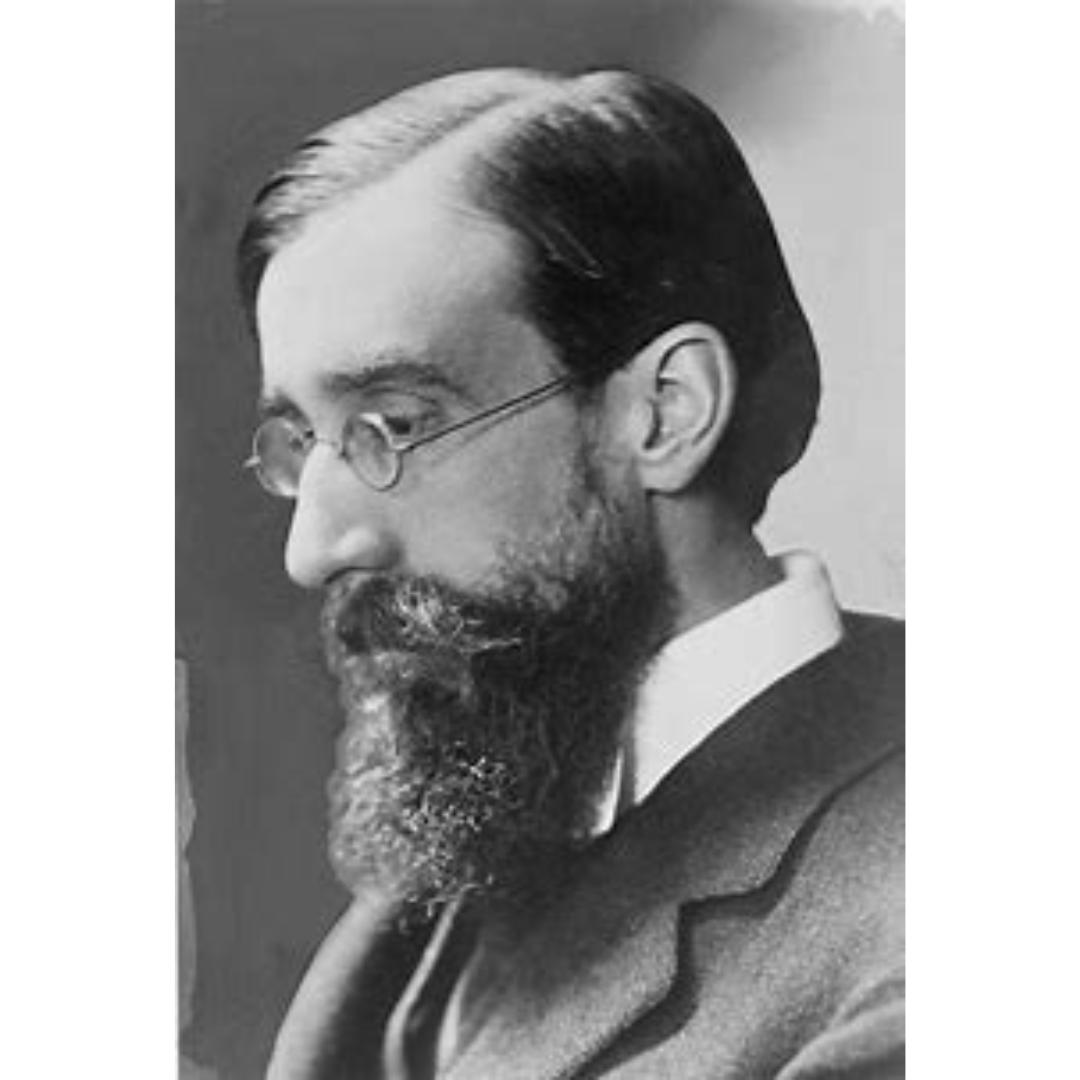
Lytton Strachey (1880-1932)
Personal letters have long been at the centre of modern biography writing. In antiquity, too, letters were thought to be particularly revealing guides to an author’s character. In a treatise on literary style, composed probably in the second century BCE, the Greek writer Demetrius observes: ‘everyone in writing a letter more or less composes an image of his own soul. One can indeed see the writer’s character in any other kind of writing, too, but in none so clearly as in the letter’ (On style 227, trs. D. Russell). The quantity of Cicero’s surviving letters should certainly give those interested in Cicero’s character plenty to go on.
Recent years have seen a hugely welcome flowering of sophisticated studies of Cicero’s self-construction. That the persona projected in Cicero’s speeches is an artefact crafted to serve a particular forensic or political end is perhaps uncontroversial. The corrupt governor of Sicily Verres was notorious for the dodgy means by which he satisfied his passion for masterpieces of Greek sculpture. Cicero, in his prosecution speeches, pretends to be ignorant of the most famous sculptors’ names, thereby drawing a sharp distinction between his own character and that of the accused. With regard to letters, too, we need to bear in mind that their purpose is not just to convey information to, but often to persuade, perhaps to mobilise, the addressee to take action on behalf of the writer. Letters played a crucial role in maintaining friendships between individuals separated for long periods. Cicero was fully conscious of the need to project the right sort of character in his correspondence. He was a master at generating an impression of warm intimacy in his letters – but we should not underestimate the rhetorical artistry that went into this. Indeed, this is part of the reason Cicero was so admired in antiquity as a model letter-writer. The persona of the letter-writer, however ‘real’, however spontaneous it may seem, is always a carefully constructed literary artefact.
There are almost a thousand letters in the collections which bear his name (including some which are addressed to him by other people – revealing in their own way). These represent only a fraction of the letters Cicero wrote over the course of his life. Yet the surviving letters are by no means a random selection. There are a few letters written to his wife and family (several dating from his time in exile), and others written to his trusted ex-slave secretary Tiro. But whoever assembled these collections (Tiro may well have played a key role) wanted readers to encounter Cicero primarily in correspondence with the leading men of his day. Of 97 named addressees in the collection of over 400 letters known as Ad familiares, 74 are senators. In what terms did Cicero write to his (much younger) second wife Publilia, we might wonder? Or to his rather badly behaved son, away studying in Athens? Or to the many individuals of lower social status with whom he had dealings? We should bear in mind that some versions of Cicero have not survived.
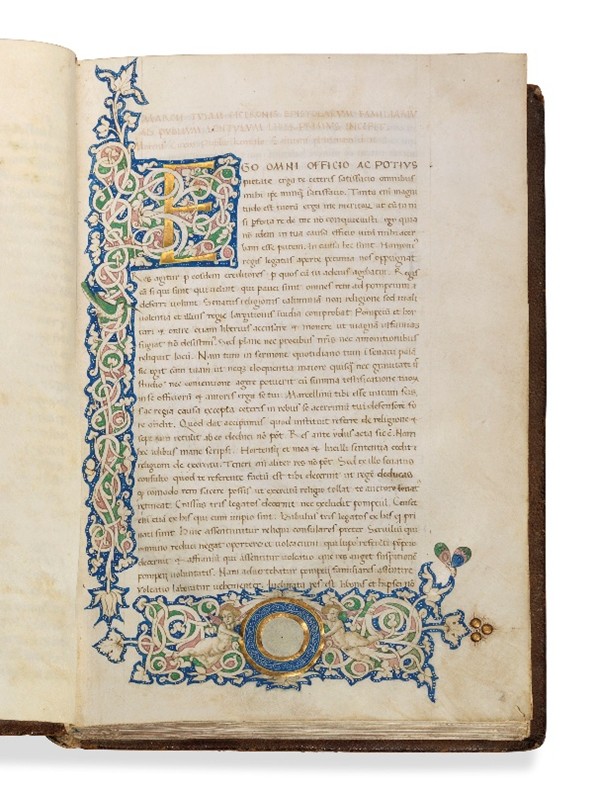
CICERO, Marcus Tullius, Epistolae ad Familiares, in Latin, illuminated manuscript on vellum, written by Ser Pietro di Bernardo Cennini and illuminated by Francesco di Antonio del Chierico [Florence, c. 1460-1470]
Even so, letters to different friends and acquaintances present us with a kaleidoscope of very different Ciceros. A letter is never a mirror of its author as an isolated individual. Cicero himself, we might note, often underlines the importance of crafting a letter to suit not just the particular purpose for which it is written but also the relationship between the letter’s author and the specific person to whom it is addressed. We might observe the strikingly different versions of Cicero conjured forth in one letter to the easy-going Marcus Caelius Rufus (Fam. 2.12) and in another to the prickly scholar Varro (Fam. 9.8). Cicero, writing to the Younger Cato, is ponderously formal and deferential, while the Cicero who appears in the letters to Cassius by contrast is full of witty philosophical jokes. For many readers, however, the ‘real’ Cicero is the man veering between confident optimism and despair, who appears in the letters to Atticus. The letters in this collection are generally regarded as the most unguarded, most revelatory.
Sometimes, certainly, we may trace what seem revealing disjunctions between Cicero’s letters and his other writings. After sixteen long months in exile, Cicero had made it back to Rome in September 57 BCE, crucially with the help of the great general Pompey. Cicero had long been an (at least occasionally) outspoken critic of Julius Caesar. But now Pompey and Caesar (along with Crassus) were in league. In early summer 56 BCE, Cicero, under pressure from Pompey, delivered a speech On the consular provinces, praising Caesar’s achievements and supporting an extension to his already protracted time as commander in Gaul. Around the same time in his letters to Atticus, Cicero expresses his extreme anxiety at the extent of Caesar’s powers and the hypocrisy of his own public comments. By way of excuse, he complains that the conservatives in the Senate who had promised him support when he was faced with exile had failed to follow through: ‘I was thrown to the wolves!’ He thus found himself obliged to back Pompey and Caesar: ‘good night to principle, sincerity, and honour!’ (Att. 4.5.1, trs. D.R. Shackleton Bailey). Is this Cicero unmasked? What Cicero really thought? We also need to bear in mind, I think, Cicero’s anticipation of Atticus’ response – and the likelihood that such ‘confessions’ to Atticus might well be transmitted to others, reassuring them of Cicero ‘true’ feelings about Caesar and Pompey.
A couple of years earlier, when he was in exile, Cicero had taken out some of his frustration on his old friend. In mitigation, he excused himself. Such frankness was a sign of the affinity between the two men: ‘You must forgive me here. I am reproaching myself far more than you, and if I do reproach you, it is as my alter ego’ (Att. 3.15.4, trs. D.R. Shackleton Bailey). But even if exchanges with Atticus could be figured as a conversation with another self, Cicero - like the rest of us – might still be prone to self-deception
All the same, there remains something very seductive about the letters. From his youth the Italian humanist Petrarch was a keen reader of Cicero’s speeches and felt huge admiration for his commitment to republican government. Petrarch devoted himself to tracking down overlooked works of Cicero in the monastic libraries of fourteenth-century Italy. In 1345 he was thrilled to discover a manuscript of Cicero’s letters to Atticus in the cathedral chapter library in Verona. So intense were his feelings on reading them that he was moved to write his own letters to his long-dead hero: ‘Hitherto I knew what true counsel thou gavest to others; now, at last, I have learned to what degree thou didst prove mentor to thyself’ (Fam. 24.3, trs. M.E. Cosenza). But as he had immersed himself in the letters, he had come to feel increasing disappointment. Why had Cicero attacked Mark Antony in defence of the Republic – and then sucked up to young Octavian, whose ambitions were every bit as tyrannical? Petrarch found Cicero’s political actions contradictory. And yet for all Cicero’s flaws, Petrarch was entranced by these letters. No wonder. Cicero, through these in the moment – and of the moment – writings, offers extraordinary glimpses both of cataclysmic political change and of how it was experienced by those in the eye of the storm. As a witness to his own time, a period of phenomenal conflict, creativity, ambition and despair, Cicero is surely without parallel.
Every age finds its own version of Cicero, its own version of the Roman republic. At a time when contemporary political structures feel increasingly under pressure, when questions about the place of persuasion and appeals to the popular will in politics are especially pressing, Cicero’s life and times – and his extraordinarily varied writings – have perhaps never seemed more relevant.
A Fellow of the British Academy, Catharine Edwards teaches Classics and Ancient History at Birkbeck, University of London. She has written widely on Roman cultural history and on Roman stoic philosophy. Her books include The politics of immorality in ancient Rome (second edition 2025) and Death in ancient Rome (2007). Her translation of Suetonius Lives of the Caesars appeared in the Oxford World’s Classics series. She has often taken part in the BBC Radio 4 series, ‘In our time,’ and presented a BBC Four series ‘Mothers, murderers and mistresses: empresses of ancient Rome’. Her book on Cicero, Orator: the life of Cicero and the end of the Roman republic will be published by Hutchinson Heinemann in 2026.