
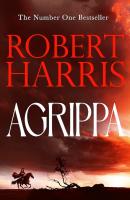
Hutchinson Heinemann (2026) h/b 384pp £12.00 (ISBN 9781529154412)
Born into a plebeian family in the mid-first century BC, Marcus Vipsanius Agrippa became one of the most powerful men in the Roman Empire largely thanks to his relationship with Julius Caesar’s heir, Octavius (later Augustus). Indeed, so indispensable was he as both a military commander and political surrogate that, without Agrippa, the sickly Octavius may never have succeeded in becoming emperor or maintaining his early grip on power. Yet, as H. points out in his ‘Post Mortem’ endnote, throughout the self-aggrandising Res Gestae Divi Augusti (‘Achievements of the Divine Augustus’), Agrippa’s name ‘occurs in passing only twice’. This begs many questions about the true relationship between these two men, the wily fox, Octavius, and the bluff bear, Agrippa, which H. sets out to explore.
He couches his novel as an autobiography written by the 50-year-old grandee on his deathbed in his villa on the Bay of Naples. At its heart are Agrippa’s musings on the nature of power, about how it warps personalities and friendships, about how it ‘makes monsters of us all’. It is a phenomenon which H., once political editor of The Observer, has seen at first hand, and one of the stand-out qualities of the book is his vivid characterisation of key players such as the patronising, self-satisfied, back-stabbing Cicero or the oleaginous Maecenas, who exercises power in the shadows and who, were he alive today, might find himself briefly (if rashly) appointed British Ambassador to the United States.
But most complex of all is the figure whose metamorphosis dominates the narrative, transitioning from timid Octavius to determined Caesar, to increasingly authoritarian Augustus (his three names introduce each section of the narrative). Cruel, vindictive, determined to exact his vengeance on any who dares challenge him, he is shown to be (in the words of a lieutenant) ‘a finest scrap of a man hiding behind an enormous name’.
What of Agrippa himself? Considering his character, H. tells us in his ‘Post Mortem’ that he imagines there is a clue contained in the inscription above the door to Rome’s Pantheon: ‘M•AGRIPPA•L•F•COS•TERTIVM•FECIT’, ‘Marcus Agrippa, son of Lucius, in his third consulship, did it’. ‘Terse, plain, no-nonsense language’ is how H. rightly describes it, and both for better and for worse its tone pervades the book—for better because it lends tremendous authenticity to the words of the pragmatic, practical narrator; for worse because on the whole it prevents H. from including the kind of dramatic set-piece descriptions which pepper many of his other books.
So, some readers who have thrilled to his description of Dreyfus’ humiliation in An Officer and a Spy or Charles I’s execution in An Act of Oblivion or blitz-torn London in V2 may feel that the sprawling narrative spanning fifty years of fighting, politics and construction works, with little dialogue, reads more like Agrippa’s own Res Gestae than the ‘slices from the great banquets’ of history that H. more often sets before us. But even they will surely find this study of the seemingly unstoppable descent from republic to dictatorship both timely and chilling, for it is H.’s genius to make today’s world chime with history and long-dead characters seem modern.
Engaging, fast-paced and historically sound (though, pace H., Agrippa’s Pantheon had no dome), this novel is a splendid introduction to the history, politics and personalities of Rome’s late republic and early empire. It can be highly recommended to anyone from pupils to students to interested others wishing to immerse themselves in the period. Agrippa’s voice will stay with them long after they have finished reading it, as will many of the sententiae scattered throughout it: ‘One’s name shapes one’s character. One’s character determines one’s destiny’; ‘All power depends on force. All force depends on money’; ‘Memories breed memories. They multiply like vermin’; and – most disquietingly – ‘War always breeds more war.’
Over the twist in the tail, we shall draw a veil, since only after reading to the end will its full impact be felt. Whether it is factual or not, we must decide for ourselves, but it certainly packs a punch.
David Stuttard