
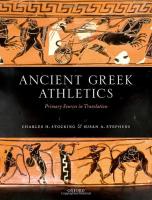
OUP (2021) p/b 464pp p/b £25.99 (ISBN 9780198839606)
When Herodotus claims that ‘common habits of practice’ helped to define ‘Greekness’, he is probably thinking (among other things) of athletics. From funeral games in the Iliad and Odyssey to local Olympic-style Games under the Roman Empire, equestrian and so-called ‘naked contests’ (running, wrestling etc.) permeated Greek life. Today we have evidence of their importance in archaeological remains, inscriptions, papyrus fragments, and diverse works of literature, all of which S. and S. mine for this well-organized sourcebook. Written records form the bulk of their material, with extracts from literature (all by Greek authors—no Latin writers here) predominating.
These are arranged chronologically in four sections (Archaic and Early Classical; Classical; Hellenistic; Roman), which not only enables the user to trace organizational, social, and attitudinal developments, but allows the editors usefully to point out when a later source draws on an earlier one. All (even notoriously complex poets such as Pindar) appear in clear, easy-to-grasp translations with key words (such as aretē, aethlon, and paidotribēs) transliterated, bracketed beside their English equivalents, and listed in a useful ‘Glossary of Greek Terms’. A brief introduction sets each author in context, while valuable notes gloss less familiar references within the text. The same is true of the much briefer epigraphic section (again arranged chronologically but under geographical headings, and ranging from epigrams to lists of payments for contractors prior to the Pythian Games) and the small selection of ten papyri. Three final appendices (‘The Athlete in Greek Culture’, ‘Sites and Conduct of Games’, ‘The Events’) draw together and give an overview of much of the source material.
There can be no doubt that this volume will prove extremely valuable for anyone wishing to study (or, more likely, teach) Ancient Greek athletics. Not only does it include a treasure trove of primary evidence for the overall organization of Greek games, the nature of individual events, and many of the athletes who participated in them, but thanks to its inclusion of a wide diversity of authors and variety of material, it explores the many different ways in which sport was central to Greek life across more than a millennium—from the enthusiasm of its champions such as Pindar and Bacchylides to philosophers such as Aristotle, who considered it important to a child’s development, to Galen discussing its relationship to health, and Pausanias exploring the venues for the four major Greek Games to Philostratus offering advice to athletes, and poets recorded in the Greek Anthology mocking boxers for their battered faces or runners for their slowness.
There are some caveats, however—inaccuracies such as the statement that Cimon the Elder was ‘one of the generals who led the Athenian army against the Persians before the battle of Marathon’ or that ‘democracies united with Athens’ (tell that to the Syracusans of 415 BC!) or that Sparta was ‘ruled’ by two kings; infelicities such as the claim that Xenophon’s Symposium is ‘at some level … a parody of Plato’s’; and the tiny site maps—and it is oddly discombobulating to read in the context of the ancient world about Greek cities being on the ‘Turkish’ coastline.
These grumbles aside, however, this is a hugely valuable book. With 26 full colour illustrations, an historical time-frame (which could have been more compendious), a list of Pindaric victory odes, tables showing when ‘important Greek athletic contests were established’ and the circuit of the four crown games, as well as a good bibliography, an index of names and a general index, it more than earns its place in libraries of schools and universities.
David Stuttard