
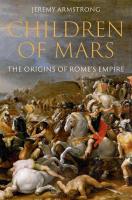
OUP (2025) h/b 288pp £17.99 (ISBN 9780197584972)
How did Rome emerge as the dominant city of Italy? What drove its expansion from perhaps fifty ruling families and just three tribes to mastery of the whole peninsula and then into the colossus that ruled the whole of the Mediterranean from east to west? And were later historians of the empire right to attribute to its earliest years a scale of purpose and a degree of cohesion that don’t readily match the available sources?
These are the questions that Professor Armstrong tackles in this new study of Rome’s first five centuries, from the 8th to the 3rd BC. He rightly weighs archaeological evidence, much of it new, against the analyses of those historians (Livy, Dio, Polybius, Plutarch). The result is a more nuanced, and fairly convincing, picture of Rome scaling up its networks, expanding its clan structures, and slowly developing a loosely federated grip on the peninsula. Progress wasn’t uniform or systematic, or even strategic; these were not cohesive military operations.
There were, of course, plenty of wars along the way as Etruscans, Latins, Sabines and other Umbrians across central Italy were successively engaged and defeated. The Roman clans, however, seem to have raided them as much for their wealth as their submission. If there was a strategy, it was at first one of extraction rather than integration. Later Rome saw the benefit of alliances that could supply additional troops to its citizen armies.
The sack of Rome by the Gauls (390 BC) incentivised a more centralised approach: city walls were built, taxes levied, armies organised, and the original tribes expanded. Roman citizenship was offered to whole communities, not just to individuals, creating further military obligations and strengthening local bonds. A. suggests a parallel here with the clans of medieval Scotland.
Towards the end of the 4th century A. picks out two key, more systematic developments. The construction of the Via Appia in 312, running 130 miles south into Campania, was Rome’s first great military road and one of its biggest-ever infrastructure projects. Its further extension in 268 and 241 marked the consolidation of Roman power across the southern peninsula.
Second was the introduction of the first specifically Roman coinage in 310, again primarily for military purposes: troops could now be paid centrally, and a few years later a navy could be built and manned. The concept of Romanitas began to thread a network of loosely bound communities into a more formal confederation. I would have liked more on this, especially on the relationship between the tribes and the emerging central treasury function.
This short book is written in a very informal, almost chatty style, and hasn’t been well-edited (‘Aeneas may have simply fit the bill’). Nor do I recall Gibbon or Mommsen concluding that ‘this feels like the start of something special’ or that Rome ‘was developing into something a bit more.’ But it’s all certainly a useful corrective to those self-serving ‘origin histories’ of the empire’s later chroniclers.
Michael Fallon
Sir Michael led the Parliamentary campaign (2007) to save Ancient History ‘A’ level.