
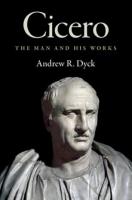
CUP (2025) h/b 1099pp £120 (ISBN 9781107085640)
This book by Andrew Dyck, who has already published extensively on Cicero, has been conceived and executed on a truly formidable scale: the reader is faced with 1100 pages, 19 chapters, 30 Appendices, over 100 pages of ‘References’ i.e. bibliography, six Indexes and eight pages of Abbreviations. Such a work calls for, say, a ‘Review-Article’ in JRS rather than the necessarily attenuated Notice which will follow here. However, a reader who is initially put off can make his—or her—reading slightly less daunting by starting with the conclusion in chapter 19 ‘An Intellectual between Tradition and Power’. This is not a ‘revisionary’ work, but its fulness and attention to detail are exceptional,
While the main narrative, of course, covers Cicero’s career, D. devotes space to his education, much of it in Greece (and Rhodes, where he was taught by the Stoic Poseidonius); here was engendered his lifelong interest in philosophy and especially Plato (see p. 409, note 237), before turning to Cicero as he appeared and became increasingly influential both in the courts and in politics: Cicero was never allowed to forget that he was a novus homo, an eques, rather than a patrician, and, as such, he constantly had to struggle to maintain his position against the ‘spite and envy of the born nobiles’. (Here it needs to be added that Cicero never was able to present himself as a great military commander, unlike [obviously] Caesar or Pompey—a severe disadvantage for one seeking to make his way in politics in that age). Cicero did serve briefly in 89 BC under L. Cornelius Sulla and G. Pompeius Strabo, but only reluctantly did he accept the governorship of Cilicia in 51 BC; and as a Pompeian at Pharsalus in 48 BC he confessed much later to having been gripped by fear (as were others around him).
Cicero’s forensic and political careers took off in the 70s BC: quaestor, with membership of the Senate (76 BC), set him on the path to the consulship, but it was his prosecution of Verres on multiple charges of extortion during his successful propraetorship of Sicily from 73 to 71 BC that decisively launched his forensic career. There were obstacles to overcome (including Hortensius for the defence and the dangers encountered during two months of gathering evidence in Sicily), but his case won the day—even if, as D. suggests, the enforced retirement of Verres still left him in comfortable circumstances. Here it is relevant to record that of the book’s 30 Appendices, 15 are devoted to accounts of trials in which Cicero played a part—usually the major one: other cases are discussed in the main body of the text, e.g. Pro Fonteio, pp. 131-4. D. does not conceal—though Cicero may have wanted to do so—instances where Cicero’s case is weak or unconvincingly argued, even if victory is secured: the pages on the Manilian Law, designed—successfully—to give Pompey command of the war against Mithradates, give examples; the ten pages on the Pro Cluentio which follow demonstrate Cicero’s technical mastery of forensic skills in a case where the guilt of his client was at least a possibility.
To return to Cicero’s political career: he was elected aedile in 69 BC and praetor in 66 BC (coming top of the poll), soon to be followed by the speech on the Manilian Law, partly, at least, designed to earn credit with Pompey (interestingly, Pompey’s lack of interest in viewing famous cities and artworks is contrasted—by implication favourably—with the philhellene bent of his rival Lucullus who had been ‘plagued by morale’ problems in 68-67 BC in Armenia and shown himself less than dynamic elsewhere). Now came the major step: standing for consul in 64 BC as a novus homo, against two patricians, C. Antonius and L. Sergius Catilina (henceforward Catiline). D. takes us with laudable clarity through the campaign, won, of course by Cicero, with Catiline coming third. In office, Cicero declared that he had taken over a state that was on edge, partly caused by a crisis of liquidity: there was much disquiet over agrarian reform (D. gives accounts of Cicero’s speeches against Rullus’ bill on that subject, in which he takes a ‘recognizably optimate course’).
In Chapter 6 (‘Crisis Management: September-December 63’), D. gives his account of the Catilinarian Conspiracy. The chapter is accompanied by especially numerous (228) and detailed footnotes—an indication of the many matters concerning which questions can still be raised. D. summarises Cicero’s four Catilinarian Orations which demonstrated the guilt of the conspirators and effectively sealed their fates, despite Caesar’s preference for a version of exile. One senses that throughout those turbulent days, for Cicero salus reipublicae suprema lex est, although by his action he ignored the Lex Sempronia, which forbad the execution of a Roman citizen without allowing appeal to the people—and, as will appear, there would in due course be dire consequences for Cicero himself. As D. observes in the conclusion to this chapter, the consulship was the pinnacle of Cicero’s career, as was perhaps foreseen by Cicero himself. Nor did he, then or later, understate in his writings (prose or verse) the extent and importance of his achievements. Catiline himself was killed with his ‘army’ in 62 BC.
In the aftermath of the ‘Annus Mirabilis’ in chapter 7, D. reports that the ‘book length’ and boastful letter which Cicero sent to Pompey detailing his achievements as consul did not go down well. Pompey—perhaps not a great reader—offered no praise, and there was not, and never could be, a close friendship between the two men. As it was, Cicero returned to the lawcourts and accepted the defence of P. Cornelius Sulla—probably the nephew of the dictator L. Sulla—on the charge of involvement in the conspiracy: the details are complex, and Cicero’s case was far from compelling: in it he again took the opportunity to ‘trumpet the achievements of his consulate’. One consequence was that he was enabled to buy a house on the Palatine from M. Crassus for 3.5 million sesterces, partly financed by a generous loan from P. Sulla—a public relations disaster, and one which would have grievous consequences. Nor would his successful defence of the right to Roman citizenship of the Greek poet P. Archias result in a (hoped for) commendatory poem.
Now comes the ‘Bona Dea’ Case, in which Clodius dressed as a woman attempted to intrude on the all-women ritual, but was found out and escaped (avoiding immediate prosecution). However, the Senate raised the stakes and treated Clodius’ action as a crime against the public order. Clodius now created a distraction by attacking Cicero’s execution of the imprisoned Catilinarians (Cicero counterattacked) and was narrowly acquitted. Thus were created the seeds of a feud which resulted in the tribuneship of Clodius, after his giving up of his patrician status, Cicero’s exile in 58 BC and the destruction of his property on the Palatine (and damage elsewhere) and ultimately in the death of Clodius in 52 BC.
The familiar events of this period are chronicled soberly by D., including Cicero’s composition in Latin of the poem De Consulatu Meo in 3 books, of which (mercifully) only fragments survive. D. describes the work as a failed experiment which under the empire became less and less cited; he argues also that now we are at the point where Cicero’s tendency to turn to literary production in order to assert his views, and distance himself from current Roman politics, becomes visible: as perhaps it had done earlier, when Caesar implausibly invited Cicero to join the First Triumvirate in 60 BC. Cicero declined (his political stance as a Republican was fundamentally opposed to Caesar’s ambitions). The pair enjoyed a relationship which was never a close friendship, though Caesar sometimes showed himself surprisingly forgiving when their paths crossed, e.g. in the matter of Cicero’s speech Pro Rege Deiotaro, or at Pharsalus, with Cicero taking Pompey’s side; a more agreeable incident was when, as D. tells us, Caesar invited himself to dinner with Cicero at Formiae—turning up with a complement of 1,000 soldiers: at dinner literary matters were discussed. In 51 BC, Caesar had sent Cicero to govern Cilicia (perhaps partly to enable Cicero to improve his financial situation?)—but the outgoing governor was a brother of Clodius, and made handing over as difficult as possible, e.g. by locating himself in the most remote province of the country. They did eventually meet and diplomatic courtesies were observed.
D. sums up Cicero’s position after his return from exile: ‘He had to choose to play either a subservient role or no role at all’. With great learning, D. chronicles the closing period of Cicero’s life, in which Rome was moving towards civil war and the end of the Republic in which Cicero always believed (he welcomed the assassination of Caesar); frequently grief-stricken (afflictus in a letter to Atticus), mourning the death of his daughter Tullia, he continued to play a part in the courts, even defending Milo who had played a major role in the violent death of Clodius in 52 BC. As civil war looms, D.’s pages on Cicero’s activities at this fraught period are well described (pp. 497-512 are essential reading; Cicero did not choose the winning side). His final major forensic activity lay in his stream of Philippics directed against Mark Antony. As for Octavian, now linked with Antony in the coming proscriptions, one recalls Cicero’s bon mot: adulescentem laudandum, ornandum, tollendum. Did Octavian too recall those words when he and Antony pronounced a sentence of death on Cicero?
Asking questions is not D.’s forte, and inevitably much of the book’s content is devoted to what actually happened, (von Ranke’s wie es eigentlich gewesen), what allegiances were formed—and dissolved. D. has told us that Cicero declined Caesar’s invitation to join the First Triumvirate: just so, but is there not more to be said? Why did Caesar issue the invitation? At the outset of this huge book, D. says that Rome at that time had two geniuses—Caesar and Cicero (Mommsen would have disagreed): Cicero’s rather tense relationship with Caesar could be—perhaps already is—the subject of a separate study. D. also usefully discusses in detail some of Cicero’s major published ‘philosophical’ works, including De Oratore, Orator, Brutus, De Officiis, De Republica (which has reached us sadly incomplete), De Finibus and Tusculan Disputations: however, the reviewer ventures to suggest that most readers will pay less attention to this part of the book than to Cicero’s active part in Rome’s history at a time of exceptional interest and constitutional upheaval. Perhaps it is D.’s seriousness which deters him from quoting Cicero’s description of Clodia, cited by Quintilian: quadrantariam Clytemnestram, Clodia, a lady of light morals, having allegedly poisoned her husband, Metellus Celer. And Cicero showed himself capable of very mild literary humour when he wrote to Atticus: flavit ab Epiro lenissimus Onchesmites; hunc σπονδειάζοντα si cui voles τῶν νεωτέρων pro tuo vendito. Clearly there was a coterie of ‘neoteric’ poets at Rome.
This is a truly impressive work of scholarship: to be sure, even at its now reduced price of £120, its readership will of necessity be limited: but it will be an essential resource for Roman historians who specialise in late Republican affairs. Your reviewer, as an undergraduate, would have jumped at it. Dyck deserves our warmest congratulations on a work ‘de très longue haleine’ successfully brought to a conclusion; and the quality of CUP’s work is outstanding.
Colin Leach