
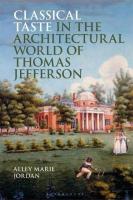
Bloomsbury (2025) h/b 210pp £59.50 (ISBN 9781350428508)
Thomas Jefferson is best known as the primary author of the American Declaration of Independence and one of the Founding Fathers of the United States, who served as President from 1801 to 1809. Slightly less well known is that Jefferson was a keen classical scholar. Familiarity with the ancient authors was one of the guiding forces of his life. This book is a study of how Graeco-Roman architecture and architectural theory influenced the buildings that Jefferson created.
Andrea Palladio (1508-1580) was an Italian architect who designed churches, palaces and villas. He was the author of Four Books of Architecture. Palladio drew heavily on De Architectura, which had been written by Vitruvius during the reign of Augustus. The writings of Vitruvius and Palladio were highly influential in eighteenth century Europe. Jefferson closely studied both works and put them to good use. He designed his family home, Monticello, at Charlottesville, Virginia. This was a Palladian villa standing on a levelled hilltop. It had a dome in the centre, inspired by the Pantheon in Rome, and Doric columns around the front portico. In later life he designed his retirement home, Poplar Forest. This was in octagonal form. Again, it included Doric columns. In the central room there was a frieze, copied from that within the Baths of Diocletian in Rome.
After completing two terms as President of the United States, Jefferson turned to the biggest project of his life, the creation of the University of Virginia. He chose a suitable location. Construction work started in 1817. Jefferson was closely involved in the design, as well as supervising the construction project. He believed that classical architecture surrounding the students would both educate them and inspire them morally. The university was laid out in the form of a village, with twelve pavilions each echoing the Graeco-Roman world. There were Doric, Ionic and Corinthian styles, often as developed by Palladio.
This book is more than just an account of classical architecture in the American context. It is also a review of Jefferson’s study and use of the classics. For this purpose, the author has cited many of Jefferson’s letters and unpublished papers. As noted on page 25, these were not available to certain earlier Jeffersonian scholars. Jefferson seems to have been an admirer of all the classical authors. But, as demonstrated in chapter 2, he was particularly keen on Horace and made a close study of Epicureanism. He espoused that philosophy in his way of life at Monticello and Poplar Forest. The ‘Garden School’ of Epicurus was one of Jefferson’s models for the layout of the University of Virginia.
Judged by the standards of his age and his contemporaries, Jefferson was a man of altruism and high morals. Judged by the standards of today, he most certainly was not. As the author points out on pages 88-94, Jefferson was a racist with shocking views about the inferiority of African people. He owned about 200 slaves. The luxury in which he and his family lived at Monticello and Poplar Forest was only made possible by slave labour. Apparently, the slaves at Monticello lived in cramped dwellings along a road named ‘Mulberry Row’, so-called because it was lined with mulberry trees.
This is a fascinating book, which this reviewer found difficult to put down. It is part of Bloomsbury’s series about classical reception. It will be of interest both to classicists and to students of American history. Luckily, the book is not terribly long, the print is fairly large and there are some fine illustrations. Although not designed to ‘catch the Christmas market’, it would make quite a good Christmas present for relatives or friends of a classical disposition.
Rupert Jackson