
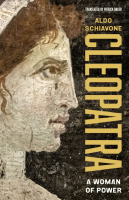
Princeton (2026) h/b 232pp £22.00 (ISBN 9780691270630)
In his foreword to the English edition S. promises a 'radical reconsideration [of Cleopatra] in a book that can be read all in one sitting' because 'this is what writing history is for me: combining powerful interpretation with the joy of storytelling in the most innovative way possible.' The book, however, contains little that is radical, and many English-speaking readers, especially those seeking objectivity, may find its style off-putting.
S. presents his biography in six chapters, each introduced with a brief setting as if for a screenplay. From the eve of Actium, we backtrack to Alexandria for Cleopatra’s encounter with Caesar, Rome for Caesar’s assassination, Tarsus for her first tryst with Antony, Antioch for their preparations for his Parthian campaign, back to Actium for the sea battle and so to Alexandria for the final showdown. As readers might expect, there is much to be said about not just the Roman constitution and first century BC politics but Cleopatra’s relationships with Caesar and Antony. As readers might also expect, Cleopatra comes across as attractive, educated and astute, well aware of the fragility of Egypt and her own position in the face of the rising power of Rome.
I say 'as readers might expect' because, in truth, there is little new to find in S.’s treatment. In fact, the only really radical material comes in the last chapter, where S. shows an obsessive determination to defend Cleopatra by trying to prove that she did not from the start intend to flee the fighting at Actium ('the black legend of the backstabbing queen'—but, if that was not her intention, why did she take ocean-going sails on board along with her treasure chests?) and that afterwards, when Antony was plunged in self-pity on the island of Pharos, she did not try to do a deal with Octavian (this is, he writes. 'pure post hoc slander'). Instead, he insists on Cleopatra’s loyalty to Antony, with whom S. is convinced she was in love (though facts suggest it is more likely that she was manipulating him), filling out his gauzy argument by quoting Plutarch’s version of her speech over Antony’s corpse, in one sentence 'almost certainly invented', in another 'hardly the words of a traitor' (but you can’t have it both ways). As for Cleopatra’s message to Antony with false news of her own death, 'it can be explained: it was not a trick but rather an announcement of what she intended to do.' (Really, m’lud?)
Elsewhere, S. makes bold assumptions, and although some of his suggestions about Cleopatra’s influence over Antony’s eastern policy may seem persuasive, they go too far and are not well served by a pervasive tendency not only to present conjecture as fact but to do so in breathlessly flowery prose. A few examples will serve to illustrate the whole.
On Caesar and Cleopatra’s relationship: 'In reality, neither of them was acting as merely a private individual. They were nothing of the kind, nor did they want to be, nor could they have been, not even in the slightest. And not because they lacked feelings, passions, or an interior life, which on the contrary they both nurtured. No, the fact was that the hummings of the heart were always subordinated, in both of them, to the logic of ambition and power—or rather, to the projection of the self into the space and time of the immortal, which was their common calling and destiny.'
About Cleopatra’s love of power: 'This was Cleopatra’s true intoxication: to exhibit a power over things and people so total that it could only express its outsize force by destroying the object over which it was exercised; an unopposed will to command that manifested itself fully only by negating what was under its control.'
On Antony and Cleopatra’s final days: 'They had caught sight of a grand yet hazy path opening up in the history of their time, but they were unable to follow it to its conclusion in thought and deed, unable to maintain the height of the ambitions they harbored. They sailed off into the storm, turning their errors into their armor and their sustenance, transforming their tragic finale into a spectacle of personal and private triumph, insolent and transgressive, that reduced life—their lives—to an uninterrupted performance of their excesses.'
If you like this kind of thing, S.’s book with its gorgeous cover, endnotes, index and bibliographical essay is for you. If you prefer your history to be less purple and conjectural, other books on Cleopatra are readily available.
David Stuttard