
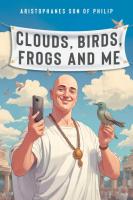
Vanguard Press (2025) h/b 340pp £13 (9781837942114)
This book purports to be the autobiography of Aristophanes, son of Philip, the famous Athenian author of Attic comedies (floruit c. 410 BC). Like most celebrity autobiographers, he employs the assistance of a ghost writer but only on the back cover do we find ‘as told to Peter Acton,’. This is perhaps only a logical extension of recent biographical experiments. In 2018 David Stuttard published a biography of Alcibiades which imagined many vivid incidents and suggested conversations, but these were all presented in the third person, not the first.
This format permits the introduction of a wide range of incidents, in each of which Aristophanes claims that he was a participant. He attended both the Assembly debates on Mytilene and was balloted to row in the second trireme which had to catch up with the first. He was picked out for his singing skills to supply the timing for the oarsmen. He also heard Pericles deliver his famous funeral oration and records it in substantially the same words as Thucydides. He served as a hoplite in an engagement near Delium against the Boeotians. He was too old to go on the Syracuse expedition, but his sons were conscripted for it. He cast his ostracon in the session which saw Hyperbolus exiled.
For most of his life he tried to identify a trade which would make the family money while still remaining respectable. He failed in this and his three sons followed him in writing comedies, but mainly for the rural festivals in Attica. Socially he was fairly mobile, attending a number of symposia including the famous one, after which he was asked by Plato for help in putting together an account of the discussion. Plato also sought his help in drafting a speech for Socrates’ defence during his treason trial. Aristophanes stayed with Thucydides at his house on Salamis and discussed his philosophy of history.
His sexual profile was very similar to that of Samuel Pepys. Like Pepys he had a edgy, though successful, relationship with his wife of whom he was slightly scared; like Pepys he lusted after his female servants and was generally up for any activity with courtesans or mistresses; but, unlike Pepys, he was also prepared to act a mentor to Plato when he was an ephebe. Overall, he comes across as a bit of a wimp.
Add to all of this activity extensive commentaries on his playwriting—their plots and construction, the metres that he used and his production values—and you get a fast moving, wide-ranging and entertaining narrative. The reader has to proceed on the presumption that the incidents as described are at least plausible in a historical context—although it is discouraging to read in the recent CfA review of an edition of the Knights that the editors regard the life of Aristophanes as ‘sparsely…and also imperfectly, documented’. The likelihood is that this book has a lower plausibility quotient than ‘The Crown’ by Netflix.
Despite that conclusion, this is an engaging account of a slice of life in classical Athens and a constructive introduction to the performance of comedies at the Athenian festivals which will both benefit the general reader and may also occasionally stimulate a thought in the academic reader. The ghost writer possibly conceals the depth of his scholarship. It remains a moot point however whether this book constitutes either history or biograph—but at under £15 why should CfA readers not find out for themselves?
Roger Barnes