
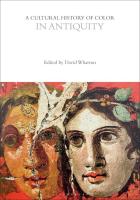
Bloomsbury Academic (2024) p/b 272pp £25.99 (ISBN 9781350459793)
Influenced by black-figure paintings on terracotta vases and pure white or cream marble statues and pillars, some still imagine Antiquity to have been a world of monochrome. Yet Pompeiian frescoes are alive with pigmentation, recent scientific advances have let us retrieve traces of paint from architectural fragments, and Greek and Latin literature brims with words for colour. That said, however, as William Gladstone recognized as early as 1858, the Greeks and Romans seem not to have viewed colour in quite the same way as we do. Homer’s ‘wine-dark’ sea is a case in point: what precisely does the epithet mean? Does it suggest a deep red hue? Or that the Greeks were colour blind? Or (as one scholar has suggested) is it evidence for Homer’s total sightlessness?
This collection of ten essays seeks to address the question of what colour meant to those living in the ancient world. Part of a series of six volumes tracing the history of colour from roughly 3000 BC to the present day, whose ten chapter headings are identical, it covers a wide range of issues including philosophy and science (where Katerina Ierodiakonou traces the sometimes outlandish ideas of thinkers from Parmenides and Empedocles down to Epicurus regarding what causes colour and how we perceive it), technology and trade (Hilary Becker’s interesting discussion of how pigments and dyes were made, used and sold), body and clothing (Lloyd Llewellyn-Jones making a characteristically convincing case for specifically coloured clothing carrying its own meaning—in Greece, for example, red signified transition associated with death, marriage or coming of age) and artifacts (providing a useful overview of everyday objects, Ellen Swift includes fascinating details, such as that some Roman tableware was colour coded to show its intended use, or that some Romans deliberately dyed newly made objects to make them look like ancient heirlooms).
While Greeks and Romans did not perceive colour differently from us, they were at all times conscious of aspects other than superficial hue, including luminosity, saturation and the wider associations of certain tones—something which is brilliantly discussed by Verity Platt in her chapter ‘Religion and Ritual’, where she analyses both the Homeric Hymn to Demeter and Catullus’ Poem 68, showing how colour vocabulary acts as conscious or unconscious metaphor to enhance the reader’s (or listener’s) experience. And, while many contributors make much of the colour purple (prized not just because it was so hard to come by and therefore expensive, but because it kept its intensity for longer than other dyes), Kelly Olson and David Wharton show how it emerged as the symbol of power in Rome, a society where (more than in Greece) colour played a vital role in defining hierarchy.
There is, then, much of interest in this relatively slim volume (the present review can mention only some highlights), and with its copious notes, comprehensive bibliography and index it is enthusiastically recommended for all students of antiquity. The book also contains 32 illustrations, which (somewhat bizarrely) appear both in greyscale within the body of the text and in colour in a set of dedicated plates.
Not that this ‘Cultural History’ would claim to have all the answers. There are still many known unknowns. Nothing is black and white. The ‘polychromy debate’ of the nineteenth century may be over, but many questions remain. As Lloyd Llewellyn-Jones remarks: ‘The pure blue of the cloudless sky, the natural color of wood, the yellow of saffron, the green of the Paphian myrtle, the darker green of the oak [etc.] … these are the colors of antiquity. So, while we can dispel the myth of classical whiteness and look to restore to … the Greeks and Romans all the colors they enjoyed, we need to concede that we are defeated by the imperfect way in which we understand ancient color theory and the process of … even seeing color.’
David Stuttard