
Bloomsbury (2021) h/b 260pp £75 (ISBN 9781350042728)
These ten scholarly, detailed, densely written and fully-referenced essays, concentrating on Athenian democracy but with some reference to Roman republicanism, can here each receive only an outline review.
In the introduction the two editors attempt to find evidence of democratic or proto-democratic government in the rest of the known world prior to the Greek democratic revolution in the 5th century BC. It would have helped to have had a definition of proto-democracy or even democracy, since the early existence of ‘corporate social organization’ and ‘complex hierarchies of officials’ within a monarchy bear no relation to Athenian democracy, even ‘in a general way’ as the blurb rather desperately suggests. The authors’ motive is to counteract ‘narratives of Western European exceptionalism’. But since democracy is now sacred, when mostly it was despised, and whole world is now ‘democratic’, it would be interesting to know the authors’ view of how that change came about. Was Western Europe to blame?
Chapter 1 (‘Sovereignty’ by Andrew Monson and Carol Atack) offers a discussion of the extent to which the concept of sovereignty could be applied to any element of the democratic system: did it exist in the demos? The law? In individuals of sound and long-lasting influence such as Theseus, much welcomed by the people? Greek philosophers and dramatists discussed this in great detail without coming to any fixed conclusions, except that some popular involvement had something to be said for it. Rome meanwhile could call itself a res publica even when it was ruled by an all-powerful emperor.
Valentina Arena (‘Liberty and the Rule of Law’) suggests that the Greek sense of liberty, embodied in cults such as those of Zeus Eleutherios, found its roots in Hittite and Jewish fear of debt-bondage which led to loss of political autonomy. Thus liberty was to some extent seen as the absence of slavery i.e. of forced dependence on the will of others, especially tyrants, and strongly associated with the right of all men to equality and freedom, or at least frankness, of speech. Romans too thought of liberty in terms of non-domination, but freedom of speech was thought of as a virtue, qualified by social norms and therefore needing control.
For Dhananjay Jagannathan, ‘The Common Good’, a concept which is nowadays almost the default position of democratic ideologies, was there from the very beginning of the democratic tradition in Athens, because democracy made power accessible to everyone, while the rule of law, as the just exercise of power, was applied equally to everyone. That laid the groundwork for Pericles’ funeral speech, the ultimate statement of the matter: the common good was a matter of co-operative endeavour with self-interest set aside. J. goes on to show in persuasive detail how Plato, Aristotle and Cicero, even though they did not favour democratic government, were in agreement about the importance of the idea of the common good as the basis of sound governance.
In ‘Economic and Social Democracy’, Emily Mackil discusses how the Athenians provided security and prosperity and attempted to mitigate economic inequality among citizens (i.e. not women, metics or slaves). It makes for a very impressive list, from state aid (e.g. pay for jury service) to private leitourgiai. The purpose was to protect vulnerable individuals and redistribute wealth in the interests of, and to promote the equality of, all citizens, as well as to engage them in and maintain the democracy. One imagines an Assembly in which the poor greatly outnumbered the rich played a considerable part in this process.
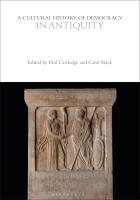
Georgia Petridou (‘Religion and the Principles of Political Obligation’) points out that the cover picture of this book depicts Athena and Hera, the tutelary deities of Athens and of Samos, in full ritual fig, shaking hands over a political agreement between two city states. She goes on to argue, with many examples, that at every level of society, from education, health and the law, and from the individual, the household and professional associations to the city state as a whole, this was the norm: religion was thoroughly embedded and of high significance (she cites the panic over the profanation of the mysteries). The Demos, the Boule and Demokratia itself were all personified as deities and duly worshipped.
In ‘Citizenship and Gender’ Carol Atack argues that both men and women were judged on the extent to which they lived up to the gendered roles which society seemed to expect of them. For males this required ‘manliness’ in both political and military spheres; for a woman, it involved engagement in the cultural and religious life of the city, and also in a degree of social and economic activity, while her status as an Athenian citizen was essential for the production of citizen children. But in tragedy, as Atack makes clear, many women come across as powerful figures, deeply engaged in political issues, while Aspasia provides an alternative model: a metic but Pericles’ long-term mistress.
In ‘Ethnicity, Race and Nationalism’, Denise Eileen McCoskey begins with the black leader Malcolm X’s attack on American democratic government for its ‘oppression and exploitation and degradation of black people in this country’, generated by the ideologies and operating principles at work in contemporary culture. Since the ancient slave trade was not centred on Africa but in Thrace, the lower Danube, the coasts of the Black Sea and Asia Minor, she argues that neither somatic difference nor colour were the markers of Greek racism but rather geography and environment (tough Europeans vs. flabby Asians) and then, in association with the defeat of Persia during the Persian Wars, political structures (democratic, egalitarian Greeks vs tyrannical and hierarchical barbaroi [= non-Greeks]). Romans, meanwhile, were far more inclusive than Greeks and thought of differences between races more in terms of differing ‘values and qualities’. Autochthony—the belief that Athenians were racially pure, having always lived in Attica—was another racist feature, not one that Romans, who believed their origins lay in Troy, took on board. She emphasizes that slavery was far more deeply ingrained in Athenian society than appears to be the case at first reading: slaves are always there in the background.
Paul Cartledge (‘Democratic Crises, Revolutions and Civil Resistance’) suggests that the fault lines within the composition of the citizen body give the clue to civil conflict. He identifies two in particular: rich vs poor and democrat vs oligarch, in the latter case sometimes with intervention from external powers. But revolution as such was rare: the only example was Cleisthenes’ democratic revolution in 508 BC, which did indeed introduce wholly new way of doing things (neoterismos ‘innovation’ was one word for ‘revolution’, neotera pragmata ‘newer [or ‘too new’] matters’ another). But tyranny was never far away in the Greek world. The Athenians experienced it in 404 BC. Apart from a brief democratic interlude, Dionysius I established a permanent tyranny in Syracuse, the Persians always favoured it, while Philip II in Macedon encouraged it wherever he could as he set his eyes on the mastery of all Greece. Throughout this period Greek thinkers like Plato and Aristotle and tragedians on the public stage debated the nature of political dissent. But from then on the term demokratia gradually came to mean a sort of republican constitution, free of external or internal autocracy. Cartledge ends by contrasting Roman republicanism, which for all its democratic elements and aspirations of liberty, never ultimately escaped the grip of the wealthy elites.
Cartledge and Atack take on ‘International Relations’, arguing that formalised rituals involving shared deities, customs, foundation stories, heroes, symbols and historical interactions could all be used to forge alliances of one sort and another. Treaties and leagues expressing mutual support, often confirmed by past relationships, were common. Copies of the agreements were displayed in Panhellenic places like Olympia, Delos and Delphi: such neutral sites, displaying cities’ wealth and influence, were also ideal locations for establishing defensive alliances. Such alliances could be reinforced by invitations to attend great festivals such as the Panathenaea or Great Dionysia. At the same time influential individual citizens and monarchs, accompanied by exchanges of honours and celebratory statues, could forge new alliances.
Finally (‘Beyond the classical Polis: Expanding Citizenship and Connecting Communities’), Benjamin Gray examines the afterlife of democracy in the Hellenistic world. G. points out that, exclusive as Athenian democracy was and as effective too in generating internal solidarity and mutual trust, it did not prevent non-citizens (e.g. women and metics) engaging fully in other aspects of public, if not political, life. Non-Athenian philosophers like Diogenes began to argue about the principle of cosmopolitanism—the truly wise and virtuous person was home everywhere in the cosmos, irrespective of birth (as long as he was wise and virtuous enough, of course)—and Hellenistic stoics took up the theme, while Christians thought of their ecclesia on the model of the city-state, open to all as long as they were followers of the faith. All this sort of thinking had an effect on the development of different styles of quasi-democratic communities as far away as Bactria.
Many cities founded by kings were supported by Greek-style rules, regulations and councils; cities granted polis status boasted of their Greek institutions. Long-established poleis experimented with welcoming and naturalizing incomers, sometimes even permitting multiple citizenships. Even more dramatic was the merger of poleis into a super-polis with a single citizenship; Hellenistic kings were obviously quite keen on this idea. Further, it became common even for non-Greek cities to become integrated with Greek ones in a sumpoliteia. The establishment of leagues of poleis on a federal model was a natural development. Meanwhile the Romans, as oligarchs, could afford to be much more relaxed about citizenship and distributed it widely in varying grades, a major factor in the growth of their empire.
The one oddity about this volume is that it does not contain any account of the actual workings of Athenian democracy. It is, in other words, designed for classicists. In those terms it is very successful. This reviewer was particularly taken by the contributions of Jagannathan, McCoskey and Gray.
Peter Jones