
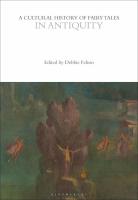
Bloomsbury Academic 2021 (h/b) 239 pp £52.50 (ISBN 9781350093799)
‘Once upon a time, there was a girl called Rose-Red (Rhodopis). One day, while she was bathing, an eagle swooped down and snatched one of her slippers. Soaring away, it flew over the head of the king and dropped he slipper in his lap. Deeply impressed by both the artistry of the slipper and the astonishing event, he sent his messengers out across the land to discover the slipper’s owner. When she was found, the king married her.’
Debbie Felton opens her introduction with this little tale from Strabo, and convincingly argues that, in spite of the fact that Rhodopis is a courtesan, the setting is ancient Egypt and the slipper is really a sandal, and that many details later added to the story are missing, we can all recognise Cinderella. The search for the shoe, leading to the social rising of the heroine, are still key elements of the story and were there more than two thousand years ago.
A Cultural History of Fairy Tales in Antiquity is volume 1 of a series taking the story from 500 BC-AD 2000. There are eight chapters, all by different authors, dealing with 1) the marvellous: prodigies and wonders in antiquity, 2) transmission, translation and diffusion of the stories, 3) gender and sexuality, 4) animals and their interaction with humans, 5) monsters and the monstrous, 6) space and place, distances and boundaries, 6) fairy tales as moral messages, and 8) power, uses and abuses of authority. There are several illustrations and substantial notes and bibliography.
Most of the examples come from Greece and Rome, naturally, because they provide by far the most literary sources, but many can be traced back to Mesopotamia. South Asia is also covered (Buddhist literature, the Rig Veda, the Ramayana), plus China and Japan. A question arises what counts as a fairy tale. Mostly the ancient examples are short and snappy little stories with a moral, like Aesop’s Fables: collections of such stories are few and late, and most often we find them individually embedded in larger works of literature. The earliest of these is the fable of the Nightingale and the Hawk, from Hesiod’s Works and Days: a nightingale, captured by a hawk, complains bitterly about it, but the hawk simply replies that it is foolish for the weak to contend with those who are stronger. The most complete fairy tale of all is the tale of Cupid and Psyche from Apuleius’ Metamorphoses, which is referenced throughout the book. This story, presented as being told by an old woman to a girl in distress, both comforts her and conveys a moral message about the importance of marriage and trust between spouses, and contains a number of elements repeated in later centuries: the envious goddess (or stepmother) and sisters, the heroine who can’t resist her curiosity, being set impossible tasks which she completes with the help of benevolent animals or insects, finally regaining her happy marriage and eventually being raised to the stars.
Scholars disagree whether most of the examples quoted are properly called ‘fairy tales’—a point discussed at length in the introduction—but at least (it is argued) they are ‘analogues’ for fairy tales, as we still know and love them. Typically told to children by their nurses, they are meant to amuse and entertain and at the same time instruct in moral and social behaviour: kindness, courage and endurance in following instructions brings rewards, cruel and antisocial behaviour eventually destroys.
One of the main impressions left by this book is of the sheer durability of many basic fairy tale themes. The cultural details change between different times and countries, but the central messages on the whole do not. We may not always agree with these messages (see the arguments in the chapter on ‘sex and gender’ that stories from Southern Asia almost always privilege men over women and pander to male fear of the female) but we can recognise them in our own literature. That is the central take from all the detail in this enjoyable book.
Colin McDonald