
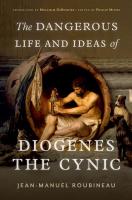
OUP (2023) h/b 143pp £14.99 (ISBN 9780197666397)
In the middle of the 4th C BC a man called Diogenes began to exhibit increasingly bizarre behaviour in the city of Athens, to which he had travelled from his home city of Sinope, a Greek city on the southern shore of the Black Sea.
Apparently, he eschewed what one might call the comforts and conventions of social life. Rather than living under a roof he lived in an earthenware jar; he sought no gainful employment, no family commitments, no comforting funeral rituals. He exercised his bodily functions on the street, scavenged for his food and barked obscenities at those who approached him. Not surprisingly, he attracted the nickname ‘the cynic’, from the Greek word for dog (kuôn). Nor is it surprising that over the years he collected a considerable number of anecdotes about him. None of his own writings survive. While there were those who regarded him as a self-advertising eccentric, there were others who saw him as living out a coherent philosophy that somehow bridged the gap between the Socratic tradition and the development of Stoicism: the key concept being that of self-sufficiency.
What can confidently be know of his life and teaching is carefully considered in the book under review, originally written in French by Jean-Manuel Roubineau with the title Diogenes l’Antisocial and here translated into fluent English, though with American-English spelling.
R. carefully sifts through what can be established about D.’s life to general agreement, from his birth in Sinope, where his father held a position responsible for the minting of the coinage and was forced into exile, with D., who may or may not have been implicated, also forced to leave his home city, ending up in Athens.
There are accounts of D. being captured by pirates, being sold into slavery, impressing his master and being granted his freedom. While the Oxford Classical Dictionary in its article on Diogenes rejects his capture by pirates (and presumably what flows from it) as ‘fiction’, R. is inclined to view the tradition more sympathetically, though he is not afraid to be dogmatic where some of the history is clearly wrong, arguing that references to D. living in a wooden barrel are clearly anachronistic.
If self-sufficiency is the ideal for authentic living, Cynics argued animals demonstrated it more authentically than humans. To quote R.’s analysis, ‘They held that the world of living things is divided into three species. At the bottom is mankind who has ceased to be self-sufficient. Above them is the animal kingdom admirably obedient to the logic of self-sufficiency, by virtue of which it holds a position morally superior to that of mankind. At the top [are] the gods who are wholly self-sufficient’.
D. embraced this philosophy with enthusiasm. As Phillip Mantis, classics and philosophy professor at New York University points out in his Foreword, ‘Ancient Greek philosophers tended to put their arguments and beliefs into practice much more earnestly and directly than those who take up the mantle of philosophy these days.’
R.’s book is divided into four chapters, on D. as an outsider, his attitude to possessions, to the body and finally as a communicator of his ideas. Each of these chapters is broken down into a number of sub-sections, each with a heading in bold type. These sub-headings together with an excellent index makes it easy to follow up the contents of D.’s beliefs and themes, such as the relationship between Socratic and Stoic ideas, over which many see Cynicism providing a bridge.
There is a number of black and white photographs illustrating memories to D. and artistic reproductions of his (supposed) activities. Numbers in the text direct the reader to notes towards the end of the book, generally identifying ancient authorities with occasional pointers to modern scholars who deal with a particular point. The bibliography is, as might be expected, weighted towards works published in French.
The book is well produced and an effective and thought-provoking contribution to a somewhat underconsidered area of classical philosophy.
Ray Morris