
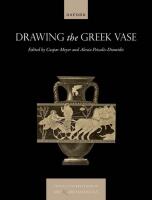
Oxford (2023) h/b 315pp £83 (ISBN 9780192856128)
This edited volume, handsomely produced, comprises twelve chapters by ten contributors, including four from the editors. Its subject is the enduring practice, stretching back to the 1500s, of illustrating Greek vases. Before photography, this was done by drawing, and it is on this technique that the contributors mainly focus. They do so in roughly chronological order, continuing into the era of photography (since the late nineteenth century) and, as of now, digital techniques, including CT scans.
All but one of the contributors is either a classical archaeologist or art-historian. The exception is Kate Morton, an historical and archaeological illustrator who has worked at the British Museum since 1994. Her chapter discusses the practicalities of illustrating Greek vases, including her personal experience. She describes the evolution of techniques through the work of talented predecessors, now all but forgotten, including the late Sue Bird, who left the museum in 1998, leaving behind in her office a Grant Projector, back then used for scaling images up or down, nowadays a dinosaur.
All contributors write well. Academic jargon rarely appears—thankfully, as one is reminded when it does (e.g. p.280, in a quotation, ‘temporalities of actuality/kairos and duration’). The clearest statement of the editorial aims occurs in the Afterword (p. 306): ‘to train eyes and minds to grow less susceptible to the temptation of wanting to see the authentic object and instead to enquire about why it was represented, what can be learnt from its reproduction, and how that information was made explicit or obscure.’
Much of the book traces the shifts in emphasis over time in the purposes which these illustrations served and, consequently, the degree of accuracy expected of them. In the early chapters a repeated presence is the eighteenth-century publication of the collections of antiquities amassed in Italy by the British diplomat William Hamilton. He published a catalogue of his first collection in 1776-77, followed by that of a second collection between 1791 and 1795. The first catalogue, described here as a ‘watershed’, began the tradition of the corpus of engraved Greek vases in an ‘enormous’ format, the large size accommodating the life-size drawings on which the engravings were usually based. In line with the German art-historian Johann Winckelmann’s recent aestheticization of the decorated Greek vase as evidence for ancient Greek drawing, Hamilton’s first catalogue included rolled-out engravings of imagery detached from the vessel on which the ancient artist drew it and purchasable individually. Inflation of the prestige of the object furthered one purpose of these images, since in effect this was a sales-catalogue, and a successful one: Hamilton’s first collection was bought by Parliament for the British Museum in 1772.
The detachment of image and vase was taken further in the second catalogue. Here Hamilton’s collaborator, the German painter Wilhelm Tischbein, initiated the practice of rendering the image on the pot in flattened outline, so as to highlight the vase-painter’s drawn line, for which connoisseurship at the time had a particular reverence. And as Amy Smith points out (p. 58), the original artisans of the Greek potteries, nowadays usually described (see above) as painters, in fact were producing, by and large, monochrome drawings.
This emphasis on line influenced other collectors and taste-makers operating in the neoclassical artistic milieu of the turn of the eighteenth century. Alexia Petsalis-Diomidis shows how the collector Thomas Hope, who died in 1831, saw Greek vase-painting as a ‘model in contemporary English art and culture’. He adopted the outline style in illustrated publications incorporating inspiration from Greek vases into his ideas for women’s costume and for interior decoration.
Other contributors show how the emergence of archaeology as a discipline in the earlier 1800s gave rise to dissatisfaction with the deficiencies in antiquarian drawings of Greek vases—not least in the Hamilton catalogues. This prompted the illustration of vases to take a more ‘scientific’ direction, with German scholars taking the lead. Several contributors comment on the ‘seminal’ work of Eduard Gerhard, a philologist and Berlin professor, who collaborated with the artist Karl Reichhold to publish Auserlesene griechischen Vasenbilder (‘Select Greek Vase Paintings’) between 1840 and 1858, its long life as a work of reference stretching well into the twentieth century.
Despite Gerhard’s greater engagement with the form and functions of the pots themselves and the introduction of colour, the focus on iconography survived, although his draughtspersons marked up the flattened images to show where the transfer to two dimensions of the original lines on a curved surface had ‘pulled apart interacting figures’. Gerhard’s other great project was the formation of a huge study collection of materials known as the Gerhard’scher Apparat. Aiming ‘to renew the study of antiquity,’ it included many drawings of Greek vases. Marie-Amélie Bernard shows how concerned he was to ensure the greatest accuracy possible. He used a team of draughtsmen trained for the purposes of standardisation to work in the same way, including the use of tracing paper to draw directly on the vase. She sees this endeavour as part of Gerhard’s new vision of archaeology as a specialist discipline.
Vase illustration took another turn with the advent of photography, a medium which increasingly took over from drawing and engraving in classical archaeology from 1875 onward. Nikolaus Dietrich discusses the pros and cons of drawing and photography respectively, asserting that ‘the drawing of a vase by Euphronios requires approximately the same immense effort from the modern draughtsperson as it did from Euphronios himself’. Photography’s advantages include, apart from its instantaneity, its ability to render colour and the effects of light on the vase’s surface, something which handling the vase does even better. On the other hand, drawing can restore the visibility of details, such as lines painted in dilute glaze. This is one reason among others, one might add, for continuing to support excellence in this skill, as with the British School at Athens’s Elizabeth Catling Memorial Fund for Archaeological Draughtsmanship.
These dilute lines were what Sir John Beazley called ‘minor lines’ in vase painting. They ‘sub-divide or diversify’ the ‘master lines’ demarcating the body. For Beazley, together they constituted ‘a coherent and comprehensive system’ revealing the personal style of a painter. The book’s Introduction notes that attribution studies are still an academic practice, albeit no longer fashionable. Athena Tsingarida’s chapter shows how Beazley’s own drawings of vase-paintings, often akin to visual annotations, played their part in his attributions of images to individual hands: as he opined, ‘‘the hand remembers as well as the eye’’.
This review does not do justice to the range of subjects tackled. They also include a case study based on Athenian vases of the Meidias Painter and his ‘circle’, and a chapter on the use of photographs in the trade in Greek vases, including dealers’ archives confiscated by art squads in the last two decades. Although the book targets a specialist readership, anyone who enjoys Greek vases—as this reviewer does—is likely to find pleasure and insight in both the text and the many illuminating illustrations. Although not explicitly setting out to do so, the book in effect offers a rounded history of its subject.
Tony Spawforth
Brighton