
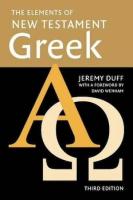
This is a double review:
THE ELEMENTS OF NEW TESTAMENT GREEK
Jeremy Duff
CUP (2005: 4th edition forthcoming) p/b 340pp £29.99 (ISBN 9780521755511)
READING BIBLICAL GREEK: A Graded Reader for Beginners
Steffen J. Jenkins
CUP (2026) p/b 363 £23 (ISBN 9781108948159)
Cambridge University Press has had a book called The Elements of New Testament Greek in print since 1914. Like the ship of Theseus in the Zeno paradox, is it the same one when every part has at some point been replaced? The first edition was written by H.P.V. Nunn, a scholar of early Christianity. A radical revision produced the 1965 second edition by J.W. Wenham, which acquired a comfortable familiarity like that held for the classical language by L.A. Wilding’s Greek for Beginners. In 2005 Jeremy Duff produced the third edition, based on Wenham but in many respects new; a fourth revision (with fewer changes, and still by D.) is imminent.
The aim throughout has been to facilitate reading of the NT in Greek, without frills and in limited time. Accents are largely ignored. No knowledge of Latin is assumed, and D. provides a ten-page summary of relevant English grammar which many students now need. Twenty chapters take us briskly through the essentials. Encouragement (but not of laziness) is achieved by providing an answer key for just half of the translation exercises. Each chapter ends with an unadapted NT extract. Cumulative vocabulary is about 600 words, two-thirds of them asterisked as a priority for those daunted by the total. Writing a language course requires decisions about the order of presentation: here verbs with epsilon contraction come very early, whilst the third declension, comparative adjectives and passive verbs are long postponed. Introduction of a particular feature requires a choice between wodge and drip-feed: prepositions get the forbidding former. Economy with the truth is justifiable in the early stages, but some things are questionable. Phrases like ton logon tou theou for ‘the word of God’ could have been avoided by bringing in the sandwich construction or repeated article at an earlier stage. Gender is explained as ‘a way of grouping together nouns that behave in similar ways’, which sounds more like a definition of declension. Printing, in a table, forms that would never be found (for example the nominative of a reflexive pronoun) looks odd, even with an explanatory note.
Reading Biblical Greek by Steffen Jenkins appears as a companion volume to The Elements, with the same cover logo of intertwined alpha and omega. Duff provides a foreword, and J. has had sight of the forthcoming new edition of the parent book. In a parallel twenty chapters, J. expands its content, providing more detail (with both ‘extra help’ and ‘extra material’), and sometimes a ‘second opinion’ (i.e. polite disagreement, for example about accents). In effect his book is an advanced independent study guide. The style is chatty but the content quite demanding. At times there is a sense of overkill (no less than eleven aspectual distinctions in use of the present tense). Illustration of constructions is provided initially by some confected Greek, notably several instalments of ‘Phoebe’s Banquet’ (a happier occasion than Abigail’s Party), but quotations from a wide range of classical and biblical authors also feature from an early stage.
J. acknowledges the influence of the JACT Reading Greek course, and as the book progresses it increasingly takes on the character of a ‘reader’ providing extended practice passages. A notable landmark at the halfway point is the whole of Paul’s (admittedly very short) Letter to Philemon. But the title ‘Biblical Greek’ (rather than just ‘New Testament’) is significant, as the main quarry for reading passages – in progressively less adapted form – is the Jewish novella Joseph and Aseneth, from the Old Testament Pseudepigrapha (i.e. non-canonical writings taking their cue from the Hebrew Bible). This text, of perhaps the first century BC, proves an inspired choice. Genesis 41:45 tells us simply that Joseph married Aseneth, daughter of an Egyptian priest; verses 51-2 recount the birth of their sons Manasseh and Ephraim.
From this scanty material developed a story whose dramatic potential is evident in Handel’s 1743 oratorio Joseph and his Brethren. After initial reluctance, Aseneth in a vision is fed honeycomb by a heavenly being and the romance begins. But after the marriage and the birth of their sons, Pharaoh’s eldest son (who had wanted to marry Aseneth) hatches a plot to kill Joseph and kidnap her, only to be thwarted by his loyal brothers and divine intervention.
The final passage comes from the First Letter of Clement, a text that nearly made it into the NT. J.’s choices prompt the reflection that there is rich and accessible material for Greek reading in the apocryphal writings – but also that much could be done with the great stories of the Old Testament in the Septuagint Greek version.
Both books (for which there are also online resources) have been produced and proofread to a high standard, but the page numbers in The Elements (white on a pale grey box) are virtually illegible.
John Taylor