
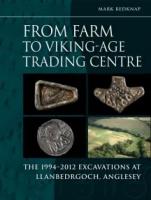
Oxbow Books (2026) h/b 710pp £48 (ISBN 9798888571972)
The project was supervised by the author, Mark Redknap, and involved hundreds of volunteers over the years. The book is an account of excavations at five sites around the farm of Glyn in Llanbedrgoch, Anglesey. The sites are rich in deposits from all periods of Welsh history. The Roman period will be of greatest interest to supporters of Classics for All, so that will be the focus of this review.
The people of Wales have never welcomed external rulers. They held out with determination against the Romans for as long as possible in the first century AD. They resisted any takeover by Angles and Saxons in the fifth and sixth centuries. They did not become part of the Danelaw during the ninth century.
The second governor of Britannia, Publius Ostorius Scapula (AD 47-52), struggled without success to bring Wales under Roman domination. Subsequent governors continued this campaign, establishing forts across the region. The Isle of Anglesey was a centre of Druidism and a key location. Paullinus established a Roman garrison there in AD 60, but this was not a success. Boudica’s spectacular campaign in eastern and central Britain meant that all military resources were redirected to suppressing the rebellion. After defeating Boudica, the Roman authorities set about reconquering Wales during the 70s. In the late summer of AD 77 the governor Agricola mounted an assault on Anglesey. His troops swam across the Menai Strait (as narrated by Tacitus) and gained control of the island. A network of forts was then constructed across Wales. Anglesey remained under Roman administration for the next three hundred years.
One of the five sites at Llanbedrgoch, site 1b, appears to be of Romano-British foundation, with a main period of occupation running from the late first/early second century into the late fourth century: see page 37. This fits precisely with what we know about the background history of Anglesey. On site 2 the first indication of Roman activity was the discovery of a Colchester-type brooch in a ditch. It is dated to the early Conquest/pre-Flavian period: see page 45. This may relate to the time when Paullinus had a garrison on Anglesey. The site also yielded many finds from the later Roman period. These included metalwork, coins, pottery and glass, dated to the third and fourth century. There was also a clipped siliqua of Honorius. This presumably relates to the early fifth century, when Britain was dropping out of the Empire. Coins were in short supply and clipping them was a common practice.
Chapter 12 contains a comprehensive description of all Roman artefacts recovered. Most come from site 1b and site 2, but some come from other sites at Llanbedrgoch. Each of the finds are described in detail and there are photographs of many. The artefacts are divided into separate categories: metalwork, glass objects, pottery and stone objects, including a fragment of a quernstone. Figure 12.6 on page 311 is a graph showing the numbers of Roman pottery finds on site 1b and site 2 relating to each decade between AD 80 and AD 400. Between AD 80 and AD 100 the numbers are low. They increase progressively between AD 110 and AD 150. There is a spike between AD 160 and AD 200. After that the numbers drop down, with a slight increase in the late fourth century. Chapter 13 provides a description of all Roman coins found at Llanbedrgoch. Unsurprisingly, these were scattered more widely and not concentrated within site 1b and site 2. These are generally dated between the second and fourth centuries. There are photographs of 25 coins taken on both sides.
Chapter 28 discusses the archaeology of Llanbedrgoch in context. The authors conclude that there was a network of closely spaced Romano-British farms in the area. They appear to have prospered. There was also metalworking. Sites 1a, 1b and 2 were comparatively densely settled. There was probably mixed farming, with livestock rearing and arable cultivation. It is likely that these communities were supplying the military garrison at Caernarfon (Segontium) and the legionary fortress at Chester. Chester was accessible by sea from Anglesey.
This book is beautifully illustrated and packed with details. It is not for the general reader, but it has much to offer the serious scholar of Roman Britain. For those with wider horizons, there is a full account of finds from the early medieval period and the Viking age. This book records a substantial archaeological project. It merits a place in every historical library and every archaeological library.
Rupert Jackson