
Princeton University (2023) h/b 496pp £29 (ISBN 9780691199207)
J. is Professor of Classics and Professor of Religion at Ohio State University and specialises in classical (particularly Greek) mythology and the role that myth making plays in religion. She has previously published frequently on these topics for an academic audience, but this appears to be her first offering for a wider public.
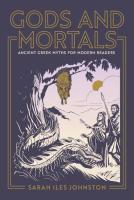
The book is essentially an encyclopaedia of Greek Myth, although it does not claim to be exhaustive. It takes the form of 140 individual stories or elements of larger stories, presented in broadly chronological sequence, starting with those concerned with the emergence of the gods (Earth, the Titans, Demeter, Zeus), moving on to those concerned with the classical pantheon and semi immortals (Prometheus, Tantalus, and Daedalus) and then to those relating the interaction of that pantheon with mortal heroes (Perseus, Oedipus, Heracles and Jason). The last 32 sections cover the Trojan War and the heroes’ return from that war. J.’s son has produced about 20 evocative black and white woodcut illustrations and the end papers are used to provide useful maps of the main sites mentioned in the myths. The quality of the production and printing is also exceptional.
Each section or story is a composite account devised by J. herself but drawn from the sources that are identified in the notes for that section. The literary sources used are listed in a 6-page index, but J. frequently also uses evidence from vase painting. Very occasionally she creates small details from her own imagination (as in section 44 on Minos and the seer Polyidus where she invents the idea that Minos tested Glaucus’ power of resurrection by killing a bull). These inventions are acknowledged in the relevant note, but you would have to read the note to be aware of them. The purpose of the composite approach is to deliver a story that is intelligible to the reader and reasonably consistent with related myths. It is a moot point whether this is a book to be read cover to cover or to be dipped into. There is arguably a distinct benefit in reading the first 14, and possibly the first 50 sections, in one go, in order to establish the linkages which subsequently affect the lives of the heroes.
J.’s style, which she developed from her lecturing experience, is basically matter of fact, using plain and direct language but with the occasional shift into a conversational mode. She uses this conversational device more expansively when dealing with the later myths which are covered more fully by the Iliad or the Odyssey. The tenor of these conversations is usually implicit in the sources she has used. J. is not judgmental—which works particularly well in the earlier episodes when the sheer brutality and gynaecological inventiveness of the earliest gods make Game of Thrones look like a pastoral idyll. She also does not blench from the fact that for most male gods there was little distinction between seduction and rape.
The deep academic background to what might otherwise be unfairly labelled as a populist production is apparent not only in the notes but also in the introductory section on the role of myths and the closing section on the ancient sources. J. explains that she has not indulged in family trees because the interconnection between the key characters is frequently so much more complex than lineage.
Overall this book is a delight and a ‘must have’ tool for anyone who is involved in introducing students to the classical world. Although it concentrates on Greek myth, it is equally relevant to students of Latin if only because of the way in which Latin authors adopted the Greek myths for their own purposes—Ovid is a key source for several sections. Classics for All might even consider making a copy of this book part of any prize it awards to participating schools or indeed as an introductory gift for any school starting to teach Greek. For the general CfA reader too it is at £29 a great bargain.
Roger Barnes