
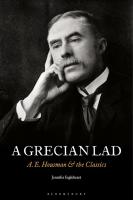
Bloomsbury Academic (2026) p/b 306pp £23.99 (ISBN 9781350574700)
Professor Ingleheart has launched her deeply-researched book into an already crowded area. It is scarcely credible, but there are already sixteen published biographies and eight partial biographies of Housman in existence (even so, completeness is not claimed), as well as at least 18 other relevant books (e.g. John Bayley’s Housman’s Poems, C.O. Brink, with a chapter in English Classical Scholarship on the methodology of his scholarship, and Paul Naiditch on A.E. Housman at University College, London: The Election of 1892). There are also the 51 volumes (to date) of the Housman Society’s Journals. All this for a man who carried out his scholarly work quietly, at Cambridge, as Kennedy Professor of Latin, for the last 25 years of his life, produced (in his life) two volumes of poetry of no great size with a long interval between their publication—he has been described as a ‘major minor’ poet—and was also the very opposite of ‘hail-fellow-well-met’; indeed was well-known for his brusquerie (Professor Hugh Last, who was present, told me of a typical instance), and regarded the fact that the Fellows of Trinity College never tried to discuss his poetry with him as their greatest kindness. He also fell permanently in unrequited love with a fellow undergraduate at St John’s (Oxford) who was reading for a science degree.
After a long and interesting Introduction, in which, inter multa alia, I. puts forward the arguable claim that Praefanda is crucial for understanding the continuity between Housman’s poetry and his scholarly prose, she opens with chapter 1: ‘Terence Hearsay in Shropshire: Classical Allusivity in A Shropshire Lad’; Chapter 2 is titled ‘Queer Loss, Queer Classics: A.E. Housman’s Lost Country’. This is followed (Chapter 3) by ‘Love, Loss, and Latin: Housman’s Latin Elegy to Moses Jackson’, which contains Housman’s ‘Praefanda: Text, and Praefanda: Translation’. Chapter 4 is titled ‘Tell Me the Truth about Sex: Housman’s Praefanda’. Chapter 5 is ‘The Invention of Housman’. Finally comes ‘Coda: Answered Passions’. There are nearly 90 pages of Notes, a Bibliography of some 20 pages, which, however, has a couple of notable omissions, an Index of Passages Discussed, and a General Index.
A.E. Housman: A Divided Life is the title of G.L. Watson’s 1957 biography, and it is I.’s aim in chapter 1 to probe the classical references in A Shropshire Lad—a title which tends to disguise rather than parade the work’s classical elements. Indeed, I. makes the valid general point that those who have attempted to harvest ASL for classical parallels have come away with a crop that seems surprisingly meagre given the ubiquity of classicizing in Victorian verse, and, far more importantly, Housman’s profession. Personally, I doubt the relevance of the playwright (and immigrant slave) Terence to the book’s sensibly discarded title, The Poems of Terence Hearsay.
The theme of Sappho’s fragmentary poem 52 (‘the weeping Pleiads’) must be the ‘frequent Sapphic one of unrequited love and the absence of the beloved’. ‘Queer readers’, says I., (who) ‘have found particular poignancy in the theme of unfulfilled desire and the experience of lying awake, unloved and alone, in the middle of the night’. The argumentation in the first two chapters is both dense and convincing. Perhaps more subtle is the way in which Housman introduces Mithridates (‘he died old’), the point being that Mithridates had so thoroughly imbued himself with small doses of poison to immunise himself, that, at the same time, he was effectively prevented from committing suicide, his chosen ‘exit route’. This reader has always preferred the subtlety of ASL XLII, The Merry Guide, in which, as I. surely correctly points out, Hermes is never named, yet is clearly the youth described, thus mirroring the way in which ‘homoerotic desire is not spelled out, and yet would be clear to readers with a Classical education’, as would the fact that the poem’s theme is ultimately about death, with Hermes as psychagogos. (The chapter concludes with an account of a scholarly quarrel with J.P. Postgate, Housman’s colleague at University College, London, concerning the MSS of Propertius. An impartial observer may well feel that Postgate had the better of the argument; I. suggests that the experience seems to have had consequences for Housman’s: poetry, and that this demonstrates that the two identities of scholar and poet that Housman embodies cannot and should not be separated: even if ‘demonstrates’ is too strong a word, I.’s point is well made.)
In chapter 2, I. considers Housman’s poetry, and ‘to a lesser extent, his scholarship, as part of a wider exploration of queer classics and queer loss’. She quotes ‘With rue my heart is laden’, a deservedly famous poem, capable of evoking an ‘immense answering pain in its audience’. However, the main theme of the chapter is how Housman’s poetry engages with loss through the work, especially, of the lesbian poet Sappho: I. asks what the Classics can mean for ‘queer Classicists today’. (Incidentally, I. says that Sappho’s poems were ultimately gathered together into nine books; true, but the total is disputed, and both Wilamowitz and Edgar Lobel argued that the total number of books was eight, not nine.) I. here quotes from the well-known φαίνεταί μοι κῆνος κτλ. as being of obvious relevance to the situation of Housman and Moses Jackson, though as I. points out, surely correctly, Jackson is simply unable to comprehend Housman’s lovelorn state—while adding that Housman’s verse speaks to a love that cannot be openly articulated. ‘He is here, Urania’s son’, the epithalamium for Jackson’s marriage—to which Housman was not invited—spells out the situation with painful clarity: ‘Friend and comrade yield you o’er/ to her that hardly loves you more’: this poem, says I. ‘has a good claim to be the queerest poem in all of Housman’, and she goes on to argue the case, showing how devastating an experience of loss is experienced by queer people as a consequence of heterosexual marriage (there remains, in the reviewer’s opinion, a question over the translation of ἀπύ in the last line of Sappho frag. 104a L-P). More Poems XXXIII, which in effect announces that Housman is freed from being a ‘sick-hearted slave’ by Jackson’s death, simultaneously ‘shows the extent to which Housman’s predictions constitute a pathetic form of wish fulfilment’ (I. also detects ‘just a hint’ of the famous line Aeneid 6.314 tendebantque manus ripae ulterioris amore). I. then goes off script, as one might say, by ‘sketch(ing) a few ways in which Housman’s queer loss and suffering might still matter to queer Classicists today’. [I do not feel qualified to comment on pp. 67–8 and accordingly think it best not to try.]
I. devotes her next chapter (‘Love, Loss, and Latin’) to the elegiacs by Housman which prefaced his text and commentary on Manilius, Astronomica 1. [Full disclosure: I was handed a copy of these verses by Maurice Platnauer at my first ever Oxford tutorial. I was instructed to translate them unseen and was then asked to give my opinion on when they had been written, and what I thought of them. I replied that the verses did not look classical, and they seemed rather sad. (Platnauer was a dedicated Housman-ophile)]. There have been translations and studies before, but the elegy ‘is of obvious relevance to this volume’s interest in queer and loss … and making Housman’s Latin-language writing accessible to readers who are not professional Classicists’. It may be noted that one of the first reviewers of the volume, H.W. Garrod, failed to recognise that the dedicatee, Moses Jackson, was a real person. I.’s close reading of these elegiacs occupies 25 pages: she concludes that the elegy is ‘suffused throughout with a sense of pathetic irony at the ultimate inability of poetry to secure immortality either for itself or those it hymns, and an all-pervading, rueful sense of sorrow at Housman’s distance from his beloved, and Housman’s impossible, star-crossed love’. (I feel sure that H.’s choice of uincla sodalicii rather than, say, uincula amicitiae in the last line was deliberate.) [It may be worth mentioning that the notes on this chapter, which number 176, are not to be ignored; Stephen Harrison’s paper on the Elegy in TAPA 132 is frequently cited to good effect.]
There is an abrupt change of mood in chapter 4 (‘Tell me the Truth about Sex’) with Praefanda (Text and Translation). The history of Housman’s scholarly study of Latin sexual vocabulary and practice, composed in Latin, is well known, with rejection in the UK being followed by publication I are n Germany (Hermes 1931). Nor was the article easy to access even thereafter: the reviewer’s samizdat copy was a present from his tutor, and it is worthy of note that J.N. Adams’ application to the Roman Society for a grant towards publication of his work on The Latin Sexual Vocabulary was also rejected (it was eventually published in the UK by Duckworth in 1990, after previously appearing in the USA in 1982). I. comments that the work in question (Praefanda) was far from detached or disinterested: a ‘study of Praefanda therefore serves to illuminate the pioneering, unconventional nature of Housman’s scholarship’. I. argues that the article’s ‘savagery is aimed far more at the injustice of society which failed to appreciate homosexuality and discuss it openly than the failings of scholars to understand it properly’ … ‘Only those who had been through a public-school education like Housman’s and then participated more actively in a homosexual subculture could understand and appreciate the wordplay, homoerotic innuendo and challenges to morality that were simultaneously concealed and revealed’ …. ‘Housman was only revealing secrets to those who were in the know’. Your pernickety reviewer notes that there is one word perhaps deliberately ignored by Housman because in a homosexual context it might not have been quite in place: it can be found in Adams p.97, while it is also alluded to (but not spelled out) in a letter by Cicero, Fam 9.22.2: those with Dessau to hand are referred to CIL XI.6721.5 and there is also the Corpus Priaporum 78.5. [See end of review for the word in question.] I.’s discussion in this chapter ranges beyond the text of Praefanda to take into account, for example, Housman’s ‘subversive(ly) suggesting that there might be an overlap between scholarly and prurient approaches to learning about sex’—not only at that moment in time, but also among Classicists of previous generations. More broadly, the ‘savagery’ (again) of Praefanda is aimed ‘far more at the injustice of society which failed to appreciate homosexuality and discuss it openly than the failings of scholars to understand it properly’.
In chapter 5, ‘The Invention of Housman, the duality of Housman—poet and scholar’—is brilliantly delineated in Stoppard’s play of 1997, The Invention of Love. As I. summarises, there is an abundance of oppositions—alive vs. dead, young vs. old, idealism vs. cynicism, emotional, romantic love poet vs. the Classicist whose scholarly work paraded its scientific rationalism. But the key scene is arguably the meeting—which did not actually happen—between Housman and Oscar Wilde; in an interview, Stoppard contrasts Housman, who died revered and honoured, had somehow ‘failed in his life—his emotional life was a disaster’, with Wilde who ‘crashed and burned and died in disgrace (but) had lived the successful life because he had lived it true to himself’. I., however, while considering Stoppard’s portrayal of Housman to be rich, sensitive and insightful, writes ‘yet (it) fails in the binary that the play’s Wilde sets up and Stoppard here confirms’. I. well argues that it is central to allow for the play’s ‘overwhelming slipperiness’ when it comes to the binaries and oppositions that it sets up as part of the doubling that is ‘such an integral and successful part of its very nature.’ ‘Stoppard’s Wilde appears to me not to be Stoppard’s mouthpiece but rather a purposeful caricature of the popular image of Wilde as a flamboyant homosexual genius devoted to the notion of art for art’s sake. Housman’s accomplishments as poet and scholar are worthless when weighed on the scale against his unhappy love’—but what is the scale measuring?
I saw the play when it was first produced and emerged largely persuaded by I.’s argument as given above. Sub specie aeternitatis, that verdict might be reversed—but eternity is a long way away. In the final short chapter, ‘Coda’, I. expresses her justifiable belief that Classics can only survive as a discipline if Classicists can communicate, ‘with a clear sense of passion and an equal dose of creativity’, just what it is that we love about the classical world. Can we Classicists find ‘innovative and inventive ways to communicate our passion to a wider audience’? Not long ago my own expressed anger about the ignorance shown in a review of an important new commentary achieved brief public coverage, and was greeted by Christopher Pelling, then Regius Professor of Greek at Oxford, with the words ‘I’d kill for publicity like that’—which perhaps sets in sharper colours the size of the task that lies ahead. Meanwhile, this book deserves to lead to useful and creative consideration of the many issues raised, though not, perhaps, to yet another book.
[I can’t help wondering whether ‘A Roman Lad’ might have been a more fitting title? The word not included (?deliberately) in Housman’s Praefanda is landica, i.e. clitoris.]
Colin Leach