
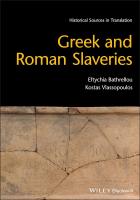
WILEY Blackwell (2022) p/b 381pp £37.95 (ISBN 9781118969298)
As one of WILEY Blackwell’s ‘Historical Sources in Translation’ series, GRS provides 12 chapters looking at slavery from social, political and economic angles through 369 literary, epigraphic, papyrological, and archaeological sources, ranging over the 1500 years from the archaic period to late antiquity, and covering the whole of the Mediterranean, the Near East and Western Europe.
There are twelve chapters: 1. What is slavery? 2. Studying slavery: the variety of evidence and its interpretative challenges 3. Living with slavery and its consequences 4. Slaving strategies 5. Masters and slaves 6. Free and slave 7. Enslaved persons and their communities 8. Slavery and the wider world 9. Experiencing and resisting enslavement 10. After slavery: manumission, freedmen and freed women 11. Slavery and historical change 12. Comparing ancient slaveries.
Each chapter is given an introduction in the form of an overview of the aspect in hand, followed by the relevant sources complete with some questions inviting students of the book—for this is an educational tool as well—to reflect on the implications of the passages. There are 22 informative b/w photographs, mostly of illustrative funerary monuments, but some of them rather faint e.g. the stele of Aulus Caprilius Timotheos (p. 41) and of Pompeii fresco (p. 334).
A sense of the resources on offer can be illustrated from the first chapter (What is Slavery?). B. and V. point out that slavery was not a uniform institution—in what precise sense was a Spartan helot a slave or the Cretan woikeis?—and how can we account for e.g. the honouring of slaves or impact of slave families? What agency might a slave have? What laws applied to slavery? Was slavery a matter of domination or a degree of benefaction and reward? The main headings of the chapter cover texts relating to Property and Domination (Aristotle, The Digest, Thucydides, Plutarch, Ps.-Xenophon); Social Death (The Digest, Egyptian papyri, Ammianus Marcellinus, Ps.-Plutarch, Greek and Latin inscriptions); Slavery as Symmetrical Negotiation (Herodas Mimiambs, Galen on malingerers and the doctrines of Plato, Aulus Gellius, The Digest, Libanius, Gerontius, Aristophanes Clouds); and Modalities of Slavery (Artemidorus, Herodotus, Xenophon, Dio Chrysostom).
Over the whole volume, this adds up to an extraordinarily impressive achievement. Perhaps the only absence is a section on the well-known legal fiction involving slaves and freemen making fortunes out of acting as their owner’s business agent (see https://classicsforall.org.uk/reading-room/book-reviews/roman-inequality-affluent-slaves-businesswomen-legal-fictions ). If there is a problem, it exists on the educational side. Here is a simple example, a quotation from Theophrastus Characters: ‘The man of petty ambition is the kind who, when invited to dinner, contrives to recline by the host himself; he takes his son to Delphi for a haircut; he takes care that his attendant is Ethiopian’. The final question for students asks whether this is evidence of a racist attitude toward black slaves. But to answer that requires an understanding of the nature of Characters. Likewise, some of the questions demand a level of historical sophistication which the average student would not be able to reach, and indeed might even challenge their teachers (some of the passages carry references to further reading on the topic).
But none of this compromises the value of this collection. After all, a teacher is free to use the questions or not (and GRS is surely too expensive for students anyway). The fact is that B. and V. have provided us with an unmatched range of sources on a topic of high importance which will become compulsory reading for anyone interested in or teaching about ancient slavery. The authors are to be warmly congratulated.
There is a 19-page bibliography, and extremely useful Indices of Passages Cited, Place and People, Names and A Thematic index.
Peter Jones