
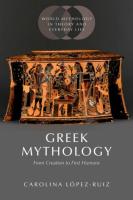
OUP (2025) p/b 256pp £12.99 (ISBN 9780190944803)
This is the third volume in OUP’s World Mythology in Theory and Everyday Life series, following The Truth of Myth by Tok Thompson and Gregory Schrempp (2020) and Old Norse Mythology by John Lindow (2020). This volume continues the series’ aim of exploring myths in both scholarly and accessible ways. López-Ruiz’s book takes a distinctive approach by narrowing the focus: rather than retelling familiar tales of heroes, wars, and quests, it examines the origins of the universe, the gods, and humankind that form the foundation of classical mythology.
Far from narrowing the book’s appeal, this focus allows López-Ruiz to explore the chosen myths in rich detail. The stories themselves are compelling and imaginative: the emergence of Earth (Gaia), Tartarus, and Eros from Chaos; Gaia giving rise to Sky (Ouranos), Mountains, and Sea (Pontos); Kronos castrating his father and swallowing his children (all except Zeus); Zeus’s rise to power and battles with the Titans and Typhoeus; Prometheus stealing fire for humanity; and the creation of Pandora, the first woman.
López-Ruiz justifies this concentrated focus in three ways. First, creation myths establish the foundation of the Greek myth-world; second, Western philosophy developed in dialogue with these myths; and third, there is a long tradition of their reception. Beyond this, the emphasis on cosmogony, theogony and anthropogony allows for a particularly fruitful comparative approach. By examining Near Eastern creation stories alongside Greek myths, López-Ruiz highlights common motifs, contrasts narrative strategies, and transforms the reader’s understanding of what ‘classical mythology’ entails. This cross-cultural perspective is the book’s greatest strength.
The book begins with a concise Introduction that defines mythology and classical mythology, surveys the major texts preserving Greek myths, outlines interpretive approaches, and previews the book’s structure. Chapter 1 focuses on cosmic and divine beginnings while Chapter 2 turns to the first human generations and their interactions with the gods. These chapters largely follow Hesiod’s Theogony. There is also due acknowledgement of alternative Greek cosmogonies and theogonies, including those found in the Orphic poems, highlighting the diversity and richness of early mythic traditions.
Chapter 3 is the heart of the book, where López-Ruiz’s comparative approach comes to full fruition. Drawing on her expertise, she presents Near Eastern creation stories in a clear and accessible manner, allowing Greek myths to be seen against a broader backdrop of shared motifs and themes. Common patterns across cultures are carefully analysed, revealing both parallels and distinctive features. For example, the creation of the cosmos is familiar from Genesis in the Hebrew Bible: ‘In the beginning God created the heaven and the earth.’ López-Ruiz emphasizes how naming also shapes reality in the creation myth Enuma Elish showing that in both Genesis and the Babylonian tradition, language not only describes but organizes creation. Hesiod, by contrast, begins his cosmogony with the concept of chaos, a novel image of the first generative moment.
Flood narratives further highlight these contrasts. The Babylonians, perhaps inspired by local catastrophes, told of a divine flood sent to punish humanity for its numbers and noise. This motif reached the Greeks, but no narrative survives in Greek epic poetry. The story of Deucalion and Pyrrha is preserved in Apollodorus’ Bibliotheke. Unlike the universal Mesopotamian flood, the Greek version is localized: its survivors are not progenitors of all humanity but only of the Greek peoples. In the myth, Deucalion and Pyrrha repopulate the earth by throwing stones over their shoulders, which transform into men and women, emphasizing their role as ancestors of the Greeks.
In Chapter 4, López-Ruiz turns to the reception of Greek origin myths, tracing their influence from Plato and the Roman poets to modern retellings in films such as Clash of the Titans and Disney’s Hercules. Unlike most Near Eastern texts, which were lost in antiquity and rediscovered only in the nineteenth century, Greek myths were preserved in Christian contexts largely through two interpretive traditions: Euhemerism, which recast the gods as historical figures, and allegory, which sought moral or philosophical meaning and allowed later readers to view Hesiod and Homer as proto-Christian thinkers.
The volume includes 25 illustrations, two maps, an index, and a bibliography. In keeping with its scholarly yet accessible approach, footnotes are minimal, while the main text provides abundant references for further reading, encouraging readers to explore ancient Greek and Near Eastern literatures in greater depth. It is not quite as carefully proof-read as one might expect from OUP, with small slips such as ‘Appollo’ (p. 14) and ‘illus tempus’ (p. 66). Nevertheless, it is affordably priced and offers a compelling and lucid overview of a remarkably diverse range of ancient texts, combining rigorous scholarship with clarity and readability.
Giles Gilbert