
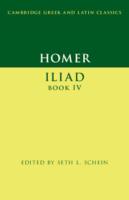
CUP (2026) p/b 243pp £24 (ISBN 9781009225663)
Iliad IV is set between the inconclusive duel in book 3 and the full-throttled fighting in book 5. It restarts the war with a divine debate leading Pandarus the Trojan to break the truce by shooting Menelaus with an arrow. Agamemnon produces a speech (155-82), full of egotism and grief: he then tries (with mixed success) to regain his authority (after his disastrous decisions in books 1 and 2) by conducting a review (ἐπιπώλησις) of his troops (see pp. 140-1 and 161 for discussion of Agamemnon’s behaviour here). The book concludes with general fighting which ends with a bleak vista of ‘many Trojans and Greeks stretched out in the dust side by side’.
S.’s edition lives up to its promise to assist ‘readers at all levels’ to understand and enjoy this fascinating book. The Introduction sets the text in its poetic and historical context with a concise summary of the Homeric problem and recent thinking about the importance of alphabetic writing ‘to create a longer more complex poem’ (although S. wisely adds (pp. 1-2) that ‘it is unclear how, and how often, such a transition from oral poetry to a written text took place.’). He sketches the historical context of the Iliad as a Bronze Age tale narrated in an eighth-century poem. The structure of the Iliad is engagingly seen as a matter of symmetrical form, as shown in the correspondence between the first three books and the last three books which is ‘analogous to the symmetrical geometric designs on Greek painted pottery of the eighth century’ (p.11).
The place of book 4 within the Iliad is splendidly discussed. S. shows how in the opening divine assembly ‘the gods’ self-serving decision for war takes precedence over human morality and human wishes’ (p.13). Agamemnon’s review of his troops is almost a rerun of both the catalogue of ships in book 2 and the scene in book 3 where Helen points out the Greek warriors from her vantage point on the wall of Troy. Agamemnon’s character and role in the poem so far is brilliantly sketched (pp.15-6): and S. then spends six illuminating pages on the role and nature of the gods in the poem. Homer’s gods do not need honour to make their lives meaningful (as mortals do in the face of death) and the contrast of divine frivolity versus human heroism is deep and powerful, leaving the fall of a great city to be decided by gods for selfish and amoral reasons: Gods live easily (6.138) while we do not (24.525-6).
S. devotes the bulk of his introduction (36 pages) to the metre, language and style of the text: he assumes no prior knowledge of the Homeric hexameter but goes further than a quick student’s guide and leads us into the placing of the caesura and the defamiliarisation afforded by the poet’s prosodic freedom which allows the poet to stress a word simply by his placing of it in the metrical schema. The rules of scansion are ably set out (pp.31-3), as are the necessary facts about Homer’s Greek as an amalgamation of Ionic and Aeolic with a dash of Arcado-Cypriot. A full list of Homeric morphology and syntax follows (pp.39-46) with abundant examples taken largely from book 4. The section on Style covers formulas as an aid to the oral composition but as themselves susceptible to flexible handing by the poet and as signifiers of narrative themes. Formulas are also focalised, so that (e.g.) the ships at 1.12 are ‘swift’ to the eye of poor Chryses who imagines them whisking away his daughter (p.51: cf. 148n.). Similes are also more than decorative, adding a connection between the audience for whom the poet is singing and the people about whom he is singing (e.g. 141-2n.): so for example the similes tend to speak of iron where the narrative talks of bronze (485-6n.). When the Greeks are compared to destructive waves and the Trojans to bleating sheep (422-438) this reflects the ultimate fate of Troy but also adds a layer of pity for both sides: the world of nature is cruel enough already, but warfare makes things a lot worse. This section ends with a judicious account of the speeches, the use of myth and parataxis and finally a superbly lucid account of the transmission of the text. S.’s text leans heavily on West’s Teubner edition of 1998 and explains disputed lines and phrases (e.g. 456n.) in the commentary.
The commentary is expertly pitched and manages to provide enough information for the comparative beginner in Greek (e.g. 193n., 210-11n., 494n.) while also moving at higher levels of scholarship for the experts. The book is obviously aimed at people who are reading the text in Greek and not in translation and so citations to illustrate the language (e.g. 185n.) are left untranslated in Greek, while quotes to illustrate characterisation (e.g. 162n.) are produced in S.’s own elegant English. S. avoids the blanket-bombing of ‘cf. e.g.’ by always tying his quotes into the text under discussion. Citations of other authors cast light on the meaning of Homer’s own words especially where this is contested: see for example that tricky devil ἀμύμων at 88-9n., or ὁμοίιον at 315n., the γεφύρας at 371n., τέττα at 412n., ἐδνοπάλιζεν at 472n., or ἐρωήν at 542n.
The commentary provides most of what a new reader of this text needs to be told. S. is excellent on the intricacies of Homeric protective clothing (including the bronze underpants of the μίτρη at pp. 122-3) and weaponry at 151n.: he is also good on burial customs (p. 133), chariot-fighting (pp. 153-4) and the top-knot hairstyles of Thracian warriors (533n.). Verbs are parsed in full (e.g. 494n.) and the many hapax legomena (such as the wonderful πτωσκάζω at 373 and ἰξάλου at 105) are noted and defined when their meaning is not obvious. We learn a huge amount about why words are ‘winged’ at 69n., why Argos is ‘thirsty’ at 171n., why Pallas Athene is called Pallas (78n.), how the names are significant at 391-5n. and what μοῖρα connotes (517n.).
The great strength of the commentary is its unpacking of the literary quality of the poetry: from fairly standard features such as apostrophe (127-47n.), zeugma (282n.) and clarity (223n.) to some brilliant insights into the creative process: so, for example, Eris throws a quarrel (444) like the famous golden apple which started it all. S.’s reading of Agamemnon is brilliant: he is obviously a brute (162n.) but might be rude to Odysseus out of embarrassment as it was Odysseus who saved the day when Agamemnon messed up in book 2 (see 338-48n.). When abusing Diomedes, he manages to turn a compliment into a sneer (400n.).
Similes are also well-analysed. The Babel-like nature of the Trojans (437-8) is shown to be sympathetic rather than pejorative: and the fact that their troops contained men brought in from elsewhere with different languages both explains and enhances the simile of the bleating sheep. S.’s superb account (pp. 125-6) of the beautiful simile of Menelaus’ wound at 141-7 brings out the way Homer aestheticises and feminises the Greek warrior. Tiny points of language are made to show Homer’s wonderful way with words—Achilles ‘baking’ his anger at 513, the scorn in the enjambed name Ἀργείοις at 510, the use of vowel sounds at 251n..
The only place where I disagreed with S. was at 285-91n.: Agamemnon here prays to three gods and then wishes that all the Greeks were as good as the two Ajaxes, but S. asserts that Agamemnon ‘flatters them by wishing that Zeus, Athene and Apollo felt as they do’ which is misleading. S. is good on gods: see for instance his words on gods in disguise (86-7n.), Zeus and destiny (29n., 160-8n.), on κνίση (48-9n.) and especially on Zeus’ challenge to Hera to eat the Trojans as meat (34-6n.). The books ends with twenty pages of bibliography, an index of Greek words and a subject-index.
John Godwin