
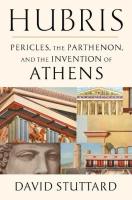
Harvard (2026) h/b 416pp £24.95 (ISBN 9780674258471)
A new perspective on ancient Athens at the height of its powers is always very welcome, and there can be few more conscientious researchers or exhilarating storytellers than independent scholar David Stuttard, whose previous work on Athenian heroes Miltiades and Cimon and their age was such a success. Pericles, however, may prove a challenge of a different sort.
Quite conventionally, the city’s supposed ‘Golden Age’ is often taken to fall in the fifth century BC, following—and as a direct consequence of—its prodigious military role (Marathon, Salamis) in the defence of mainland Greece from Persian occupation. Herodotus, expressing what he knew would be a controversial view (there was at least one other claimant to the title), lauded the Athenians as ‘the saviours of Hellas’ (7.139), assigning them thereby a quasi-religious role. But there are those of us who see the fourth century BC, an age that boasted Athenians Plato, Praxiteles and Demosthenes (among others), as at least comparably deserving of the epithet ‘golden’. And then there’s the problem of just how the fifth-century ‘age’ should be characterised and labelled.
A favourite choice—followed here—is to dub it ‘the age of Pericles’. No doubt, during his adult lifetime (he was born c. 495, came of age in c. 477, and died in 429), the city of Athens did witness a spectacular flowering of philosophy, visual art, and architecture (including architectural sculpture) among other cultural accomplishments. Most monumentally, the democratic city undertook and largely completed a hyper-ambitious building programme, with as its centrepiece the building we—but not they—know as the Parthenon. But was there, actually, ever an ‘age’ of Pericles? He wasn’t after all an absolute monarch, as was Louis Quatorze, of whose reign Voltaire plausibly wrote Le siècle de Louis XIV? And might not our perception of Pericles be at least somewhat skewed by the prominence accorded him by the most distinguished historian of the age by far, Thucydides?
David Stuttard, however, has his sights fixed elsewhere: on hubris. Something of a weasel word, in antiquity technically and legally it was focused upon interpersonal violence, including especially the kind of violence involved in status transgression. Less formally today, it’s often taken to have most to do with breaching the status barrier between gods and humans, when humans individually or collectively behave as if they (think they) are super-human and so violate regulatory social norms. Stuttard’s titular hubris is a combination of all that. As he shows in this extraordinarily vivid and readable account, the seemingly triumphant city was in fact riven by conflict and contradiction. Though nominally a democracy, his Athens culpably led a tyrannical empire.
That formulation inescapably recalls one of Thucydides’s own views—his own, in the strong sense that it is expressed in his own voice as a commentator and analyst, not as (mere) narrator. Pericles, as mentioned, died in 429 from complications of the disease that was to eliminate as many as one third of all Athenian citizens. (Pericles himself had done much to aggravate it by the war strategy he had persuaded the Athenians to adopt in response to the Spartans.) Thucydides seized the moment of his hero’s death to pen an obituary notice doing double duty, both as a posthumous appreciation of the great man and as a partial explanation of why Athens, eventually, 25 years later, lost the war. Translation of the relevant sentence of the obituary notice is, predictably, as often with Thucydides, fraught. Here is a very recent English version, Robin Waterfield’s (2025), at least defensible:
‘In theory there continued to be a democracy, but what was important, in fact, was that power was in the hands of the leading man.’
Clearly, whatever exactly were the nature and force of the men… de opposition of 2.65.9, Thucydides wished to bring out that Pericles somehow achieved a degree of authority over the Athenian demos (‘he led the people, not vice versa’, 2.65.8) that made him in some sense a henocrat, a protarch (his was a ‘rule of the first adult male [citizen]’, literally). Thucydides’s own authority, of course, counts for a very great deal. And yet… as Thucydides had himself earlier reported, so far was Pericles from being a non-responsible autocrat that he could even be prosecuted, found guilty by a popular tribunal and thereby automatically deposed from his office of General and compelled to pay a fine. When nevertheless at the next round of Generalship elections, he was—yet again—re-elected to serve as his tribe’s representative, Thucydides showed his true—non-or anti-democratic—colours: that re-election occurred, he sneered, ‘as the masses typically (reprehensibly) do (2.65.4)’. Pericles, himself, in other words, may have been in Thucydides’s positive opinion the great exception to the standard demagogue (democratic leader) type, but the democracy itself had not ceased to function ‘normally’ even in the face of such an exceptional politician-statesman.
What of the Parthenon itself? For Pericles and his circle, so Stuttard contends, the Parthenon was less a holy place than a propaganda vehicle. Its sculptures carried the message that the Athenians, beloved by the gods, were nearly divine in their own right—which to many Greeks smacked of (our as well as their) hubris. To understand the Parthenon and the Athens that built it, Stuttard reasons, we must recognize the tensions among the city’s rivalrous families, generations, and social classes, whose visions of their place in the world ultimately proved incompatible to the point of outright civil war. Much of that is unexceptionable and very well put. The Parthenon as a temple was indeed odd in not having its own dedicated altar (it had to share with the altar attached to the city’s premier temple of Athena Polias, better known as the Erechtheum). It did serve the very secular function of being Athens’s principal treasury, its Fort Knox. It was without question, too, a propaganda vehicle, though a vehicle not exclusively for Athenian self-serving civic-national pride but also for an admittedly Athenocentric version and vision of (pan)Hellenism. But was the Parthenon particularly, even peculiarly, ‘of’ Pericles? Would it not have been conceived or executed as such without his input? Was it specially ‘his’ project?
Hubris offers among several dramatic portraits of key figures an affecting one of master-craftsman Pheidias, who famously sculpted the monumental chryselephantine cult-statue of Athena Parthenos. Yet this is the one feature or detail of the entire Parthenon project with which Pericles is unambiguously associated by the credible ancient sources—as he is also, in consequence, with the charge of theft of public property (gold) to which his friend Pheidias fell prey. That was just one of several accusations ostensibly against Pericles’s friends and associates (most notoriously his partner in life Aspasia of Miletus) that were directed as much or more against Pericles himself.
As long as things went well, Athenian democracy appeared to prosper. Indeed, Pericles, following the assassination of his reforming senior associate Ephialtes in the late 460s, had done not a little to make it so. But just a year after the Parthenon was finished, Athens and Sparta (plus allies) were at war; between 430 and 426 a plague killed up to a third of the Athenian citizen population, including Pericles; and in Pericles’ own personal ward, Alcibiades, Athens then had to deal with a psychopathic playboy whose mercurial ego did little to support let alone enhance the kind of cautious, stable domestic and foreign policies that statesman Pericles had overtly favoured.
Defeat in 404 hit Athens very hard—meaning, as it did, the end of its democracy, the end of its empire, foreign occupation, and the imposition of a vice-like ultra-oligarchic junta. Stuttard carries his story of Athens on, past the recovery of democracy in 403, to 399. In the wake of what seemed to many ordinary Athenians like divine retribution, popular outrage against those such as Alcibiades and later Plato’s relative Critias accused of undermining state religion was so strong that it took the self-execution of Socrates finally—as Stuttard graphically puts it - to lance the boil. Stuttard’s own sober and sobering coda goes as follows: ‘Pericles’ and Pheidias’ vision of the citizen as hero had been a heady dream. But the sun had set on that old world. The time for dreams was over’. True, but within half a century another, less outwardly glittering, golden age had come to be for Athens, if another whose democratic vistas were to end in the barbed wire of foreign (Macedonian) domination. Such are the vicissitudes of Athenian-style democracy and, yes, hubris.
Paul Cartledge
His Pericles: Statesman, Demagogue, Eccentric (Reaktion Books) will be published later this year.