
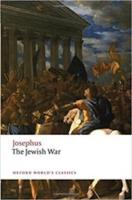
OUP (2017) p/b 562pp £10.99 (ISBN 9780199646029)
If the factions, politics and conflicts of the Middle East seem complex and brutal today, they were certainly no less so in classical times. The Romans, as other imperial powers before and since, struggled to understand, and therefore to govern, the Jewish nation, with its resolutely stubborn sense of independence and fiercely defended religious exclusivity. Whether attempting to control through client kings or by direct rule, they found the Jews never far from rebellion, leading eventually to the great revolt of AD 66, which culminated in the siege and destruction of Jerusalem in AD 70.
Our most comprehensive guide to the causes and events which led to this catastrophic outcome is the work in Greek by Josephus, known as The Jewish War. It covers the period of 200 years before the great revolt of AD 66 to the final defeat of the last rebel stronghold at Masada some seven years later, and deals with it at length and in great detail, interweaving political and military history, including that in Rome itself, with religious, racial and economic perspectives.
Born Yoseph ben Mattatiyahu and dying Flavius Josephus, our author was himself appointed a rebel commander and given control of the rebel forces in Galilee. Faced with defeat, he tells us that, having to choose whether to die in battle or by suicide or to surrender, and relying on his supposed gift of prophecy ‘he offered up a prayer to God under his breath. “Since it is your will”, he prayed, “to bring to its knees the Jewish nation, which you created, since all good fortune has passed over to the Romans, and since you have singled out my spirit to foretell what is to come, I now choose to surrender myself to the Romans, and to live: but I call you to witness that I go not as a traitor, but as your servant”’ (III 354). So the freedom fighter became adviser to the victors, arguing that, by their self-seeking machinations and unrealistic personal ambitions, his one-time fellow rebels had forfeited their right to speak for the nation, which would be better served by seeking an accommodation than by continuing confrontation.
The great strength of this excellent addition to the Oxford ‘World’s Classics’ series lies in the way that a flowing translation is supported by an introduction, copious notes, maps and a first class expanded index, which enable the readers to find their way through a maze of similar sounding individual, family and place names. Martin Hammond, a now retired distinguished headmaster, and his collaborator, Martin Goodman, currently Professor of Jewish Studies at Oxford University, have rendered an admirable service in facilitating their readers’ access to a fascinating historical narrative, which should guard against any oversimplification of the complexities that are (and have long been) Middle Eastern politics.
Ray Morris