
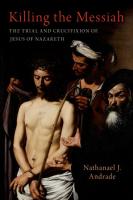
OUP (2025) h/b 280pp £19.99 (ISBN 970197752487)
The Gospel accounts of the trial and execution of Jesus leave a number of questions unclear: for example, why exactly was he arrested, what was he charged with, why was Pontius Pilate involved, and why did Pilate condemn him to the most extreme form of public torture and execution available even though, as is strongly suggested, he did not believe Jesus was guilty. To clarify such questions, A. sets the Gospels in the context of what else we know about Judea at the time, especially from the writings of Josephus and Philo of Alexandria, Roman and Jewish governance and legal practices, archaeological evidence etc., and subjects the whole to forensic examination to determine as clearly as possible what really happened.
There is much of interest. We learn for example about the problems of keeping order, especially in Jerusalem at Passover time when the city and Temple were full of visitors and it could be easy to spark off a riot. The Roman governor alone had the power to execute ringleaders, yet if he was wise, he would be very cautious exercising that power, since he had to work with the Jewish authorities and keep them on side. Pilate usually managed it but made some serious mistakes and was eventually sent home for trial for an act of brutality.
The narrative covers how Judea and Samaria were governed, including the complex interaction between Roman authority and local rulers such as Herod Antipas, problems of dissent and sedition and how these were dealt with, the details of the arrest, trial and execution of Jesus and how the Gospels deal with these. It is a good read and presents us with a larger, wider vision. The problem is, as so often with ancient history, one wishes it could be clearer—so much of what is presented is probability but far from certainty.
Through his narrative, A. draws out one clear conclusion, relating to the Pilate paradox—why did he condemn Jesus to extreme punishment while believing in his innocence? After all, he had full power: he could have let Jesus go, or go after a flogging, and no-one could have stopped him. A.’s solution is that Pilate did not believe Jesus was innocent. The charge against Jesus was that by preaching in the Temple in what seemed an inflammatory way, during Passover time, and claiming kingship, he could have caused dangerous disturbance and was therefore, in Pilate’s eyes, a seditionist. This was the one crime that had to be taken most seriously by the authorities. The Jewish authorities were responsible for keeping order and, whether they really believed it or trumped up the charge to get at Jesus anyway, they were within their rights to have Jesus arrested as a preventative measure. Since they wanted him dead, they were obliged to hand the case over to Pilate. Pilate tried to test the evidence but, faced with Jesus’ refusal to deny the charge that he claimed to be a king, believed that he was indeed a seditionist and, by his preaching during Passover week, was a public danger; Pilate therefore considered it his duty to have Jesus publicly executed as a warning.
A. argues that there are echoes of this in Mark, the earliest of the Gospel sources available to us, but that the later Gospels worked the evidence so as to suggest that Pilate really believed in Jesus’ innocence, and to transfer all the blame to the Jews, with disastrous results throughout history, as we all know. Why they should have done that is not clear, but the explanation could partly have been that Christian groups in the later 1st and early 2nd century, when the Gospels were probably written, had to survive in Rome or Roman-dominated societies, and by then the Jewish state as it was in Pilate’s time had been obliterated.
Well, it’s plausible. It is hard to believe that Pilate would have executed Jesus in such an extreme manner if he had really believed that he was not a serious danger: crucifixion was designed to be a very public statement. A Christian would add that Jesus knew in advance what would happen and behaved deliberately so as to bring it about; we know little from the Gospels about his public preaching during those last days, but no doubt it contained the necessary handles for his enemies to use against him, and Jesus conspicuously, according to all the Gospels, did not deny the accusations quoted. A. makes a good case—and his feelings about the unfairness that, throughout history, the Jews have carried all the blame, are palpable. But, again, ‘plausible’ is as far as we can go. As one reviewer has put it, this is ‘a historically reasoned account of the evidence’ as far as we have it.
Recommended, but not to be taken as Gospel.
Colin McDonald