
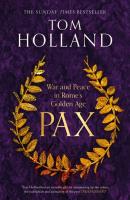
Pax was a tough concept for the Romans. It was not peacefulness, calm or tranquillity, but a settled order achieved by force and the threat of future force. In a rough world, in which violence and insecurity were never far away, it was hard to attain and worth a lot. So it is not too much of a paradox that Tom Holland’s Pax is mostly about war. Gibbon famously began his Decline and Fall by presenting the period between the death of Domitian (AD 96) and the death of Marcus Aurelius (180) – that is, the reigns of the emperors Nerva, Trajan, Hadrian, Antoninus Pius and Marcus Aurelius – as a time of exceptional peace and prosperity. Holland cites Gibbon early on. His own book is a mostly narrative history beginning with the funeral of Nero’s wife Poppaea (65) and ending with the death of Hadrian (138). Half the book relates the end of Nero, the civil wars that followed, the ‘year of the four emperors’ (69), Vespasian’s ultimate victory and the siege and capture of Jerusalem by his son Titus (70) – five or six years in all. The rest of the book covers the remaining six and a half decades more briskly, reflecting the comparative poverty of our sources for this period. It is divided into two parts, ‘War’ and ‘Peace’. If the Antonine age was indeed a golden age of stability and affluence for the Romans, Pax is the story of how they got there.
Holland is an outstanding storyteller. He writes with verve and vividness but also a kind of voluptuousness. With only a little licence, he brings to life the sounds and scents as well as the sights of the ancient world, and his prose is laced with occasional allusions to English poetry: Shakespeare, Tennyson, Matthew Arnold. He quotes a poet writing, ‘The centre cannot hold’; this turns out to be not Yeats but the patriarch of Latin literature Ennius, more or less fairly represented. Rightly he insists that we should try to understand the Romans on their own terms, not on ours. He has some terrible events to describe, and he does so unflinchingly but with a dry economy which Gibbon and Tacitus would alike approve. He seeks to avoid anachronism: so the Jews are called Judaeans throughout, and the Colosseum is the Flavian Amphitheatre. (Successive Jewish revolts and their brutal suppression are a recurrent theme.) The rich archaeological evidence of Pompeii gives him the opportunity for some social history, as well as for a gripping narrative of the city’s destruction.
Holland also discusses slavery. He recognises the appalling conditions of slaves in mines, quarries and agricultural estates, but also the range of occupations which were practised by slaves: they might be doctors, teachers and secretaries. In one respect I think that he is mistaken, influenced by modern sensibility and the nature of American and Caribbean slavery. The most wretched of the free, he says, preserved the spirit of liberty and a shred of dignity. ‘There were fates, after all, worse than starvation’ – that is, to be enslaved. Perhaps one would need some experience of starving to be confident of that. And the fact that there were laws forbidding people from voluntarily enslaving themselves shows that some disagreed. ‘Slaves, by definition, constituted the lowest class of humanity.’ But when Pliny discussed literary topics at dinner with his educated Greek slaves, did he or they really suppose them inferior to the unemployed day labourer or the peasant farmer struggling to extract a living from his few acres? Slavery was a legal status but not straightforwardly an economic or social one. In Marxist terms the senior slaves in upper-class households were rentiers. Of course, there were snobberies. Horace in an early poem says that everyone sneers at him because his father had once been a slave. But that is because he was already so successful, on friendly and even intimate terms with the rulers of the world. Holland says that slavery, of its nature, feminised every male subjected to it. What about the gladiators?
Holland’s chapter on Trajan’s reign is titled ‘The Best of Emperors’, echoing the flattery of the time, but his narrative gives that an ironic edge. He gives Domitian a better press than that emperor usually gets: a monster indeed, but one who left the empire in good condition for his successors. Then Trajan, on this account, messed things up by over-ambitious attempts to extend the empire in the north and east. It was then the task of Hadrian, his successor, to clean up the mess by cutting losses and withdrawing smartly from the areas which Trajan had supposedly subdued. Hadrian’s final gift to the empire was to name Antoninus Pius as his successor, to make the good times even better.
Fortunately for the narrative, Hadrian is as interesting and complex a personality as any of Rome’s many emperors, and Holland is also able to tell the extraordinary tale of Hadrian’s beloved Antinous, mysteriously drowned in the Nile when not yet twenty. This part of the book feels a little rushed, but it is still excellently told. Holland ends with Hadrian’s colossal mausoleum and his ‘most stunning monument’ of all, the Pantheon, a building in which for once the interior mattered most: only inside ‘was it possible to appreciate just how radically, just how brilliantly, Hadrian had redesigned it’. But there is a problem here. Recent archaeological investigation has made it probable – I would say near certain – that the Pantheon was begun under Trajan, and Hadrian merely oversaw its completion. Trajan’s reign is the radical moment in the history of Roman architecture. His baths were the most grandiose yet conceived. His forum was staggering in scale and originality of conception. And although he presented himself as a simple, modest soldier, its iconography is of a boastfulness that makes Augustus look diffident. The novelty and daring of the Pantheon fit into this picture. The temples that we know Hadrian to have commissioned were much more conventional.
Unlike (say) Holland’s remarkable and compelling Dominion, Pax does not have a particular case to argue. It is essentially a story. Once the high drama of five emperors in two years is past, the story might easily seem rambling and miscellaneous, but Holland has the skill to give a shape to it. He also gives us a happy ending. Except that, as he well knows, history has no endings. As night follows day, so the second century was followed by the third – and that was not to be a happy time at all.
Richard Jenkyns