
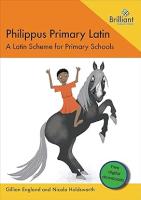
Brilliant Publications (2025) p/b 129pp £24.99 (ISBN 9781783174096)
This new resource responds to the growing need for Latin teaching materials in primary schools, particularly in light of the Key Stage 2 National Curriculum requirement to teach an ancient or modern language. While the 2025 Curriculum and Assessment Review barely mentions Latin, this scheme could prove invaluable if the status quo remains.
The package consists of a black-and-white illustrated teacher’s book containing detailed instructions and copies of all pupil materials, complemented by a downloadable set of full-colour resources. Many of these pupil resources involve cutting out and assembling items—word sorts, simple models (such as a wagon model or a cavalry soldier figure) and even dice. While creative, these activities may be time-consuming and require careful organisation.
The scheme is loosely based around a theatre troupe featuring the eponymous Philippus, a girl Thea, Tarquinius, Pelagus the horse, and Stella the amusing dancing dog. Although the storyline itself is not fully developed, imaginative teachers could use this theme to create more active, dramatic lessons with pupils taking the parts of the characters.
Grammatical content is kept simple: nominative and accusative singular forms of first and second declension nouns; present tense active verbs in the first to third person singular; singular and plural imperatives; and basic adjectival agreement. Much of the scheme focuses on vocabulary acquisition—sorting words by gender and declension, recognising person endings, and practising adjectival agreement. Vocabulary activities include card sorting, gap-filling, word searches, and labelling of pictures. However, these tasks may prove challenging in mixed-ability classrooms, where some pupils might find them too easy and others too difficult, potentially leading to guesswork rather than genuine learning.
The scheme comprises twelve chapters, each offering a range of materials on topics: meeting the actors (third-person singular verbs and English derivations), props (first declension nouns and est mihi), animals (second declension and questions), everyday life (adjectival agreement), travel (questions and prepositions), adventures (nominative and accusative cases and first translations), picnics (first-person singular verbs), games (second-person singular verbs), Pegasus (questions and adverbs), counting (numerals), cavalry (imperatives), and Latin today (comparing Latin with other European languages). Each chapter concludes with a reflective pupil page: ‘What I already know,’ ‘What I have learned,’ and ‘Next steps.’
The scheme treats language as discrete units—nouns, adjectives, verbs—with sentences rarely exceeding two or three words. While vocabulary is thematically linked to each chapter, there is a missed opportunity to show how Latin combines these elements to convey meaningful ideas. Perhaps this will be addressed in a follow-up volume.
Teachers are expected to read aloud frequently, and an oral component—such as recorded audio or ready-made PowerPoint slides—would save time and enhance delivery. Co-teaching across two year-groups seems impractical, and the length and complexity of activities may leave teachers feeling rushed. Slowing down, however, risks losing the impact of the storyline.
On the positive side, the scheme emphasises repetition, retrieval and practice, with helpful reminders and guidance in the teacher’s handbook. It offers considerable support for teachers new to Latin. Despite some limitations, Philippus Primary Latin is a welcome addition to the growing range of resources for primary Latin teaching.
The book is published by Brilliant Publications, with the pupils’ resources downloadable from the website (sign-up restricted). https://brilliantpublications.co.uk/ provides more information.
Steven Hunt
[email protected]
Associate Teaching professor in Classics Education, Faculty of Education, University of Cambridge, UK