
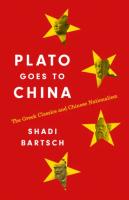
Princeton & Oxford (2023) h/b 279pp £28 (ISBN 9780691229591)
Probably many of us, at least those of a certain age, knew that Frankie goes to Hollywood. But who knew that Plato goes to China—apart from those resolute spirits such as Professor Bartsch (University of Chicago), who taught herself Mandarin over many years in order to gain such first-hand knowledge? Disclaimer: I have a certain stake in Platonic and other ancient Greek scholarship, but my own contacts with China and Chinese Classical scholarship have been minimal (two books translated into Mandarin).
Nor am I anything like as cognisant as I should ideally like to be of contemporary Chinese politics and culture—which for comparative purposes are the main object of B.’s brave study. Her secondary objective is to use an understanding of how Plato—and Aristotle and some other ancient Greek writers and thinkers—are, and have been, received in China to force us Westerners to reflect back through alien eyes upon our own understandings of those writers and that philosophical tradition.
Not that B. is here sailing out into completely uncharted intellectual-political waters. The juxtaposition of near contemporaries Confucius, ‘Master Kong’ (551-479 BC), with Socrates (c. 469-399 BC) has become almost trite: see B. pp. 162-8; to which one could add the literal juxtaposition of statues of Socrates and Confucius (by a Chinese sculptor) in the (ancient Greek) Agora of Athens in 2021. For the comparativist research project in Cambridge, see e.g. G.E.R. Lloyd and J.J. Zhao (eds), with Q. Dong, Ancient Greece and China Compared (CUP 2018); and from the Chinese side, one might cite W. Daqing’s article, ‘On the ancient Greek ἄγων᾽ Procedia. Social and Behavioral Sciences 2 (2010) 6805-6812, where the author freely confesses (n.6): ‘To sum up, in the Chinese academic circle the study of the ancient Greek sport games becomes a very important research field in recent years [sc. prompted by the 2008 Beijing Olympics: PC]. At the same time, we have to admit that there are many shortcomings in these researches. An obvious weakness is that Chinese scholars generally pay little attention to the rich achievements of the foreign colleagues’.
According to B.’s readings, however, it is not so much that Chinese students of Plato et al. pay little or too little attention to foreign colleagues’ researches and publications, but that they mostly also pay the wrong sort of attention, one that is ideologically overdetermined, to the original texts. Take, for example, the remarks of Chen Haosu (CCP official and honorary Professor at several Chinese universities) in the published version of three (1998, 2000, 2002) Socrates-Confucius conferences co-hosted by Greece and China. B. (pp. 162-3) quotes a revealing snatch and then comments, quite diplomatically, that the views he expresses so far from illuminating ‘the real Socrates’ (admittedly, in itself a problematic notion) contribute to his or its disappearance! Not that this is a uniquely Chinese problem as such, although in terms of enforcement of party-political ideology, of a ‘line’, it may well be. Consider, from ‘our’ side, for example, Katie Fleming’s eminently usable article ‘The Use and Abuse of Antiquity: the Politics and Morality of Appropriation’, in Classics and the Uses of Reception, ed. C. Martindale & R.F. Thomas (Blackwell, 2006) 127-37.
So, if not uncharted, these are nevertheless deep waters. The concluding Chapter, ‘Thoughts for the Present’, opens thus: ‘The frame on which this book hangs is a study of broad and mostly nationalistic interpretations of a number of ancient Greek philosophical and political texts in China’ (p. 175). But that frame is capacious, as B.’s most helpful summary of the preceding six chapters in her Introductory section ‘From “Master Li” to Chairman Xi’ (pp. 10-16) makes plain enough. In particular, she studies Chinese engagement with ‘the West’ since the end of the 19th century, drawing attention above all to ‘Chinese simplifications’ (p. 76), and with special reference to two ‘moments’, the pre-Communist, post-Qing dynasty ‘May 4th Movement’ of 1919 and the current burgeoning interest in Western antiquity. She reports (p. 6), alarmingly, that Chinese engagement with the West during this period has been guided by the—surely mistaken—belief that the West is as fundamentally shaped by its Classical antiquity as the Chinese are by theirs. Ancestor-worship can, it seems, rather seriously mislead.
Chapter 1 deals with the Jesuits’ first bringing of Classical texts to China, from the mid-16th century on. In Chapter 2 B. addresses receptions hostile to Aristotle’s Politics (far too egalitarian!) and (especially) to Athenian democracy (understood, as by its own original critics, as a form of mob rule). Plato’s Republic occupies centre stage in Chapter 3, especially his ventriloquised recreation of an imaginary ideal Kallipolis, ‘Fair or Fine Polis’. Twentieth-century liberal Western critics have often roundly condemned that work and that construct’s proto-fascistic tendency; in the 1980s Chinese receptions were also often hostile, even though recognising the validity, or necessity, of perpetrating Noble Lies.
Chapter 4 focuses on rationality, however ethnocentrically defined, and its role in fostering human thriving. As classically trained political philosopher Alasdair Macintyre once famously asked, ‘Which Justice? Whose Rationality?’. Interestingly, provocatively, some Chinese intellectuals have used their understanding of Plato’s rationality as purely instrumental in order to expose and excoriate the ‘moral vacuum’ at the heart of Western moral-political culture. Chapter 5 turns to the Western author of a very particular, very conservative form of political thought and textual interpretation and to what B. calls (Chicago-based) Leo Strauss’s ‘wild popularity’ among Chinese thinkers. The late Myles Burnyeat would not be alone in decrying this reception, not least because his own reading of Strauss was far less generous than that of B. herself. Finally, B. uses her last substantive chapter, the sixth, to take the measure of the recrudescence within the present millennium of a dominant Chinese ideology infused with if not composed by Confucian-based nationalism. There are 44 pages of endnotes, and a 40-page bibliography (showing many Chinese characters) running from Albrow (Martin) to Zuo (Jinquan).
Cui bono? Bartsch correctly argues that her original and penetrating study should be read as if in a mirror, reflectingly and reflexively. We Western readers should come away with a better understanding both of what some Chinese scholars and propagandists read into their engagement with Western texts (see a crucial endnote 31 on p. 193, where B. is at pains to discriminate and delineate her target Chinese audience) and of our own ‘axiomatic assumptions’, such as ‘that democracy is the best form of government’ (p. 8). But is that actually still an axiomatic assumption—or should we rather assume that (one or other version of) democracy is the least worst form of self-governance, apart from all the rest?
In an interview published in the popular-history magazine History Today for April 2021, B. was asked, ‘Which genre of history do you like least?’, to which she responded, ‘Anything with teleology baked in’. Plato might have agreed, though Aristotle surely would not. But over and above Chinese scholarly understandings and receptions of those two—very different!—ancient Greek intellectual giants, I would want to place the emphasis rather, pragmatically, on official Chinese manipulations of the concept of tianxia (literally ‘of all the lands under heaven’), which is rightly mentioned early on (p. 10). For it is invoked by nationalist-conservatives in order to affirm the moral superiority of a supposedly Confucian view of geopolitics, a view which both explains and, designedly, justifies China’s seemingly inexorable advance towards a form of global domination, a form very much not premised on any genuinely ancient Greek understanding of ‘democracy’.
Paul Cartledge