
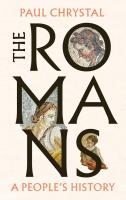
Reaktion Books (2026) h/b 416pp £20 (ISBN 9781836392644)
There is often today a strong feeling that the writing of history has in the past been in the hands of a privileged male elite which has concerned itself too much with the doings of its counterparts in other ages. The story of ordinary people—including women—remains and needs to be told. To confront a society and the growth of a huge empire which lasted for over a thousand years whilst keeping this firmly in view requires a brave heart, an indefatigable curiosity and an unflagging verve, and it must be said that Paul Chrystal has all three. The problem has been how to grasp and control an immense kaleidoscope of evidence.
His aim—‘to write a people’s history’—is set out in the Preface, and in the Introduction he teases out the ingredients of what he believes being Roman meant and how various cultural, societal, administrative and military constructs all contributed to an awareness of Romanitas, concluding with a beautifully apt memorial from South Shields in which a husband’s grief is expressed both in Latin and the dialect of his far-away birthplace, Palmyra.
The first chapter explores some of the early gradations and complicated struggles of early Roman society—this does hop about in time and gets particular incidents like the Verginia story out of proportion. It would be hard going for someone without prior knowledge of the background and vocabulary.
The next two chapters take us up to the fall of the Republic and employ the same strategy—an introduction emphasizing the struggle that plebeians and women faced in order to make their marks in a stratified society. This is then followed by examples. Amongst eight other women Lucretia gets the full treatment (including a luscious, full-page portrait by Gentileschi portraying her suicide). Then there is Spurius Ligustinus with his eight children making his way in the army and the famous Tiro, Cicero’s diligent and loyal secretary, who prompts a glance at the survival of his shorthand system.
The next chapter mostly veers away from personalities and covers some conspicuous achievements in Art including Mosaics, Books and Publishing (Pamphile of Epidaurus—the first known Graeco-Roman woman historian gets a mention). The book trade in the city of Rome leads on then to the renowned Hypatia as ‘a precursor to the feminist movement’.
The following chapter returns to the regular pattern of the exemplum, ‘the common or garden, the salt-of-the earth Roman who was the engine of the Roman world’: we meet among others Gaius Atilius Iustus, a military cobbler, Eurysaces, a freedman baker, Sellia Epyre, an embroiderer in gold thread (a fine illustration here) and Cornelius Philomusus, a theatre scene-painter. There are also two tables listing selected job types against social status.
Chapter Six deals with entertainers, chariot racing, dancing and sex. Two pages and another fine mosaic illustration deal with the gladiators and their accompanying vocabulary, not forgetting their sex appeal. Actors and mime artists get another two pages and a further mosaic. We then move with some gusto into sex for most of the rest of the chapter: brothels, prostitutes, sexually-transmitted diseases, prominent practitioners from top to bottom of society, publicity devices, the squalor of the brothel and its smells, a thorough immersion in the niceties of sexual vocabulary, and the varieties of adjunct occupations. This section ends with a glance at death and a few ingenious methods of execution with all their horrors.
The next two chapters on Roman women, children and on slavery cover more familiar territory with cameos of individuals who broke the mould of traditional Roman values as well as the rare examples of lower class corporate revolt which were so ruthlessly put down. Warfare and the Armed Forces get a short introduction and a tantalizing series of individual glimpses: Tullius Felix, the young eagle-bearer killed in Numidia, Claudius Ingenuus, the trumpeter killed on the Danube, M. Caelius, the centurion killed in the Teutoburg disaster, and a well-known corner of the social life of soldiers’ wives from the Vindolanda tablets.
A short and somewhat sketchy look at Medical Science and Medical Services is followed by a substantial treatment of Religion, Superstition and the Dark Arts (sections of this chapter are not for the faint-hearted!). This delves into magic, witches, curse-tablets, love-charms, voodoo dolls and the counter-efforts of nervous officialdom. The following chapter on Death and the People is oddly short—it could have been a happy hunting ground for the author’s keen interest in epigraphic evidence.
In a book of such panoramic scope a sudden whole chapter on Roman Britain seems more than a little parochial but does serve to remind us of how we fitted into the scheme of things and the various influences from which we benefitted. The following chapter on Public Services covers some of what are claimed to be universal benefits—the ‘range of public services throughout the Roman Empire for rich and poor alike’. It covers fire-fighting, the maintenance of public order, the water supply, sanitation and sewers, latrines (including intimate details of anal hygiene), Roman baths, communications, roads, public buildings, the corn dole, and public records—a plethora of topics in space and time.
The next chapter entitled ‘The Welfare State’ looks at ways in which the state/emperors devised forms of support to try to satisfy the needs or demands of the plebeian/ordinary Roman. This is followed by a chapter on the Roman Forum with a description of the main Fora in Rome and an account of how the concept functioned as a pattern for giving a sense of a much wider community. The final chapter covers what is usually described as everyday life—eating and drinking, the common components of meals, meal times, the nature and form of the insula and the domus and the social gradations of the inhabitants, shopping, household details including the pets, and opportunities for entertainments.
There are six Appendices: Some Common Latin Terms; Epigraphy and a list of the main epigraphic publications with their usual abbreviations; the Seven Kings of Rome; the Roman Emperors; the Roman Assemblies; the Cursus Honorum.
This is then a brave enterprise and ample testimony to the knowledge and labour which has gone into the collection of so much material. Does it though live up to its sub-title ‘A People’s History’? Well, yes—it is a painstaking and enthusiastic assembly of a mass of relevant information; but also, no—and for two main reasons.
First, there is a persistent feeling on coming to the end of each chapter that the generous wealth of evidence has not been fully digested—an over-flowing source-book but somehow lacking a unifying vision. It whets the curiosity again and again but one longs for the picture. The other reason is that, as the author readily admits, a great deal of our evidence for the people of the Roman world derived from the top ten per cent of the ancient population. However, in the last forty or fifty years the detailed labours of many archaeologists, epigraphists, papyrologists and above all comparative economic historians have brought us very much closer to an understanding of how the unseen ninety odd per cent of people in the Roman world may have lived and managed their lives. What were the realities of subsistence farming or household budgeting, for instance? The final chapter does touch on this but the closer realities of ordinary life can now be understood in much more domestic detail. Books like Kim Bowes’ recent Surviving Rome are beginning to open our eyes.
One serious technical complaint has nothing to do with the book’s author. The book has been delivered with a warning from the publisher that the reviewer should not quote ‘without checking against the final book’. This is all too necessary: the book as received is a proof maddeningly peppered with misprints (or errors?) which the most cursory proof-reading should have picked up and which the reviewer is instructed to check against some final version of the book which has not been received. Publishers do have responsibilities, and sending out a proof in this condition for review is a grave disservice to a careful, serious, experienced and enthusiastic author. Paul Chrystal deserves much, much better than this.
John Muir