
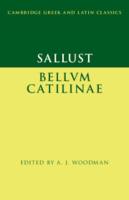
CUP (2026) p/b 358pp £24.99 (ISBN 9781009371490)
Sallust (like Thucydides) was a rare ancient historian who witnessed what he described, and he did so in astonishingly original and powerful Latin, being quoted in antiquity more often than any Latin prose author after Cicero. He wrote, as Syme (Roman Revolution p. 249) put it, ‘with all the melancholy austerity of a moralist and a patriot’ but the Bellum Catilinae (henceforth BC) is not so much a jingoistic jeremiad as a thoughtful and exciting account of a time when hundreds of years of Roman republicanism looked—and were—on the verge of collapse.
The Latin is versatile and deceptively simple: Sallust can produce honeyed phrases, balanced clauses and superb rhetoric, but he also his own snappy, archaic and pithy narrative style. The BC is also an excellent page-turner: there are secret meetings, a female whistle-blower (Fulvia), drinking of human blood, murder-plots foiled, a nocturnal ambush, some brilliant oratory, a grisly prison scene—and a superbly climactic (but problematic) battle-scene which leaves the reader almost as conflicted as one is at the end of the Aeneid and the De Rerum Natura. The author maintains suspense: halting the action at key moments (such as 53-4 after the verdict was delivered to execute the conspirators) to interpose his own thoughts in digressions, rather like the chorus in a Greek tragedy. All this in the space of about 33 pages of Latin.
W.’s Introduction covers everything we need to know about Sallust and Catiline as people, before looking in more depth at the text itself as a self-consciously artistic creation. The chief witness to this war was of course one of its leading actors—Cicero—and W. explains with wonderful clarity how Sallust was not hostile to Cicero—but neither was he his mouthpiece, and the infrequency of any references to Cicero’s published speeches In Catilinam make Sallust’s judgement all the more worthwhile. W. examines the structure of the BC and shows how the author melds together narrative and commentary, aiming to maintain interest both in the racy mixture of intrigue (‘none of which would be out of place in a modern thriller’ [p.14]), counterfactual reflections (e.g. p. 39) and empathetic assessment of characters—above all the central figure of Catiline.
This man enters the book as a villain but dies like a hero (60.7), outplaying Petreius (who underestimated him to his cost) and proving that he (like Jugurtha in the BJ) was as much a creature of Roman mores as their destroyer. Catiline’s rousing speech to his men (58) leaves the last couple of pages to the brilliant coup de theâtre of the final battle, where the villain dies fighting bravely and his conquerors end up with very mixed feelings of grief and joy over their victory in what starts as an uprising and ends as a civil war. Sallust’s political thought is examined judiciously by W. (pp. 15-18)—put simply, Rome declined after its defeat of Carthage in 146 BC when good old Roman virtues were replaced by corrosive avaritia and ambitio—but this oversimplified moral tub-thumping is outplayed by the subtlety of the debate and especially the characterisation embedded in this ‘open-ended’ text.
About half the text is taken up with narrative, the rest being direct speech either by the author himself (in the form of a long preface and several digressions) or in the mouths of his key players such as Catiline, Cato and Caesar. Catiline’s speeches are freely composed by Sallust but the speeches of Cato and Caesar might have drawn at least some of their material from the ipsissima verba recorded in the senate-house—although W. is rightly sceptical here as the debate is too close to Thucydides’ Mytilene debate (3.37-48; see pp. 259-60) to be a coincidence.
W. takes us through three major features of Sallust’s style: brevity, Thucydidean influence and archaism (such as his use of 5th declension plebes at 37 but 3rd declension plebs at 33.1)—which is a feature that W. shows to be a mannerism rather than anything more programmatic. There follows a wonderfully rich account of the reception of Sallust in Rome after his death: even before the battle of Actium in 31 BC great writers were reading and alluding to his work. Tacitus (Annals 3.30.2) refers to him (hexametrically) as rerum Romanarum florentissimus auctor and his imitation of (as well as his distancing from) Sallust confers on the older man the highest accolade from his ablest successor. The Introduction ends with a brief account of the textual tradition and a remarkably astute discussion of the question of orthography in printing this text. W.’s text is his own, with a selective apparatus criticus, and the main areas of textual disagreement (e.g. 53.5, 57.4) are fully and clearly discussed in the commentary.
The commentary is a delight to read. Sallust’s Latin is generally simple, but W. translates and explains anything which might puzzle the student, and he translates any Greek which is quoted. We receive help with vital historical information, so that this book can be consulted by a reader with little knowledge of the period: and the commentator also points out the rhetorical and literary effects of this text, using typographical features to bring out the way sound and sense combine to create Sallust’s mesmerising prose: see (e.g.) his note on 5.4 where he prints ‘satis eloquentiae, sapientiae’ to bring out the sound-effects. It will be no surprise that this commentator on Horace is highly attuned to prose-rhythms both in terms of clausulae and also where the prose slips into something like epic metres (see e.g. 6.1n., 12.1n., 53.6n.). Where more information is called for, W. offers abundant guidance and his command of the voluminous secondary literature is total.
Sallust’s sententious preface appears to offer us a quasi-philosophical analysis of events, and yet (as W. puts it [p.17]) ‘there is little, if anything, that is original’ about it. Sallust’s blend of moralistic hyperbole in describing the effects of Asian conquest on Roman troops—like the sentiments of Cato at 52.22-3—can sound today like the rantings of a black-hatted Puritan, but W. elegantly shows that Sallust was subscribing to ‘the common ancient belief in environmental determinism’ (p.141) with eminent back-up from Herodotus and Hippocrates amongst others. Where Sallust generalises—the Gallic race is bellicosa (40), young men are ferox (38), the Roman plebs was fickle and selfish (48)—W. is on hand to qualify and offer context and subtlety. Where Sallust winds up the suspense, taking us into the thought-processes of the Allobroges (debating whether to help Catiline right their wrongs or alternatively help Cicero and thus incur his valuable support) or of Cicero (46.2)—who wants to save the state but is anxious about bringing down key citizens and risking his own future—W. looks at the bigger picture and points out (e.g.) authorial hindsight where he sees it. The set-piece speeches by Caesar (urging imprisonment rather than execution of the conspirators) and Cato (urging the death-penalty) are outstanding compositions, revealing far more about Roman ideas and ethical values than one might expect, and (again) W. is generous with his help as he brings out their artistry along with their arguments. The book ends with a select bibliography, a general index, an index of Latin terms and a list of ‘select intertexts’. The proofreading is exemplary and the price is well within the budget of students—and of librarians who should stock this book and promote it.
Sallust has slipped off the examination radar in recent years and it is high time that he made a comeback. When Cicero (Ad Fam. 5.12.5, quoted p.302) was urging Lucceius to write up the Catilinarian conspiracy for him, he promised hyperbolically (and self-interestedly) that a full account of the events would fill the reader’s mind with the sweetest pleasure (expletur animus iucundissima lectionis uoluptate). He was right.
John Godwin