
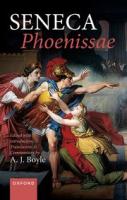
OUP (2025) h/b 477pp £176. (ISBN 9780198889168)
Phoenissae was (probably) the last play Seneca wrote before his forced exit from the world in AD 65. It is a hugely interesting text: the manuscript breaks off at the end of Act III and there are no sung choral lyrics in it, so that the eponymous ‘Phoenician women’ never actually speak: the ending is also abrupt, and the text lacks the usual Senecan prologue. This all leaves Phoenissae as a work of elusive incompleteness but one which nonetheless shows us a tantalising blaze of Seneca’s dramatic and poetic fire at the end of his creative career.
The opening act sees the old man Oedipus in exile with his daughter Antigone, driven by anger and the compulsion to kill himself. Their dialogue expresses both the closeness of their relationship and the theme of suicide within the play. The second act is a masterpiece of design and dramatic writing which divides down the middle with an ‘Oedipal’ half and a ‘Jocastan’ half. First of all, a messenger arrives, begging Oedipus to help in the upcoming war between his sons, one of whom has married the daughter of the king of Argos and is about to attack his native Thebes to gain the throne. Oedipus—mired in his own self-loathing and guilt—refuses to help and even welcomes the civil war before leaving the stage. Jocasta—the wife/mother of Oedipus who took her own life in Oedipus the King—is here very much alive and now enters, agonising about the conflict and channelling her own guilt into maternal care for her beloved boys. Her speech of aporetic self-debate (377-86) sees her rise to the role of true tragic heroine—one thinks of Hecuba, for instance—and matches the negative wrath of Oedipus with more positive emotional and philosophical honesty in a Latin which is clever and convincing, assisted by Antigone who is trying to keep both of these parents alive. Jocasta opens act 3 by going onto the battlefield, standing between the warring brothers and inviting them to kill her first. This opens up both the tragic scenario of (say) Orestes the matricide and also the recent drama of Agrippina’s murder at the orders of her son Nero—that chilling line (447) hunc petite uentrem (‘strike this womb’) cannot but recall Tacitus Annals 14.8. There is a powerful agon scene between Jocasta and Polynices and then—just as Eteocles starts to present his side of the debate—the manuscript stops. The final act(s) would presumably have concluded the debate and seen the deaths of all three, although how this would have been staged is anybody’s guess.
As in previous volumes, Boyle gives us a lengthy introduction, his own Latin text, a performable English verse translation, and a detailed commentary. The first five sections of the Introduction—on the background to the text—are reprinted from earlier volumes, but B. gives us new and wonderfully perceptive pages (60-122) on the myth, the play and its reception. B. makes it clear just why this plot appealed to Seneca, working as he was in the human zoo of Nero’s court: its themes of ‘violence… self-loathing, suicide… the cyclicity of evil, the allure of power…the triumph of nefas… the dissolution of political, moral, social and natural order’ (p.69) give this play a contemporary feel both in AD 65 and in AD 2025, and pp. 108-111 analyse how this Greek drama is a ‘mirror of Rome.’
B.’s mastery of the entire corpus makes him the perfect commentator to point out how this play fits into the author’s oeuvre and what is perhaps most striking is how this long introduction interlocks with the commentary, analysing the text in broad terms but also making a lot of acute literary observations of its own (see for instance the analysis of 279-87 on p. 80-81) and sometimes dropping brilliant comments into the abundant footnotes (see e.g. p. 84 n.218 on Ismene). There are fifty pages of bibliography, an index of passages from elsewhere in the Senecan tragic corpus and a general index. The quality of copy-editing and production is excellent, and the book is handsomely produced.
The verse translation is printed facing the Latin text. It is rhythmic without being doggerel, and is close enough to parse the Latin but lively enough to be performed. For an example of this, here is Oedipus talking to Antigone about his doom-laden infancy (243-8):
infanti quoque
decreta mors est. fata quis tam tristia
sortitus umquam? uideram nondum diem
uterique nondum solueram clausi moras;
et iam timebar. protinus quosdam editos
nox occupauit et nouae luci abstulit
This is rendered:
as a mere baby
I was marked for death. Who was ever allotted
A fate so grim? No sight yet of daylight,
No release yet from the hold of a closed womb,
And already I was feared. Night has seized some
Straight from birth and robbed them of the new light.
The commentary shows how some of this borrows from Seneca’s own Oedipus, some of it goes back to Euripides’ Phoenissai 1595-1600, and much of it is freely created for the occasion. The translation recreates the anaphora of nondum and nicely captures the ‘noun style’ of uteri… clausi moras with ‘hold of a closed womb’. Elsewhere there are felicitous renderings such as ‘lug an unburied father’ for patrem insepultum trahere at 98 or ‘carpeting the fields’ for obtexit agros at 636. Sometimes the Latin falls into excellent English easily (e.g. 318-9) but the real achievement is translating the Senecan paradoxes which makes this play both rhetorical and punchy: Jocasta’s nil possum pie/ pietate salua facere at 380-1 is excellently saved with ‘I cannot act with family piety with piety preserved’ and the gnomic one-liners (e.g. 79, 181, and Eteocles’ few sententious lines at 654-664) are neatly captured in suitably pithy English.
The commentary is up to B.’s high standard, glossing the text in Latin and in English and offering a full range of intertextual comparanda as well as astute remarks on the style and content: see e.g. his full helpful note on 252-3 (p. 277) which covers everything a reader would expect: stylistic and linguistic explanations as well as a full account of possible allusions to other plays on the same theme; or the massively helpful long note on the messenger scene on pp. 301-2; or the concise note on the unique three-word line 223 with its brilliant coinage incestificus. All Latin and Greek is translated into good English—although B. sometimes cites modern scholars (four times on p. 99 alone) in their original languages without translation.
Lipsius in 1588 asserted that Phoenissae is a ‘little gem of writing’ (scripti gemmula: quoted p. 112) and B.’s new edition and hugely helpful commentary make this gem shine brighter than ever before. B. proves beyond all doubt that this play deserves to be read and taken seriously as a major piece of drama and a fascinating study of humanity at war with itself.
John Godwin