
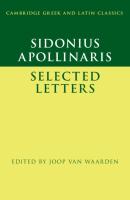
CUP (2026) p/b 306pp £28 (ISBN 9781009087629)
Sidonius Apollinaris was a man of consequence in the 5thcentury of our era: man of affairs, Bishop, epistolographer, poet, praefectus urbi (AD 468; he may even have had hopes of the consulship), occasional diplomat; yet we cannot state with certainty the date either of his birth or of his death: ca. AD 430 for his birth and the AD 480s for his death are as close as we shall get, thus allowing Sidonius to see what is often regarded as the ‘formal’ end of the Western Roman Empire in AD 476, when Odoacer transferred the western imperial regalia to Constantinople.
This ‘Green and Yellow’ from Cambridge contains 20 Letters (and three poems), compared to the 147 letters, and 36 poems which he is known to have written. The poems generally observe classical canons, though with not a few exceptions; they also show considerable ingenuity with Names and Places, and are mostly unexciting to read, but they also include the worst Spondeiazon that I have ever seen. They comprise hexameters, elegiacs, hendecasyllables and even sapphics. The Introduction is of exemplary quality: in an era for which external sources of history are scarce, W. reminds us that S.’s correspondence is an important source.
Sidonius (henceforth S.) was born in Lyon around AD 430 from high-ranking Gallo-roman nobility; he was at least partly educated in Arles; returning to Lyon circa 452, he married Papianilla (daughter of Avitus, the future Emperor in the West) with a substantial dowry, there were 4 children, who receive scant mention in the correspondence (the son was clearly rather unsatisfactory). The 460s were a period of aristocratic leisure, in which he will have created much of his (substantial) output of poetry; inter multa alia he prepared for baptism—he became bishop of Clermont ca. 470. The increasing power of the Visigoths led to S.’s exile (c. 475) to a fort near Carcassonne, but he was pardoned within a year or so and reinstated as bishop after paying poetic respects to Euric, king of the Visigoths. He died between 479 and 486, possibly at Clermont.
W., in the second section of the Introduction, lists the works that have survived, including the 36 works in verse; there is a considerable margin of uncertainty when it comes to dating the individual pieces. His religious output, which must have included many sermons, is lost. And although S. was a writer in the mainstream of Latin literature, he has to be understood within a broader ‘literary and historical paradigm’.
Late antiquity has been summed up as a ‘different antiquity, a different civilisation’ (sc. from Augustan Rome); the late Averil Cameron described it as ‘remaking the past’. (Did S. know any Greek? There is no hint of it, though the letters contain many Latinised versions of Greek words —transcribed, not translated). W. takes us briskly through the fifth century, with the influx of Germanic populations (‘a period of insecurity and change of statehood’); Vandals caused havoc from 406 as they moved across the country all the way to Spain. S. himself changed sides from Visigoths to Burgundians in the 470s, which led to his brief exile at Carcassonne, ended, as mentioned above, after S. paid poetic respects to Euric, king of the Visigoths—surely calling on all his diplomatic skills.
W. goes on to draw attention to the tensions which resulted from the progressive domination of Gallic society by newcomers: highly educated Romans showed condescension to the incomers—who, however, needed Romans to run the state. Social strata were very distinct, as displayed in S.’s correspondence with blue-blooded Gallo-roman aristocrats and intellectuals—yet we also find glimpses on his journey from Lyons via Ravenna to Rome of a range of ‘ordinary working people’, of whom W. gives a generous selection; the position of women, however, ‘must be teased out between the lines:’ The same journey, which involved crossing the snowbound Alps, displayed Ravenna’s manifest lack of an adequate sewage disposal system, leading to S. being afflicted by a ‘fever’ (malaria?) and desperate for a drink of clean water.
For both the intellectual and administrative elites, office holding was an essential gauge of status, with office-holding gradually gaining weight over birth for the aristocracy; thus in 468 we find that S. celebrated the (distantly related) emperor Anthemius in a panegyric, was promoted to the rank of patricius, and appointed praefectus urbi; a year or so later he was appointed bishop of Clermont, a role which he evidently took seriously. At the same time, the Neoplatonism of Sidonius and his friends in the ‘Platonic brotherhood’ was centred on Narbonne, where it ‘peacefully coexisted’ with a non-polemical Christianity (the works of e.g. Origen had to be translated into Latin by scholars such as Rufinus of Aquileia); the emperor Constantine had embraced Christianity in 312 and Theodosius 1 excluded pagan cults from the public sphere in the 390s. W. also explains the moderate asceticism which originated in the island monastery of Lerins (near Cannes).
In literature, we find both a harking back to the classical past and production of anti-classical works—‘textual mosaics from heterogeneous fragments’; visual effects were popular and often achieved by ekphrasis. W. describes briefly the distinctive strategy via ‘intertextuality’ of late antique poets. Letter writing was an indispensable tool of day-to-day exchange (taken by S. to an elite level of literary sophistication).
W. looks in detail at S.’s correspondence: pp. 16-25 are essential reading: they cover the structure and aims of the (ultimately) nine book collection; epistolary conventions; text, linguistics and narratology; intertextuality (where W. lists eleven poets on whom S.’s poetry to varying degrees relies). Plautus and Terence supply archaic language; cultural anchors are Fronto, Pliny, Varro, Gellius, Apuleius; glimpses of Cicero, Sallust, Livy and Suetonius are less important than epic—especially Lucan; the Bible too is an important point of reference. W. helpfully fleshes this out with appropriate references to the selection in the volume under review. ‘(You are) veteris reparator eloquentiae’, wrote Mamertus Claudianus, a lifelong friend. S.’s syntax is almost wholly classical; his style includes both smoothness and complexity, of which examples are given. It is noteworthy that his clausulae are classical, with cretic plus spondee (e.g. esse credebant) accounting for 28% of cases.
W. then briefly looks at S.’s ‘afterlife’, followed by a look at the MSS tradition; we possess 77 manuscripts, ultimately depending on an ur-archetyp with a bipartite stemma; a table is provided of the 47 places where van W.`s text, based on Lutjohann`s ‘seminal’ edition of 1887, is reconsidered in the light of Dolveck`s revision and new stemma of 2020, the aim being to approximate the ur-archetyp as closely as possible. The differences are relatively minor.
The Latin text, comprising 20 letters (one of which is of only one line), takes up no more than 23 full pages (whereas its Bibliography occupies 26 pages, and the Commentary on the Latin exceeds 200 pages). The text also includes three examples of S.’s verse (elegiacs, sapphics and hendecasyllables). The Cambridge ‘blurb’ for the book describes the Commentary as detailed, ‘providing help down to the level of individual words’: its length fully justifies the description. S.’s Latin is not especially difficult to read, though sentences can be overlong, and his vocabulary of necessity includes many unfamiliar words.
Here in more detail is how W. approaches just one letter, 2.9, i.e. the ninth letter in Book 2 of the Correspondence. A letter is typically introduced by W. with an outline of its content, a general introduction, the narration (the self-presentation of the author, with eating and drinking never far off the agenda), verb tenses (and clausulae), readerly focusur-archetyp—the letter aims to create a diverting story for senators about senators; the addressee (Donidius), was a virspectabilis, an intermediate degree of senatorship; the date (almost certainly during one of S.’s periods of retirement, i.e. 461-7). and place (discussed, but not quite settled), and recent literature (here rather short, unlike the 13 items given for Letter 2.10). Thus letter 2.9 (entitled ‘Villa Life’) has all the preceding items, and plentiful detail is given; indeed, the two pages of Latin are followed by 19 pages of commentary, in which—for example—the reviewer had not previously encountered diversorium (guest wing), gestatio, (a formal walk set in shrubberies and often connected to a colonnade, or catastropha, which has puzzled the lexicographers, but may be part of a game: S.’s fondness for superlatives is well displayed : amoenissimos, humanissimos, lectissimos, voluptuosissimum. The mood of the letter is distinctly upbeat. Overall, in reading the Letters, I found that there was not even a single instance where my perplexity was not put to rest by van W. (who does not, however, comment on the technical aspects of the poetry, e.g. non-classical trisyllabic endings of pentameters in elegiac verse).
Van W. has written extensively on Sidonius, and this scholarly and generously proportioned Commentary will be welcomed by future scholars or students who concern themselves with him: the softback edition is attractively priced, and CUP’s printing standards are, as usual, impeccable: I noted just one, utterly trivial, typo.
Colin Leach