
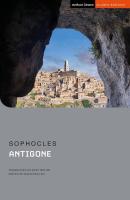
Methuen (2nd ed., 2026) p/b 69pp. £10.99 (ISBN: 9781350510425)
Sophocles’ Antigone is being staged—and studied—somewhere in the world probably every day. This new edition is aimed at drama students more than classicists, and assumes no knowledge of the play or its setting. The editor David Bullen provides a crisp summary of the dramatic world into which this play and its author were born and urges us to see past the modern baggage which the word ‘tragedy’ has acquired. He discusses the nature of Greek tragedy and wisely steers us away from the misguided reliance on old tropes like ‘tragic flaw’ in favour of seeing the genre as evolving as it was being composed by a succession of highly original minds.
B. writes well about the chorus, seeing them as ‘raising the stakes’ as they show the public nature of what is being handled on stage and also bearing their share of the fallout for what happens. The opening dialogue of Antigone and Ismene alone on the stage offers insight into their isolation but also gives them a rare chance to speak freely, out of earshot of ‘the men who dominate their lives (including the chorus)’. B. also explains with admirable clarity the traditional generic features of agon, kommos, and messenger-speech. Since the chorus is not generally found in modern drama, it is right that this author takes the time to explain its importance in Sophocles: he also discusses the place of ritual and gender-roles in ancient tragedy which a modern European audience could find troubling. Traditional roles of women are seen in Ismene and Eurydice but exploded (largely) in what B. calls the ‘rambunctious’ role of Antigone who defies the state but does so in observing the traditional female role of tending to the dead.
B. devotes a sensible amount of space to the dramatic festival, going so far as to compare the City Dionysia to the Eurovision Song Contest rather than to an evening at the Donmar Warehouse. Greek dramas were performed outdoors and the dramatic use of space is ably described and discussed. Another key point of difference between ancient and modern theatre is that the actors were all male and wore masks: these points are well explored and explained, with wider inferences drawn about the ancient approach to drama. The transmission of the text is briefly accounted for and then follows an insightful page or two on how Taylor’s adaptation of the text for a television audience throws up anomalies to the ancient (and the modern) ear—of which more anon. The problem of avoiding the Scylla of canonicity and the Charybdis of banality is splendidly handled in a succinct page or two.
The book also prints Don Taylor’s ‘translator’s note’ which is his apologia for his taking on this task. He seeks to justify his decision—as somebody with no knowledge of ancient Greek—to produce a version of the Antigone as an experiment in delivering Greek tragedy on television. His tone is strident at times, presenting himself (as a working director and writer of plays) as better placed to do what had been ‘left to Greek scholars and poets’ in the past. He wanted to sell Sophocles as a ‘thrillingly compelling new world’ even if this has meant transforming the text into ‘a new English poem, full of its own energy and vitality, not a pale reflection of the old’ (p.xxxv).
In doing this he clearly feels vindicated, but he fails to see that translation is not a binary choice between his own stylised adaptation on the one hand and a version which would involve ‘puffing up of the emotions by Victorian Rhodomontade’ (p.xxxv) on the other. This is obviously untrue, as a glance at versions such as that of Fagles (1982)—which do the same job with far greater fidelity to the original—would show. More seriously, he makes no reference to the ground-breaking work of Tony Harrison and Peter Hall in transferring Aeschylus’ Oresteia to the stage several years before him: here a first-rate poet and a first-rate director showed how the impossible can be achieved, the text can be translated in a new idiom with inspiring results.
The Greekless T. cannot really compete in this company and takes enormous liberties with the text instead—liberties which affect our interpretation of the play. Take Eurydice’s line at 1191:
κακῶν γὰρ οὐκ ἄπειρος οὖσ᾽ ἀκούσομαι.
This is translated by Fagles as ‘sorrow and I are hardly strangers. I can bear the worst’ which is close enough, even if ἀκούσομαι is not translated: the same line is given a bizarre twist by T. who has Eurydice say ‘we are bred to stoicism in this family’ which both imports a philosophical system not thought of in Sophocles’ time and also makes the speaker seem more like Lady Grantham than the sad, lonely mother, turning her 1st person singulars into a pompous plural.
Worse happens when T. chooses to present the guard who reports the burial as a low-life character with a mockney accent—indeed Tony Selby who played him in the television production also acted in Eastenders. This is nothing like the nuanced way Sophocles depicts him: in the original Greek the guard uses high diction with gnomic utterances (see Griffith’s 1999 edition of the play ad loc.) which is a long way from Taylor’s rambling gibberish. At 269-70 where the Guard says that
λέγει τις εἷς, ὃ πάντας ἐς πέδον κάρα
νεῦσαι φόβῳ προὔτρεψεν.
(‘one man spoke out and made us stare at the ground,/ hanging our heads in fear’ as Fagles has it.)
T. turns this elegant phrasing into: ‘then one of the fellers had his say, and he scared us all shitless I can tell you’.
T. is right to plead that we need versions today which aim to be as striking as the original was in the 5th century BC. The problem lies in T.’s claim that we owe Sophocles ‘the most idiomatic’ (my emphasis) language we can find, as idioms go out of fashion very quickly. So, when T. has Creon shout (p.37) ‘you damned impertinent devil’ (for ὦ παγκάκιστε) at his son Haemon he sounds absurdly Victorian. T. then brings in an extraneous metaphor of his own in translating the Greek word κενός (‘empty’ ‘void’) as ‘misbegotten’ at 753-4 before rendering Sophocles’ idiomatic imperative μὴ κώτιλλέ με (756) as ‘don’t father me…you’re a woman’s lapdog’ when the words mean ‘don’t flatter me’ (vel sim: Griffith [ad loc.] points out the gendered senses). Again, even back in 1986 angry males were unlikely to call each other lapdogs.
The translation simplifies the Greek where the original would confuse the television audience, but some mythological references (e.g. Menoeceus, Niobe, Labdacus) remain and the notes on the play-text by B. explain these clearly along with brief pointers to some themes and also some help for modern readers with English words no longer in common parlance (e.g. ‘superannuated’). There is a chronological chart of the poet’s lifetime and a few suggestions for further reading (pp. xxv-vi), to which I would add George Steiner’s excellent Antigones (OUP 1986).
I cannot end without a note of gratitude to the BBC, whose production was duly taped and played in endless Classical Civilisation lessons to allow teenagers to experience the drama taken seriously by serious actors, even if the chorus was less securely cast, with one old chap visibly unable to recall his lines. The students learned the text from Fagles—but they got the issues and a real sense of the visual side of the drama from this production. It is high time that the BBC commissioned a new one.
John Godwin