
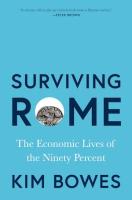
Princeton (2025) h/b £35 490pp (ISBN 9780691273334)
Reading this book made me think of the Bechdel test. You may have heard of it. It is a measure of the representation of women in films. The test is, in this film do two female characters ever have a conversation about anything other than a man? It is an idea that changes one’s perspective about male bias in the cinema.
It is a bit like this with ordinary people and the history of the Rome Empire. Ancient Rome is a rich and vivid part of history, but too often, it is all about the elite. This is not a surprise because the literature, monuments and fortifications, were written and built by the elite. However, in recent years there has been a quiet revolution in the archaeology with the discovery of thousands of papyri preserved in the sand of Egypt, numerous handwritten postcards from the saturated soil underneath Vindolanda, and graffiti on the walls at Herculaneum. These delicate texts are coming to light and being examined, and in them we can make out the voices of the common people. These are the writings of workers and farmers who made up the vast majority of the population of the time. It is these people whom the archaeologist Kim Bowes, focusses on in her book Surviving Rome: The Economic Lives of the Ninety Percent.
Nothing is more complicated than other people’s personal finances; a true statement if ever there was one. And in this book, Bowes makes it clear that it was just as true for the everyday Roman people as it is now. Far from a life of subsistence, people at this time managed and kept track of a bewildering array of accounts, loans, debts, taxes, rent, earnings in coin, goods and favours. They tackled issues like, who owes what to whom and when is it due? Can I sell my wool before it is shorn, to pay the merchant for the seed I sowed last month? Is my child old enough to be sent to the wife’s brother to learn as an apprentice, or work as a slave, or perhaps both? The distinction wasn’t clear, but it was one less mouth to feed either way.
The texts reveal accounts like that of an ox-driver’s wife, who withdrew her husband’s pay to make a down payment on wholesale wine, which they sold in the town for a profit. The ox-driver, Maron, was also a day-labour for the local landowner but didn’t immediately use the money he earned but left it on account until this wine-selling trip. The money untouched for months highlighting that coin-use rarely made up more than a small proportion of the ordinary person’s economic world. A world which this book pictures vividly.
It is remarkable also, how much sophisticated numeracy people would have required to do this. They would have needed to calculate percentages and interest rates. Perhaps literacy was also more widespread than we thought. What Bowes suggests is not to look at whether people were numerate or literate or not, but what degree of literacy and numeracy people needed. The view of Roman society consisting of a tiny aristocracy squeezing taxes from subdued hordes of peasants, underestimates working and farming communities enormously. After all, humans have always been clever, wherever and whenever they come from.
Bowes’ work demonstrates that the ninety percent were also consumers. They bought a lot of stuff. And it was not only essentials they bought, but what we might call luxuries, (which, by the way, they pawned in the hard times). But these were necessary luxuries, like an iPhone is necessary to a teenager. These things were the must-haves that secured people’s position in their social groups. These consumables were the cost of engaging in society. For example, even the poorest needs a smart suit for a funeral or a job interview. This kind of social belonging has always been important and at those times perhaps even a matter of survival.
The book follows the evidence and hence centres on Egypt, Italy and Britain in the first to the third centuries AD. It has seven themed chapters with footnotes and a thorough academic bibliography. It is also written for the lay person and contains many fascinating and entertaining examples. Until recently studies of the ancient Roman economy have been somewhat dry, top-down, monetary and fiscal analyses, but this is a bottom-up examination of the everyday, and just like Bechdel, succeeds in changing our perspective.
Guy Harvey