
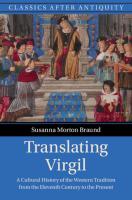
Cambridge University Press h/b 992pp £150 (ISBN 9781108470612)
Cambridge University Press’ Classics after Antiquity series, as the second page of Susanna Braund's new book states, ‘presents innovative contributions in the field of Classical Reception Studies. Each volume explores the methods and motives of those who […] have entered into a contest with and for the legacies of the ancient world. The series aims to unsettle, to provoke debate, and to stimulate a re-evaluation of assumptions about the relationship between Greek and Roman classical pasts and modern histories’. This volume, we are told on the very first (half-title) page, ‘is the first synthesis and analysis [of the translation history of Virgil]. It asks when, where, why, by whom, for whom and how Virgil’s poems were translated into a range of languages. Chronologically it spans the eleventh- and twelfth-century adaptations of the Aeneid down to present day translation activity, in which women are better represented than in earlier eras. The book […] challenges classicists and other literary scholars to reassess the features of Virgil’s poems to which the translators respond and offers a treasure trove of insights to translation theorists and classicists alike.’ How far Braund achieves these ambitious aims is the subject of this review.
It is a clue to the extraordinary scope of this book that the bibliography runs to 95 pages, a testament to the vast reading and admirable dedication of the author, who has given us a comprehensive account not only of translations – Braund discusses over fifty languages, from Afrikaans and Argentinian Spanish to Ukrainian, Welsh and even Esperanto – but of a whole world of adaptations, versions and travesties not just of Virgil but of Ovid, Horace, Lucretius, and of course Homer himself, without whom there could have been no Aeneid. Braund gives full weight to the major figures in Virgil translation, such as Douglas, Caro, Dryden, Pope, and William Morris, and in modern times scholars and poets like Day-Lewis, Rieu, Jackson Knight, Fitzgerald, West, Lombardo, Fagles and Heaney. There are useful chapters on ‘The Paucity of Female Translators of Virgil’ (an improving situation, as mentioned above) and ‘The Economics of Translating Virgil’ (how authors, illustrators, publishers and printers make sure copies will sell) as well as one with the irresistible title ‘The Fascination with Dido’, to mention but a small part of this huge canvas. Further than this, Braund, Breugel-like, brings to life the many different milieux in which so many scholars have tirelessly toiled away. What emerges, fascinatingly, from this almost 1000-page study is the degree to which for a millennium students in the humanities – and even the general reading public, as the four Penguin Classics Aeneids attest – have been obsessed with Virgil. As Braund says (p. 42), ‘At least until the mid-twentieth century, Virgil’s Aeneid was often viewed as the central text of European literature: “the classic of all Europe”, according to T. S. Eliot’.
Throughout the book Braund uses close textual analysis to great effect to explore every aspect of a translator’s relationship with the original text. But she does far more than that. Every translator of importance is carefully placed in his or her historical, social, ethnic, and literary context, and Braund adduces an abundance of material in order to place the translator both synchronically and diachronically vis-à-vis predecessors, peers, competitors, critics, admirers, the general public and, of course, those who follow and are influenced by the translator’s work. Thus Braund is enabled to trace overarching trends – not to mention feuds – extending over decades, as fashions in translation veer wildly between literal and paraphrastic, prosaic and poetic, and foreignizing or domesticating. Braund is particularly good on this last pair: whether the author aims to represent Virgil’s foreignness as closely as possible, e.g. at the verbal level rendering Penates as ‘Penates’, pius as ‘pious’ and virtus as ‘virtue’, leaving the difficulty of understanding Latin nuance to the reader; or to interpret Virgil in terms of the intended reader’s own culture, e.g. finding words (for an English reader) such as ‘household gods’ for Penates, ‘dutiful’ for pius and ‘manly qualities’ for virtus. But Braund digs deeper than this, explaining how in all ages translators have had axes to grind, very often promoting political agenda as they seek to harness Virgil to comment on, or complain about, their current political situation. Many a translator has portrayed Aeneas as their current sovereign in order to flatter him (see below), or shamelessly altered Virgil’s plot, characters, or even types of weaponry to suit their target audience. To mention just one other form of domestication, Braund fully discusses the many ways Virgil has been Christianized, even so far as to portray Aeneas as a saint, and his wanderings as a pilgrimage.
Braund’s writing style serves her well in such a wide-ranging work, but three features are particularly worth noting. First, the style is discursive. This is not altogether a bad thing: I am intrigued to learn that Goebbels may have translated the Georgics (see below); and that in an illustration by Francis Cleyn in Dryden’s Virgil of 1697 Aeneas’ nose was reshaped to look less like William III’s and more like Charles II’s; and that the astounding John Ogilby had to restart his career three times, after a fall that put an end to his career as a dancer, then a shipwreck in the Irish Sea, then the loss of everything in the Great Fire of London in 1666 (not content with translating Aesop as well as the Iliad, the Odyssey and the Aeneid, and setting up a press to issue superbly illustrated books, Ogilby, we are told, produced the first British road atlas (1675) and created the inch-to-a-mile scale that in modified form is still the basis of modern cartography). Braund, it must be said, is meticulous in acknowledging her sources in the footnotes, crediting other scholars for every fascinating tidbit of information, however distantly related it may be to the translating of Virgil.
Secondly, the style is repetitive: having been told on p. 172 that Hélisenne was ‘an innovator who produced France’s first sentimental novel, Les Angoysses douloureuses qui procèdent d’amour (1538; ‘The Painful Torments that Arise from Love’)’ we do not need to be introduced to the same book in exactly the same words, complete with full title and translation, on p. 235. Again, on p. 173 Braund discusses Hélisenne’s decision ‘to translate part of the epic poem which was the centrepiece of the Western educational curriculum’, and only seven pages later we have her ‘translation of part of the epic poem which was the centrepiece of the Western educational curriculum’; there are countless other instances.
The third aspect of Braund’s style that militates against concision is the ubiquitous reminders of the author’s presence: a good example is p. 44, where on a single page we find ‘I conclude by … I tackle … I analyse in depth … I start with … I address … I consider … I then demonstrate … I argue … I conclude …’. The road ahead is obscured by all the signposts.
A further minor point is that the names of the major translators are in bold type, to refer the reader to the useful brief biographies in Appendix 1, but the methodology for this is opaque: for example, Thomas Twyne is in bold for his three first appearances (p. 6, 58, 124), then drops into roman (p. 136), then is back into bold for p. 242, then on p. 298 is given three mentions, the first two in roman and the third in bold. Braund’s statement on p. 51 that the names are presented in bold ‘throughout the book’ is not borne out.
Finally, there are several problems with the indexing. Although the important figure of Hélisenne is often referred to as such in the text, you will search in vain for this name in the index, as it is not cross-referenced to her other less commonly occurring names (de Crenne and Marguerite Briet). Similarly, the intriguing snippet of information about Goebbels on page 170 is not referenced in the index; instead his entry points us to the briefest of mentions in the Preface (Braund calls the Preface a ‘Prelude’, and the Introduction ‘Chapter 0’, which may not please every reader). Terry Jones of Monty Python fame (footnote, p. 375) makes it into the index, but Matisse, Rembrandt, Wagner and Jean Genet (main text, p. 393) do not. And whilst the entry on the Aeneid is excellent, being divided up into helpful categories, including one for each Book (who knew that there was a Book 14 of the Aeneid as well as a Book 13?), the same cannot be said for many of the other entries, which have so many unidentified page references that they are more or less completely useless, e.g. ‘translations in prose’ has 99 references, and ‘English’ has 225.
The number, range, and quality of the illustrations are all first-rate; and typographically the book is excellent, with very few errors; but for the second edition it should be noted that the eminent German philosopher has been called ‘Friedrich Schleiermacher Schleiermacher’ on p. 37, and that there are two spacing issues in the indented quotation on p. 306. There is a nonsense on p. 617 (‘through a detailed collation Dryden’?) and mistranslations in note 262 on p. 748 (it is Priam, not Pyrrhus, who is ‘slipping in the copious blood of his son’) and on p. 804 (the French for ‘patron’ is mécène, not mécénat). The justification in particular is good, with traditional hyphenation (splitting of words between lines) frequently employed to escape the modern disease of absurdly squeezed-up or wide-spaced words, which occurs only once (p. 793, where a paraphrase from Aeneid 2 has suffered both fates at once). The sturdy cased volume itself is clearly printed on good quality paper with optimal opacity, marred only by the slightly cheap-looking spine printing, where the serifs in the word ‘Cambridge’ run into each other, and the horizontal gold line is not quite centred.
I make no apology for the length of this review, which is an indication of the very serious attention that Braund’s huge survey merits. However, for those who lack either the time or the money to read it, I will cheekily summarize her findings in one word: Dryden. John Dryden emerges as a towering figure, not only the best translator of Virgil there has ever been, but a most astute literary critic. I for one will never be rude again about the seventeenth century and its literary giants; they simply had the misfortune to come directly after a certain bard from Stratford.
Priced at £150 ($195), this important work will be out of reach of today’s students, but will be a most valuable addition to college libraries and to the bookshelves of scholars, and of anyone else interested in how Virgil came to dominate Western literature ‘from the Eleventh Century to the Present’.
Andrew Mackay