
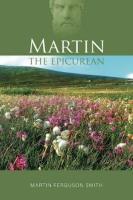
This is a double review:
URBI ET ORBI: The Epicurean Inscription and Prescription of Diogenes of Oinoanda
Tab Edizioni (Rome 2026) Paperback and Open Access 170pp (ISBN 9791256693450)
M. F. Smith
MARTIN THE EPICUREAN
(Silverwood Books 2026) £15.99 (ISBN 9781800423244)
M.F. Smith
The pairing of these two books is inspired. The first gives us a vivid translation of the latest version of the inscription of Diogenes of Oenoanda with a helpful introduction and commentary explaining it, while the second tells the story of the man who has (more than anyone alive) devoted his life to the inscription and who has lived his life by its precepts. If you need convincing that ancient texts still matter, then read these two books and you will see just how much we can learn in the conduct of our daily lives from the long-deceased. S. has been poring over these eloquent stones since 1968, visiting the site countless times and has refused to let anything—from unhelpful colleagues to ill-health—stop him. The value and wonder of epigraphy is also wonderfully evoked in both books, with a reminder that when we read a paper book it is a copy made by countless scribes and editors, but when we see the letters chiselled on stone it is the author’s ipsissima verba in the place and the form where he wrote them. When S. describes the breathless excitement of finding these words, in the very soil of the place where Diogenes had them carved, the effect for the reader is magical.
The inscription is possibly the longest one in existence and after centuries of looting (and of using its stones for building) it is now inevitably a ‘gigantic jigsaw puzzle’ (as he entitled the excellent film on the text available on Youtube). His new book (his 75th publication on the inscription) gives us a new translation of the inscription, complete with a highly readable introduction and commentary notes to bring out the history and the significance of the words. The introduction is a fascinating account of how the excavations started, and how it somehow continued with interruptions from both individuals and also political events; it also explains something of the techniques of obtaining a ‘squeeze’ from an inscription, and makes some acute comments on Diogenes’ style as well as his message.
The inscription dates from the time of Hadrian and does a good job of arguing the Epicurean case in amazing detail and with combative argumentation concerning (e.g.) the gods, providence, pleasure, perception—and he is not afraid to take on both Presocratics and Stoics with whom he disagreed. The very idea of carving this vast message onto huge stone blocks for fellow-citizens to stand and read is mind-blowing. It certainly makes our puny three-word slogans emblazoned on the side of a bus look pathetic. Diogenes aimed to produce a monumentum aere perennius and so made his record of Epicureanism last longer (and reach a wider audience) than any papyrus scroll, and S. is convinced that he was motivated in this by sincere missionary feeling. As S. well puts it: ‘D.’s philanthropic and cosmopolitan attitudes and motives, his firm faith in Epicurus as the moral saviour of humanity, and his fervent sense of missionary purpose are something special, as is his prediction of a time in the future when human beings, living in a world free from war, social strife, and slavery, will enjoy an Epicurean heaven on earth characterised by ‘righteousness and mutual love” (fr. 56)’ (p.23).
The main drawback of this book is the lack of a Greek text which would have been of great interest to some of us: I would have loved to see whether Diogenes’ Greek sticks closely to Epicurus and just how snappily he can say (e.g.) ‘so powerful is the dominion which the soul-part of us exercises over it’ (p.55): and I could also do with the Greek to be sure I understand a sentence such as: ‘the virtues, which are inopportunely messed about by these people (being transferred from the place of the means to that of the end), are in no way an end, but the means to the end’ (p.49). That said, this book can be downloaded for nothing and this alone makes it the ideal continuation of Diogenes’ mission to spread the word of Epicurus to his global fellow-citizens via the medium which the old man would probably have used if he were still alive in 2026.
The accompanying book Martin the Epicurean is extraordinary. Like most autobiographies it goes from birth to the present and moves with its author from Birmingham to Shropshire, Dublin, Wales, Durham, and finally Foula on Shetland—with lots of trips to Turkey, Albania and Romania. The early chapters are engaging as he navigates the tough world of school, and S. pulls few punches when narrating the rougher side of boarding school life at Shrewsbury in the 1950s, but he does also remind us (p.60) of the time when one could park a car anywhere in the centre of Birmingham. Modern readers not brought up in such schools may struggle to know the difference between ‘Vb’ and the ‘Classical Remove’ or to identify the (suspicious sounding) game of ‘Up Jenkins’: but they will all appreciate the very human stories of a brilliant child growing up and finding his academic and social feet.
Trinity College Dublin (where he studied as an undergraduate) widened his eyes and his horizons and S. seems to have walked away with all the prizes and top-class marks despite his increasing eye problems which have been the bane of his life ever since. Here he had the good fortune to be taught by some icons of scholarship—such as Stanford, Luce, and Wormell—and he also got himself seriously involved in the world of Irish politics. He left Ireland for his first teaching post at Bangor in North Wales with his new wife and a starting salary of £1000 per year—and a cat called Pushkin. Teaching seems to have come easily to him, as well it might for one so gifted in (and so passionate about) the subject. Less easy was his personal life, which he deals with both candour and discretion. His marriage was not harmonious and ended in divorce—but not before the couple had given birth to a wonderful daughter who shines out of the pages of this book as the guiding star of his non-academic life as well as being the mother in turn of a brilliant grand-daughter. S. had no luck in the romantic world then or indeed later in life, and the dreadfully moving story of how he was duped by a younger Romanian scholar into marriage (and immediate annulment: pp. 157-169) to secure a passport is one of the most affecting chapters of any autobiography I have ever read. Epicureans (of course) abjure romantic love, and S. has (alas) all too much personal experience to endorse this philosophy.
S. did a huge amount of travelling in often dangerous locations and this is documented in often exciting detail: he made trips to Turkey on the search for more fragments of the inscription, but he also made many friends in Albania, where the communist government of Enver Hoxha sought to create a state which forbade religious worship and private cars (pp.149-156). Meanwhile he was teaching to great acclaim at Durham, until his career came to a premature end owing to his chronic eyesight problems. Since 1994 he has lived alone on Foula in the Shetland Isles.
Here he has lived happily with no television, poor broadband and 100mph winds battering his house. S. describes life on the island in fascinating detail and some pages make Ovid’s Tomis sound like a holiday in the Seychelles, redeemed mainly by the wildlife, the peace and the assortment of lively and generous people who S. gets to know on the island and who operate a mutually helpful group of friends. The isolation appeals to his self-declared ‘ruthless unsociability’ (p.217)—especially when faced with the island’s traditional midwinter celebrations—but he manages to get to the rest of the UK and far beyond whenever he needs to and he ends the book on a serene and contented note. Like any good Epicurean he has no fear of death and his ability to enjoy life with very little of modern technology shows him to be living almost exactly as Diogenes did all those years ago in his beloved Turkey.
S. lives by his beliefs, and his meticulous scholarship informs his heart as well as his mind. These two books reveal in glorious and moving detail a man of rare—unique in fact—authenticity who has overcome all manner of adversity to show the rest of us how being true to yourself can make you happy.
John Godwin