
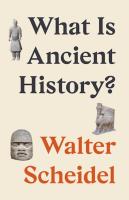
Princeton (2025) h/b 328pp £25 (ISBN 9780691236650)
Here’s a challenge. Not ‘can the classics survive?’ But ‘should the classics survive?’ This gauntlet is thrown down, pretty heavily, by Walter Scheidel of Stanford University where he’s both Professor in the Humanities and Professor of Classics and History, titles which give a fair clue to his well-expounded argument.
To simplify crudely, he believes that keeping the Greek and Latin languages at the centre of Classics teaching reinforces its exclusivity and its failure to connect with the wider humanities. We don’t make Chinese so central to Asian Studies or Arabic as central to Middle East Studies. Fetishizing linguistic skills makes it harder, he argues, to tackle the current challenges facing classics: exclusivity, white supremacy and the need for decolonisation.
In fact, S.'s analysis is far from crude. He takes us through the origins of Western Europe’s infatuation with the Greek and Roman world: from its scholasticism, the humanism of the Renaissance, the Romanticism of its worship of Greek and Roman antiquities on to its high point of Altertumswissenschaft in the Prussian curriculum with secondary school pupils spending four out of ten hours on their Greek and Latin, and both languages being required for university entrance. And he poses a serious question: why does our academic humanities model frustrate the sort of cross-cultural, multi-disciplinary engagement that he believes our early history deserves?
Other civilisations—Chinese, Indian, Egyptian—also had their ‘classical’ periods and legacies. And they had texts: there were important literate societies that the classics ignore: pre-colonial India, pre-Maoist China, medieval Islam as well as medieval Europe. But where other texts were known, they were undervalued by western scholars: Macaulay ‘never found an orientalist who could deny that a single shelf of a good European library was worth the whole native literature of India and Arabia’. Euro-centric classics not only minimised the importance of even neighbouring cultures but fostered elitism, the belief that Greece was best of all.
Whether traditionally part of Classics departments (in Britain) or of History departments (Germany), our teaching of Ancient History has neglected what S. calls ‘foundational history’—that is the era of post-foraging, across the globe, prior to the agrarian and industrial periods. Proper attention to foundational history would enable us to escape artificial timelines and regionalised traditions. We’ve been missing the connectivity and comparability: Jenne-jeno (Mali, 250BC-1,000AD) and Mapungubwe (South Africa, 900-1300AD) are as important, S suggests, as Erlitou (China, 1900-1500BC) and Mohenjo-Daro (Pakistan, 2500-1700BC). More examples would have helped S’s case here.
These aren’t straw men. The Classics are indeed under threat. The precarious number of classics teachers in our schools; the flirtation with reception studies; the obsequious pursuit of social ‘relevance’; the patronising efforts in the United States to explore Greek and Roman influences on settlers and indigenous tribes alike—all these have undermined confidence in the subject’s place in the university curriculum.
S. isn’t convinced by our profession’s answers to date: each in the guises of preservationism, pragmatism, organicism, progressivism, and limited expansionism are examined and found wanting. It’s interesting that of all his potential opponents he singles out David Butterfield, the recent Cambridge exile to the USA, for his intellectual honesty: in Butterfield’s view downgrading linguistic skills, restraining the exceptionalism of classics and globalising its reach are all more likely to undermine our subject than to preserve it.
Must true Classicists despair of the Republic? S’s proffered solutions—either ‘consolidation’ in larger institutes of ‘ancient world studies’ just as botany and zoology are combined in biological sciences or ‘distribution’ into specific area studies—inevitably involve significant trade-offs. The same pressures, of resources as well as utility, also apply of course to many other Humanities subjects, not least to History itself. Simply widening the scope of ancient history may not in itself be enough to secure its future.
We have to keep the faith. Either the 1,000 years of Greek and Roman history are important keys to understanding our modern world or they’re not. If they are, they comprise a discipline in their own right, and the two languages help us to master it. Spending equivalent hours on 10,000 years of world history cannot compensate. Time as well as resource is finite: perhaps the Prussians were right after all.
S. was previously the author of The Great Leveler, a major study of inequality. His new book is equally important and timely and should be read by all of us. For (very) ancient historians such as myself E.H. Carr’s What is History? was a seminal though controversial introduction to historiography. Sixty years on What is Ancient History? may prove an equally stirring successor.
Sir Michael Fallon
Sir Michael Fallon read Classics with Ancient History at St Andrews University and led the parliamentary campaign to save Ancient History A level in 2007