
Look there, the lovers.
The Spartan boy comes first, eyes mad with joy.
Behind him, Phoebus:
His bones are fluted, his tendons, golden cords wrapt’ his form
His movements make music, his skin glows like hallowed flame
In his arms, he holds his lyre;
Its auric neck, a swan touched by Midas,
Stilled in regal grace
Its silver strings are whiskers,
swiped from the horrid snout of Cerberus, sung to sleep
When Phoebus plays, mortal men are brought to tears
When Phoebus sings, all that is unholy withers
When they carve marble, they carve it in his likeness.
Before him, the very sun bows its head
Inferior to the brilliance of its tamer.
The Spartan boy does not bow.
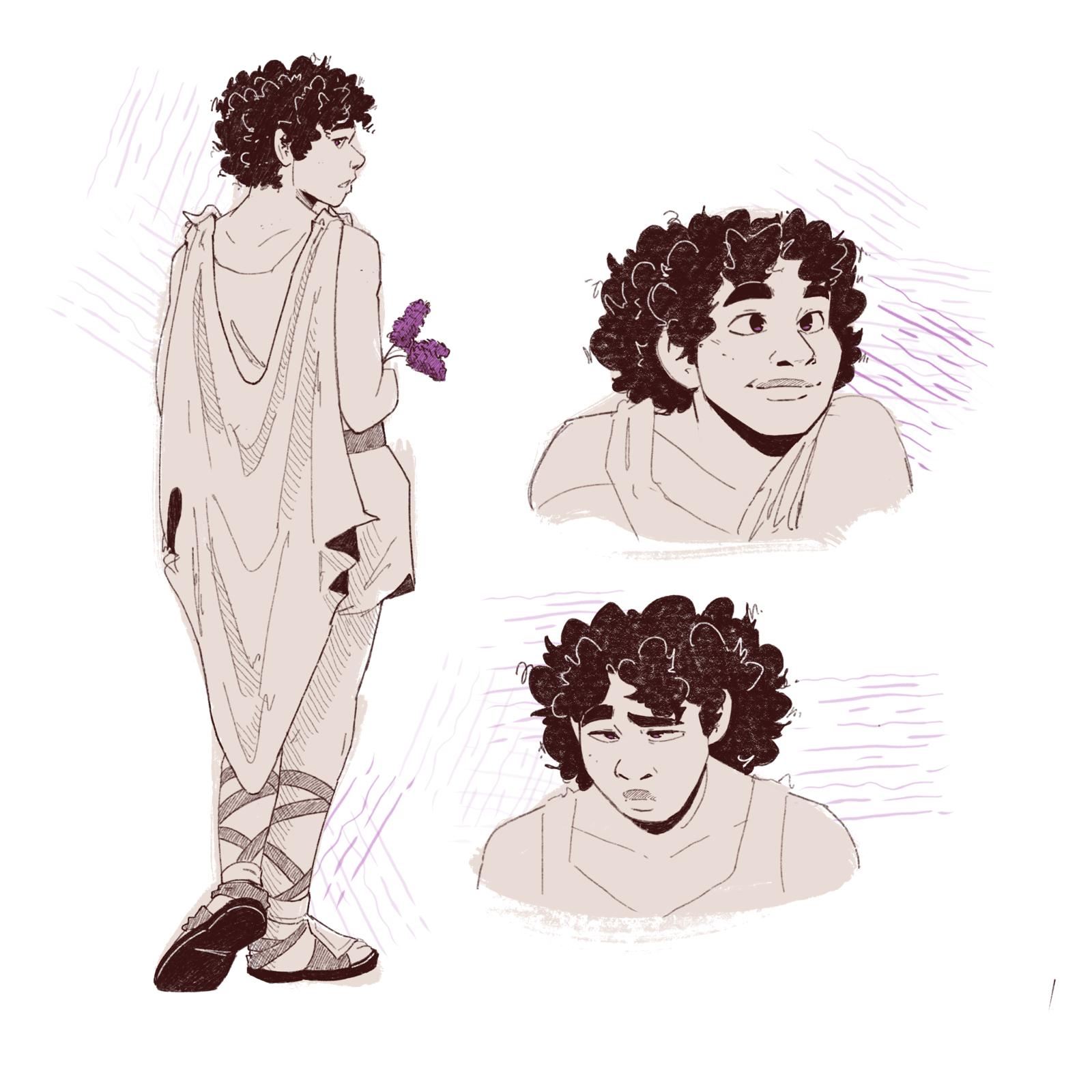
He is alive with the fresh down of youth,
He tramples beds of budding blooms
Bronze skin glimmering, but not as like the gods
Slicked with sweat, he holds no power
Besides the love of Phoebus.
He flashes teeth as he runs,
Loose tresses of his hair are weaved to braids
Abrasions color red his palms,
His soft skin, callused, hardened,
From the discus tossed between the two
It is Phoebus now holding the sacred disk
Draws back his arm and in his breath,
Casts sights on he the Fates unkindly damned
And so he sends his last volley
And there is the Spartan boy,
Beaming still across the field,
Watching as the discus nears,
Reflecting light it could not reach,
And the image of his lover.
And so his hand shoots upwards,
Reaching skyward for the heavens,
He holds the Sun cradled in his outstretched palm
Unaware that same sun is to be his undoing.
The gods cannot cry,
they are too dignified for such indecencies.
They cannot grieve for what is already dust.
They do not fall, lest it is for queens.
Phoebus rejected all.
Flashing heels across the field,
Sinews stretched, holy calves caked with dirt,
He holds the Spartan to his breast
As life weeps from his split temple
And stains the healer with the blood of guilt.
The sun dips fast below the horizon,
Splashing the sky with Aurora’s sanguine hues
The pool of red blooms thick beneath them,
As the Spartan’s neck falls slack against the earth
And alas, Phoebus can do no more
Hyacinthus watches as Phoebus breathes
Fresh air into the blood quenched dirt,
And from his end new flowers sprout
An ode to Phoebus’ deflowered boy
His namesake; his legacy
His Hyacinth.
Author’s Note
A minority of people grow up gay. It’s a peculiar paradox: the opportunity to build a powerful community forged on a belief in love and acceptance; and how this warmth is tempered by exclusion, the societal pressure to hide who you are and replace it with what is more easily understood. I am lucky to have been brought up in an area where the former far outweighs the latter, although the motif of exclusion is still visible when I turn on the news or pick up certain books.
I developed a love of mythology and ancient Greece after reading The Lightning Thief series by Rick Riordan in primary school. I quickly moved from the works of Riordan to those of Madeline Miller, Natalie Haynes, and Jennifer Saint, and from there, I began reading the original classics. Only much later, would I study canonical writers like Homer at school.
I have a strong interest in queer representation in media and literature – and I was particularly drawn to Madeline Miller’s The Song of Achilles, which depicted the relationship between two men in much the same way I had imagined it. I remember reading one of Miller’s interviews where she was asked, “Why did you write Achilles and Patroclus as lovers?” Her response traced the theories and threads of their romance back to Plato, to Aeschylus, and to the hints derived from Homer’s texts. But in my ears, I simply heard her answer: “because they were.”
In the years since I read this novel, I have seen countless translations of the Iliad, and with them, countless ways in which the two characters are depicted as companions, close friends, or cousins. There is, to some extent, a culture of exclusion which underlies much of historical education, but to a degree of subtlety where its existence could be and is easily disregarded. Now, I do not blame my school system for this apparent folly— for decades the impacts of minorities have been secreted away— but I do recognise the need for these relationships to be reexamined and rewritten from the perspective of these people whom history has hidden.
I have always felt a sense of purpose while writing, as if I could lay out my soul on a page and stretch it into a new shape or send people into a void with an emotion they know but just can’t name, and then guide them back out. I began retelling the classics to fill a different void: to tell the untold stories, and to be able to answer the question of “why did you write them as lovers” with “because they were.”
The myth of Hyacinthus and Phoebus Apollo is a play on a classic literary trope. No love story goes quite like this one: boy meets boy, boy falls in love with boy, boy accidentally smacks boy with frisbee and kills him, boy turns boy into a field of flowers. I would be lying if I did not mention my enjoyment of the absurdity. But beneath that, Hyacinthus and Apollo are just two boys playing in a field and falling further in love with one another, and that in itself is beautiful.
Micah is a high school student from Pennsylvania, US who plans to pursue a dual university degree in classics and computer science in the UK. He is the author of four children’s books and is currently working on his first full-length novel inspired by the classics. Micah is an active member of The Chorus, holding the role of Communications Secretary within the Student Steering Committee.