
‘Madeline Miller was my first introduction to the Iliad and has shaped my understanding of it.’ (Carys, Y12)
‘The Song of Achilles is always in the back of my mind when I read the Iliad.’ (Scott, undergraduate)
‘To be honest, when I first arrived at the school I had no idea what Classics was! It’s now one of my favourite subjects, all because I found out it was based on mythology. I just really enjoyed it.’ (Afra, Y10)
‘I gobbled up as many myth retellings as I could find to scratch that classics itch until I got to uni!’ (Amanda, undergraduate)
There is, of course, nothing particularly surprising about a young person enjoying mythology. But what is remarkable about the quotes above, is just how many students have been ushered towards Classics by contemporary myth retellings, and had their subsequent understanding of antiquity shaped by their reading.
This is one of the questions at the heart of my PhD research. I am investigating the pedagogical impact of contemporary myth-based fiction: the books that have been appearing in ever-increasing quantities in bookshop windows. The Song of Achilles, Circe, A Thousand Ships, Ariadne, The Silence of the Girls; these bestselling titles have been finding their way into the hands of teenagers across the country. I call these books REMIXes: Reimaginings of Myths in Context. I am interested in retellings that deliberately enter into conversation with ancient sources while creating a recognisably ancient world. This distinguishes them, from something like Percy Jackson, which has undoubtedly brought enormous numbers of young people towards Classics, but transposes the mythology to other contexts.
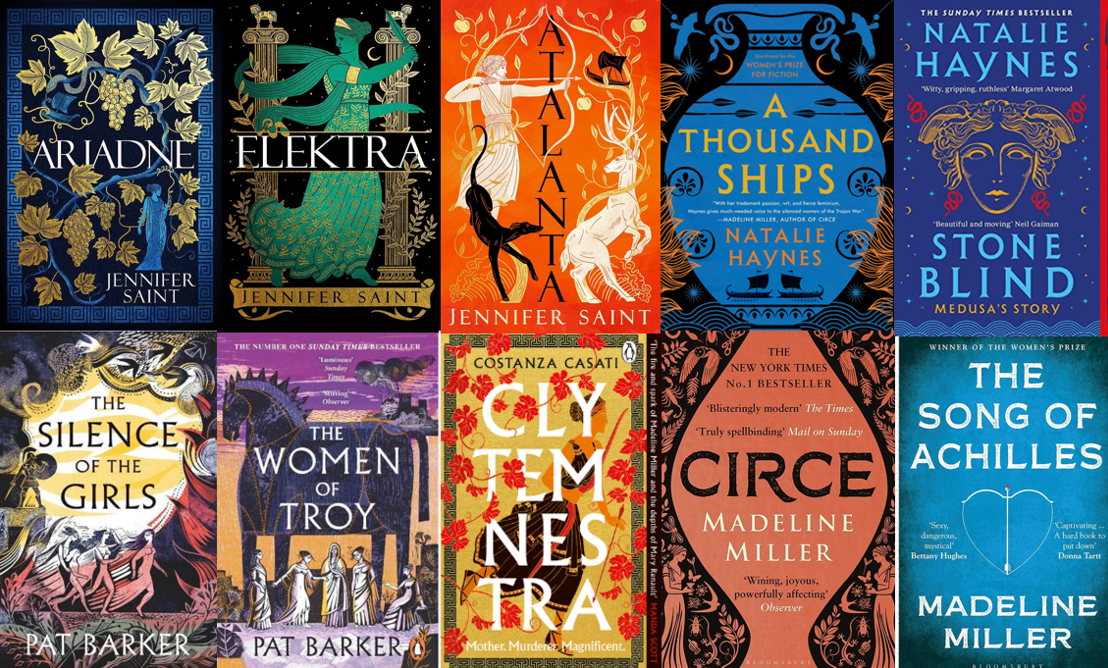
As a former Classics teacher, I had noticed that popular culture was already doing a considerable amount of the work of getting students through the door. I wanted to know what happened next. How were readers’ approaches to antiquity shaped by their encounters with fiction? To begin to understand this, I have collected more than 300 survey responses from students and teachers and conducted over 50 interviews with students, teachers, authors and others involved in the world of these books. I have spent time in schools and spoken to readers ranging from enthusiastic Year 8s to postgraduate students. I outline three primary findings below.
First: these books are acting as (re)entry points to Classics
There is an assumption amongst teacher and readers that contemporary retellings act as a stepping stone to Classics. My data suggests that, for many readers, they do, although perhaps not quite in the way we might expect. One Year 13 student told me: ‘I would never have got to A-level Classics without having read these myths and these retellings that just deepened my interest in it so much.’ Another explained that reading The Song of Achilles had ‘massively re-ignited’ her investment in mythology and classical literature. She subsequently sought out a Classics course at sixth form, where it became her favourite subject. These are not isolated stories. Readers describe the novels as reigniting an existing interest or giving them an interest in the ancient world that they had not previously possessed, such as with Afra and Amanda above. This matters particularly when we are thinking about how students encounter Classics in the first place.
Lorna Hardwick and Christopher Stray in their Companion to Classical Receptions (2007) challenged classicists to think carefully about the future ‘entry points’ into the Greek and Roman world. For some young people, these entry points will be Latin lessons, family trips to the museum or Nolan’s Odyssey. My research shows, however, that we need to add a tear-stained copy of The Song of Achilles to the list.
Interestingly, these books can also create a bridge between generations. One commissioning editor I interviewed described the readership as ‘all women of a certain age, maybe like 40s to 60s.’ When I reported this to a group of teenagers at a Classics club in Cambridgeshire, one immediately replied: ‘40s to 60s? More like 14 to 16!’ The data suggests that both are correct. Natalie Haynes described these two groups as her ‘Instagram’ and her ‘Radio 4’ audience.
There was, however, one very clear pattern. The overwhelming majority of my respondents identified as women, with a strikingly high proportion of LGBTQ+ readers too. For some, this was simply a matter of taste (it is well documented that women read more fiction than men). For others, the experience of encountering characters and relationships that felt closer to their own age was much more significant. One reader described herself when she first encountered these novels as a ‘15-year-old little bisexual girl from Ballymena trying to figure myself out.’ Reading REMIXes made her ‘feel quite seen’. Another teenager, discussing The Song of Achilles, was rather less restrained: ‘TSOA? Goddamn, yes.’ What followed was an enthusiastic explanation of how liberating this transgender student had found Miller’s portrayal of queer love.
This is worth paying attention to. If we are interested in widening access to Classics, then we need to take seriously the routes by which students are already finding their way towards the subject. These books are not a magic solution to Classics’ recruitment challenges and queer love has been deliberately represented in retellings before – such in Mary Renault’s pioneering work of the last century. But for some young people, particularly queer readers who have not previously seen themselves reflected in their understanding of the ancient world, this particular wave of popular fiction can provide an unexpectedly powerful invitation.
Secondly: some readers are crying their way to Classics
When I asked readers why these books mattered to them, they often struggled to explain it in academic terms. Instead, they talked about crying, about being angry, about loving to ‘hate’ certain characters. One student told me that the literature she most wanted to read was not necessarily the literature she enjoyed most, but ‘the stuff that breaks me the most.’ This is perhaps not the language we tend to use in schemes of work but we ignore it to our detriment. REMIXes are providing an emotional anchor to classroom study of Classics.
A teacher I interviewed described the process rather simply. A novel, she said, ‘brings it to life … makes it seem like actual people. And then you think about that as a real world, and it makes it more engaging.’ A Year 11 student put it similarly: ‘It’s harder to absorb class material when it’s about things you can’t understand, whereas somebody talking about how they feel, that helps so much in terms of understanding.’ By centring young adult perspectives, these novels not only make Classics more ‘relatable’, but provide a fertile seedbed into which to new material can take root.
These novels give readers time to live with characters. A student may spend several days reading Patroclus’s version of Achilles, or follow Ariadne through the aftermath of Theseus’s departure, or experience the Trojan War through the eyes of Briseis, Cassandra or Hecuba. The characters cease to be names encountered briefly in a textbook or on a PowerPoint slide. They acquire histories, motivations, becoming more like friends and enemies than ancient archetypes. This can make subsequent encounters with ancient material feel rather different.
One student was particularly affected by Jennifer Saint’s Ariadne. When Theseus abandoned Ariadne on Naxos, she told me, ‘I got really, really angry.’ Before reading the novel, her understanding of Theseus had largely ended in the labyrinth. She knew that he had killed the Minotaur and that Ariadne had helped him. Then she read Saint’s version of the hero: ‘after really reading Ariadne, I just thought, “I hate you!”’. Later, when she encountered Theseus again in GCSE Classical Civilisation, the stakes had changed.
This is closely connected to another feature of REMIXes: familiarity. For many students, there is pleasure in returning to the same characters and stories from different angles. As they read more, names that initially seemed bewildering become familiar, and each new version offers another interpretation to chew over. For many readers, this expanding network of characters and stories is itself a powerful motivation to keep reading.
Third: these books can transform classroom experiences
At this point, some teachers may become nervous: there were more than 100 references in my survey data to concerns about inaccuracies and student misconceptions. Teachers described some students clinging stubbornly to versions of myths found in novels or film adaptations.
The students I spoke to, however, were often remarkably aware of the distinction between ancient and modern versions and were conscious of when seepage was occurring. One Year 13 student explained that when writing about prescribed texts, he tried to stick to what was actually there, although he recognised that his feelings about characters might have been influenced by other versions he had read. A Year 11 student was even more blunt: ‘These things stick in your head so much more, and that’s not always a good thing! I have to keep telling myself not to write about the novels.’ This deliberate choice seems to me a rather good starting point for teaching.
Rather than pretending that students arrive in our classrooms as blank slates, why not acknowledge (and seek to understand) the versions they already carry with them? If a student is furious with Theseus because of Jennifer Saint, or devastated by Achilles because of Madeline Miller, that does not have to be an obstacle to studying Plutarch or Homer. Rather, it can be the beginning of a conversation: Why do you feel differently about this version? What has the modern author included or left out? What values are shaping this retelling? What’s different for you having a modern version first?
This is where I think REMIXes have their greatest potential. Not as replacements for ancient texts, or as straightforward stepping stones towards reading the Iliad independently (my data suggests this only happens in a handful of cases) but as material that can sit alongside ancient sources, casting their stories in new light. They act as prisms, whereby the ideological choices made by modern authors are often particularly easy for students to spot. Some readers have criticised feminist retellings for projecting modern ideas onto an ancient world with which they do not engage sufficiently (‘It could be set anywhere, and they just happen to set it in ancient Greece!’). That criticism is worth taking seriously, but it is also an excellent point to start developing our students’ critical literacy.
Whether Virgil to Robert Graves or Pat Barker, no retelling is neutral. Liz Gloyn, in her monograph which tracks the monsters of antiquity and their reception, has remarked that a work of reception ‘often tell us more about the culture in which it is retold – the receiving culture – than they do about the ancient world.’ But neither, for that matter, is the process by which some stories have been preserved, translated, selected and repeatedly taught while others have not. The advantage of contemporary fiction is that its interventions can be highly visible and therefore highly teachable. Students can see an author choosing to give Briseis a voice, to centre Penelope rather than Odysseus, or to imagine Achilles and Patroclus as explicitly romantic partners. Once they begin asking why those choices have been made, they are beginning the work of reception studies.
Incorporating REMIXes does not require a new curriculum. Teachers can stock the books, read them themselves and encourage students to talk about them. A short extract can sit alongside an ancient source: what has changed, and why? Emotional responses can be acknowledged and thought through rather than hurried past. The point is simply to recognise that many students are already reading their way towards us.
As classicists surrounded by proliferating popular culture adaptations of antiquity, there is sometimes anxiety about whether the modern might dilute the ancient. But the students I have spoken to suggest another possibility. For them, contemporary versions often enhance rather than replace the ancient world. Achilles does not become less interesting because Madeline Miller has imagined him differently, Ariadne does not disappear when Jennifer Saint gives her a voice. Instead, the existence of competing versions can make students more alert to the fact that stories are constructed, perspectives are chosen and an ‘original version’ of a myth is a falsity.
Perhaps that is where we should leave the students who are reading these books: not by confiscating the novel and handing them a Penguin translation with the instruction to get on with it, but by asking what they have brought with them. The answer may be anger, it may be tears or it may be an embarrassingly intense hatred of Agamemnon. But it may also be the beginning of a lifelong interest in Classics, and that seems worth listening to.
Katharine Russell is a doctoral researcher at Durham University, exploring how contemporary myth-based novels are changing the Classics education landscape. Foregrounding the voices of readers themselves has been a priority of her research which finds its home in the Centre for Classics Education and EngagementS (CERES). Her current research builds on her experience as Head of Classics at a multi-academy trust in the East of England, where she led departmental expansion recognised by a Classics for All National Teaching Award in 2022.