
Callimachus’ Aetia begins with Apollo advising the poet to ‘keep the Muse slender’, inciting the popularisation of the idea that a six line epigram can be just as powerful as a twenty-four-book epic or tragedy. This notion prevailed in the Roman period where it reached its zenith in the work of Tibillus, Propertius, Ovid and Catullus. During the Hellenistic period, Callimachus’ time spent in the Library of Alexandria earned him the reputation of a ‘cloistered bookworm’ according to the Athenian Timon. Although this comment deflates his greatness, the Callimachean epigram that resulted from his bibliophily eclipses that of any later imitator and establishes his work as the archetype of a new poetic form.
Having recently completed an Extended Project Qualification at college in which I tracked the genealogy of love poetry from the classical world to post-Renaissance Britain, I found myself intrigued by Ovid’s work. My brief exploration of his Ars Amatoria (The Art of Love), Remedia Amoris (The Remedy for Love) and his Amores (The Loves) persuaded me to contemplate some of his other works; upon reading the Heroides I was immediately enraptured.
Ovid’s Heroides are a series of love letters from scorned classical women to their lovers, written in elegiac couplets that facilitate an intimate insight into the raw heartache and anguish experienced by mythological women. We see the development of a realistic, feminine persona in Ovid’s rejuvenation of the original myths. He paints the aggrieved women in a new light and gives prominence to their suffering, which is so often overlooked in epic poetry. These women are no longer supporting characters that enable their male heroes to achieve kleos, but rather acquire new dimensions as Ovid gives them a chance to express their true sentiments. Their ire, terror and loneliness can finally be known. I believe that it is the epigrammatic form of the impassioned diatribes of the inamorata that allows for the expression of a certain depth of feeling, enhanced by a confrontational first-person narrative which plays upon Ovid’s own interest in rhetoric.
For Ovid, love and pain were inextricably linked: in the Amores he writes, ‘Nil ego, quod nullo tempore laedat, amo’ — ‘I cannot love anything that never hurts me’. There seems to be an acceptance here, that pain is a part of love — an acceptance which is echoed in the Heroides. Among all the lovers Ovid impersonates — Ariadne, Penelope, Dido, Medea and many more — it is Sappho’s epistle to Phaon (Heroides 15) that I found most captivating. I have chosen a few lines which seemed to me, to be the most poignant:
‘I wish I was eloquent now! Pain obstructs art
and my ills put paid to every talent.
My old powers of song won’t awaken for me:
the plectrum falls silent through grief, and silent the lyre.’
Ovid’s audience would be familiar with the remaining fragments of Sappho’s work. Her lyric poetry was written down as soon as possible, a testament to her renowned creative talent. Curiously, Sappho is the only ‘historical’ rather than ‘mythological’ figure in the Heroides; a fact that I believe intensifies the pathos experienced. Sappho’s evocative description of being robbed of her poetic ability due to losing Phaon’s love is particularly emotive since it conveys the ‘fall from glory’ that women in the classical world experience when their beloved betrays or abandons them — what could be described as a peripeteia (sudden change of fortune).
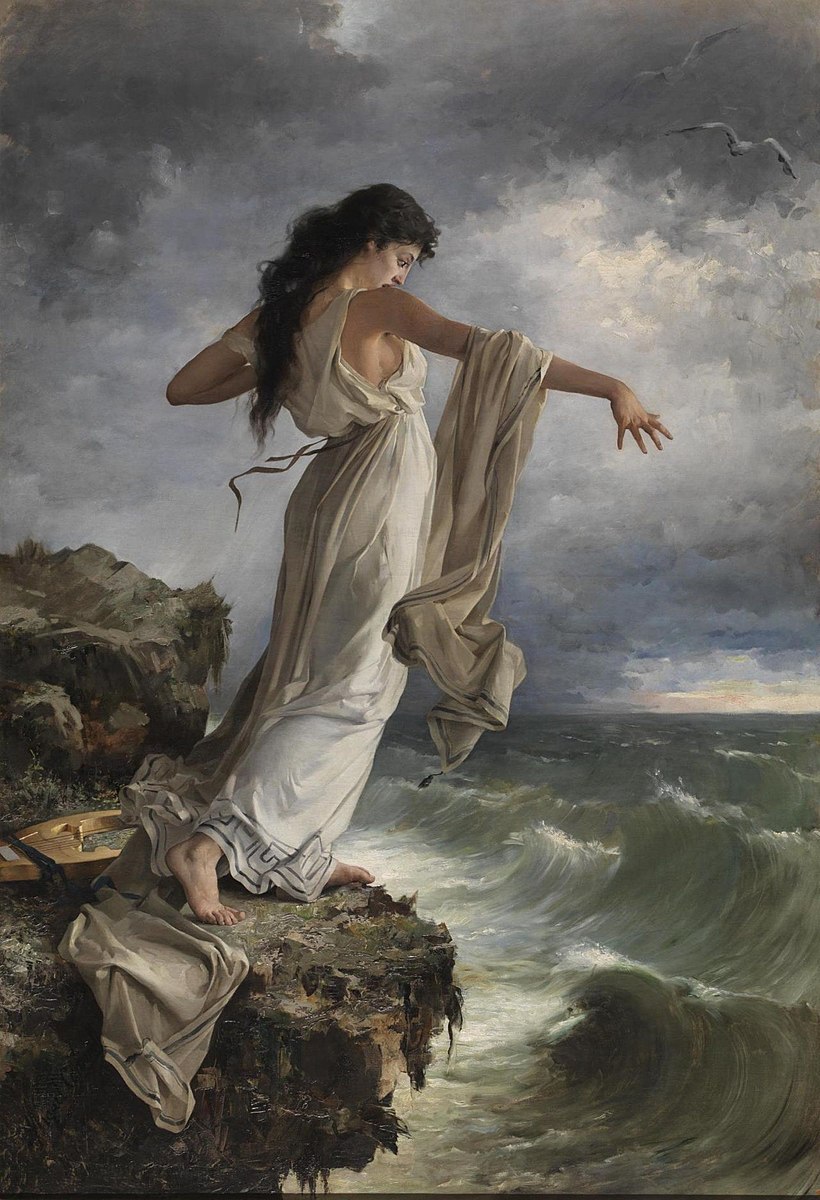
I view Sappho’s story as set apart from that of the other heroines, in that the result of her dolour is an inability to compose poetry. It has been said that Aphrodite and love were not merely the centre of Sappho’s universe, they were her universe. Her whole essence consisted of using poetry as a medium to expel her zealousness; the cumulative effect of her own romance is her undoing. Sappho, the paragon of personal poetry, finds herself, suddenly and ironically, unable to use her art as a means of expression. Her universe has been plunged into pandemonium, a fundamental aspect of her being was stripped away by the callous hand of Eros.
Critics of Ovid’s work frequently postulate a problem with the Heroides; that the poet has failed to authentically and successfully assume a feminine voice. Of course, this is not an exclusively Ovidian problem, the phenomenon is manifest throughout literature, ranging from the first two books of Callimachus’ Aetia in which the Muses take over his role of answering, to the metaphysical poet John Donne’s work ‘Sappho to Philaenis’. Sappho’s case is particularly elucidatory since fragments of her own literary corpus can be directly accessed, rather than having to peel back the multiplicity of voices that echo through each respective reinterpretation.
Ostensibly, in his assumption of the feminine voice, Ovid has shone a light on the once occluded perspectives of mythological women. I would argue that in Sappho’s case, what emerges more closely resembles a ventriloquistic appropriation of her voice, rather than it merely being made known (as is the case with the mythological women).
Perhaps a more appropriate question is not whether men can successfully adopt a feminine persona (since if we negate that claim, we must also dispute the efficacy of male actors interpreting female roles), but rather how it alters our reading of their text. With Ovid, we see him exploiting Sappho to subvert the values of Augustan Rome; similarly, he utilises the epistolary form and takes inspiration from the Callimachean epigram to challenge the previous dominion of epic. Ovid uses his poetry as a vehicle to cast aspersions on contemporary societal standards, in the same way that Donne undermines the Elizabethan aversion to homosexuality by writing of Sappho’s lesbian love for Philaenis. Both poets have used Sappho as a mouthpiece to challenge the dogmas of their respective epochs and in doing so, have altered Sappho’s legacy.
From a purely artistic point of view, though, Ovid elucidates the true potency of the feminine voice through Sappho, in her distress at being rendered impotent and her vulnerability now that she can’t even use her words as emotional fortification. The same sentiment is echoed in Ariadne’s torment after her abandonment by Theseus on Naxos, Dido’s suicide after Aeneas’ betrayal in leaving her and Medea’s uncontrollable rage that she turns on her own children which are all brought to the centre stage for the first time in epistolary form. Ovid’s work contains more than a mere whisper of an incipient mythopoeia, one that is characterised by the feminine perspective. His Epistulae Heroidum herald the genesis of a new literary genre — one that has gained unequivocal popularity in the work of modern classicists. We need only step foot in our local Waterstones to see row upon row of Madeline Miller’s Circe, Pat Barker’s Silence of the Girls and Jennifer Saint’s Ariadne (to name only a few) gracing the shelves. There has been an incontestable surge in the popularity of feminist retellings of mythological stories, with Ovid as its progenitor.
Eva is a student at Runshaw College, currently studying classical civilisations, philosophy and Spanish. Her fascination with classics was sparked by the Percy Jackson series, leading her to study both ancient history and Latin at GCSE. She has found herself completely enchanted by the ancient world and its inhabitants and intends to continue her classical education at university.